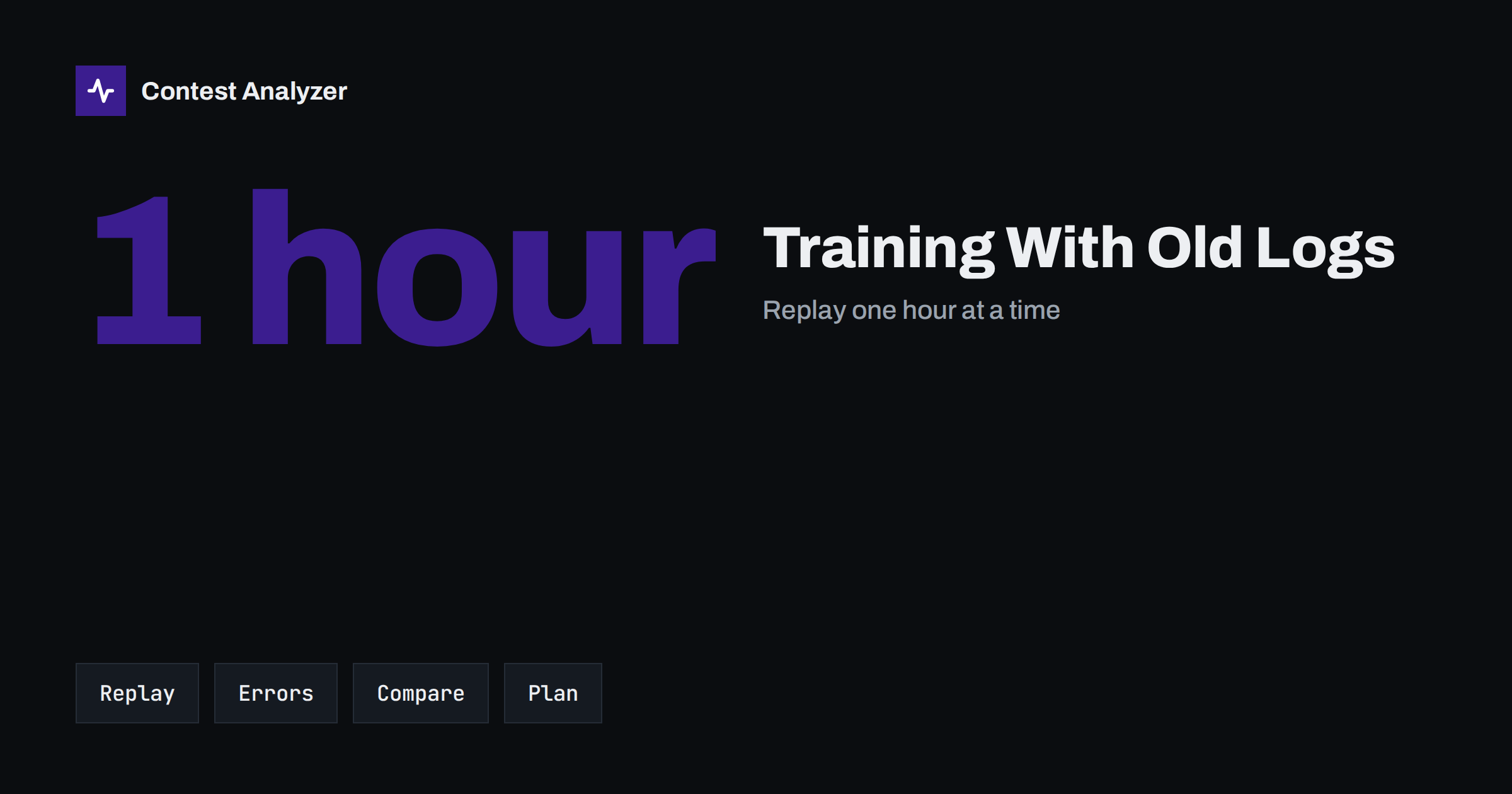
Short answer: Your old logs and recordings are a training course made for you. Pick one hour, listen to the recording with the log in front of you, and look at what you did well and where you lost time or made errors. Compare the same hour with another year, and write a short practice plan based on the patterns you find. A few focused sessions before the next contest are worth more than hours of unfocused operating.
Why use old logs for training
Most contesters spend a weekend making the log, a few hours checking it, and then put it away. This wastes the best source of information about your own operating. The log shows when you were fast and when you were slow, which stations you missed, which calls you got wrong and how your rate changed with the bands. The recording, if you have one, shows how it sounded: how you spoke or keyed, how you handled a pile-up, how many repeats you asked for.
Training with this material has an advantage over general practice: it is about you. You do not need to read advice that does not apply, and you do not need to guess where you are weak. The numbers and the audio tell you. The article on the post-contest review routine describes a first pass, and this article describes the next step: using what you found to plan your practice.
Choose one hour to replay
Do not try to review the whole contest. Choose one hour, and choose it with a purpose. A good choice is the hour with your best rate, to learn what you did well. Another is the hour with the most errors, to learn what went wrong. A third is an hour in which you were on a band that you want to improve, such as a low band at night. Use the hourly statistics to select the hour, and write down why you chose it.
Open the log for that hour in the order of time. Listen to the recording from the start of the hour and follow the log line by line. At each QSO, ask three questions: Was the call right? Was the exchange complete? How long did it take? Mark the places where you asked for a repeat, where the other station repeated for you and where you were slow to start the next call. After a few such hours you will see habits that you could not see in the heat of the contest.
Study your errors
The errors that you found during the log check are the most valuable training material. List them, and sort them: busted callsigns, wrong zones, wrong band, wrong time, wrong exchange. For each group, look for a cause. Busted calls often come from letters that sound alike, from weak signals and from partial copies. Wrong zones come from default values in the logger. Wrong bands come from lost frequency data. The articles on busted callsigns, zone errors in multi-zone countries and frequency field errors in the logger help to name the causes.
Contest Analyzer checks every callsign and every zone against official license databases and several independent reference sources and shows only the few QSOs worth a second look. In the report you can edit calls, zones, time and frequency, mark QSOs checked in your own audio recording and download a corrected Cabrillo. The list of changes you made is the list of your own errors, and it tells you what to practise. It works with Cabrillo from N1MM Logger+, DXLog and Win-Test, and covers 22 contests, listed on the contests page.
Compare the same hour in another year
If you have two or more years of logs for the same contest, compare the same hours. Did your rate on 20 metres at that hour improve? Did you work more countries? Did the errors go down? Year-on-year comparison with your own logs, a function of Contest Analyzer, shows the numbers side by side. The article on year-on-year comparison of the same contest gives tips on how to read them without being misled by different propagation or different activity.
Look for differences that you can explain by what you did, not only by what the band did. If the rate was lower because the band was closed, there is nothing to learn. If the rate was lower because you changed bands too often, there is something to change. The article on rate versus band changes helps to see this.
Practise with the recording
A recording of a past contest is also a practice track. Play a part of it at the original speed and copy the callsigns as if you were operating, without looking at the log. Then compare what you copied with the log. This is a good test of your copying accuracy, and it works in any mode. Start with a part of the contest in which you made errors, and see whether you copy them correctly now. In CW, you can also play the recording at a higher speed to raise your limit gradually.
You can use this for the exchange as well. Listen to ten QSOs in a row and write only the exchange. This builds the habit of copying the whole exchange at once, which is needed in contests with longer exchanges. The articles on CW copying accuracy in contests and SSB phonetics and confirming callsigns give more ideas.
Write a short practice plan
When you have gone through a few hours, write a plan of no more than a page. List the three or four most important things that you found, such as “ask for zone repeat only”, “check the band at the start of each QSO” and “practise two-letter suffixes at higher speed”. For each, write one action that you will do before the next contest, with a date. Keep the plan simple, and put it where you will see it.
Review the plan after the next contest. Did the errors you worked on go down? Did you find new ones? A plan that is updated each year turns your logs into a long-term record of progress. See turning this year’s log into goals for next year and setting realistic goals from last year’s statistics for more on goals.
Keep the material safe
For training you need the log and the audio from the past, so keep them. Store the final Cabrillo, the corrected file and the recordings together, with a short note of the contest and the settings. Copy them to a second drive and keep the copies up to date. The article on contest log backup copies explains how. A log that you cannot find in two years is no help for training.
It is also helpful to keep the statistics of each contest in a simple form: the main numbers, the best hours, the main errors. A one-page summary for each contest, kept in a folder, is a quick way to remember what each year taught you.
Training in small steps
The best training is regular and short. Fifteen or twenty minutes, three times a week, in the weeks before a contest give more than one long session the night before. Use the time for one thing at once: a set of difficult callsigns, a part of an exchange, a fast change between two bands. Keep a small notebook with the date, what you practised and how it went, and you will see progress without much effort.
Use the real material when you can. A callsign list built from your own busted calls is much more useful than a general list, because it contains exactly the pairs that you confuse. A part of a recording in which you were tired and slow shows what your own bad hour sounds like, and you can practise the same section until it becomes easy. These are small things, but they build the confidence that carries you through a long contest.
When the contest comes, you will notice the difference. The errors that you studied appear less often, and when they do appear, you recognise them more quickly. The log check afterwards becomes shorter, and the notes for the next training are shorter too. This is the real return on the hours you spend with your old logs.
One last idea is to train together. If you have a friend who also contests, swap one hour of each other’s recordings and logs and review them as a second pair of ears. A person who did not make the QSO often hears a callsign differently, and a fresh view finds patterns that you miss. Many clubs do this as an evening activity before the big contests, and it is both useful and pleasant.
Whatever you do, keep it light. Training should make the next contest more enjoyable, not turn the hobby into homework. A single good hour of review, with a cup of coffee and a clear question, is worth more than a long session that you dread.
Related reading
The bottom line
Pick one hour, replay it with the log, study the errors and compare it with another year. Turn what you learn into a one-page practice plan and keep your logs and recordings safe.
FAQ
Do I need a recording for this?
It helps a lot, but the log and statistics alone already show patterns in rate and errors.
How long should a session take?
Thirty to sixty minutes for one hour of the contest is enough.
Which hour should I start with?
The hour with most errors or with the weakest rate on a band that you want to improve.
Can I practise copying with an old recording?
Yes. Copy the calls without looking at the log and then compare.
How often should I update the plan?
After each contest. A short note is enough.