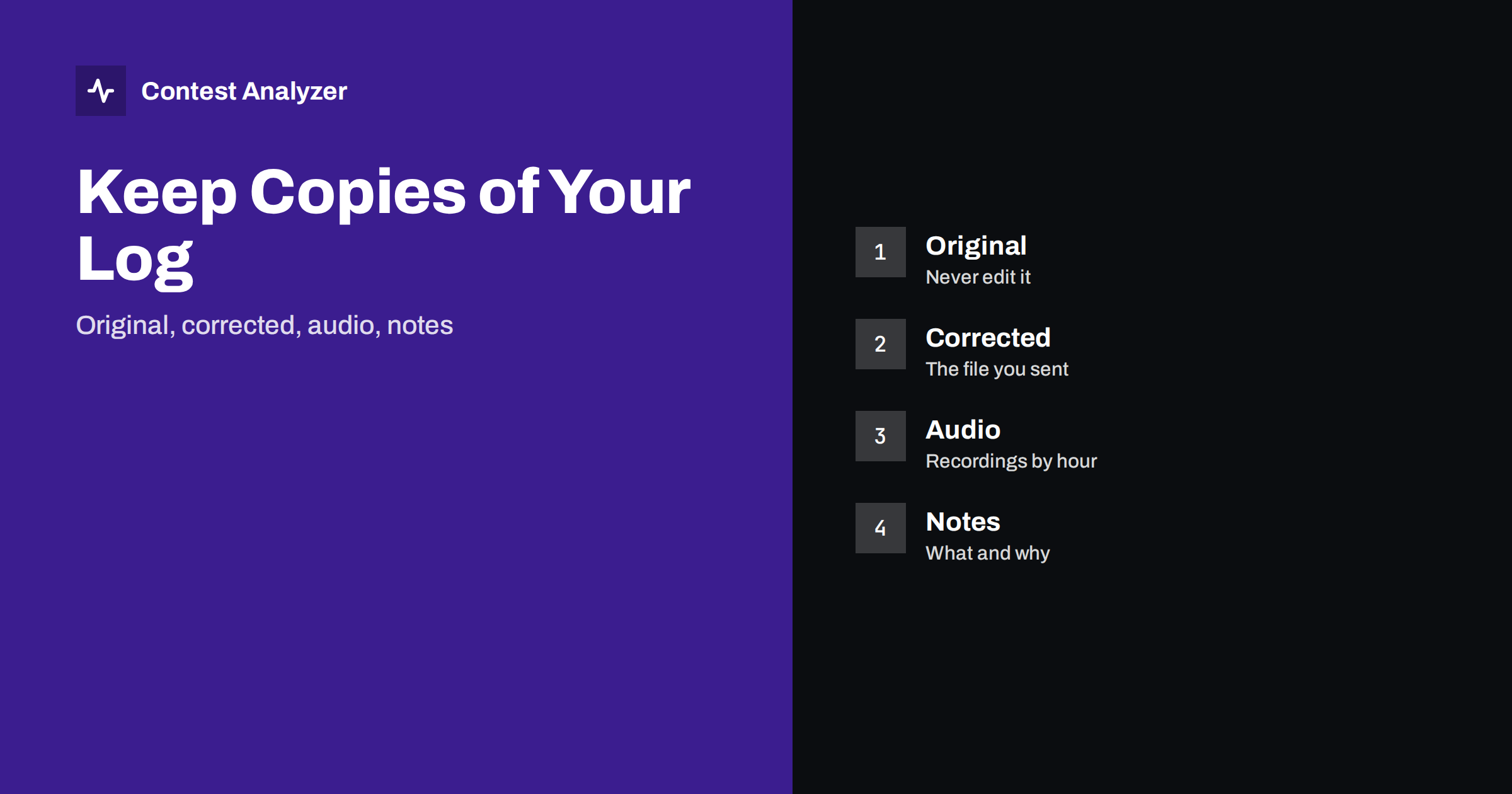
Short answer: After a contest, keep four things: the original log exactly as the logger saved it, the corrected Cabrillo file that you sent, the audio recordings and your notes about what you changed and why. Put them in one folder named with the contest and the year, store the folder in at least two places and keep it for as long as it may be useful. The work takes ten minutes and may save a long explanation later.
Why copies matter after the contest
Backups during the contest protect against the loss of QSOs while you operate. The copies after the contest have a different purpose: they protect the history. A year later you may want to compare your result with a new one, a committee may ask a question about a QSO, or you may want to look at what you did in a certain hour. Without the files, the answers are guesses. With them, they are a matter of looking. The article on protecting your contest log during the contest describes the first kind, and this article is about the second.
There is also a practical reason. In the days after a contest, you change the log: you correct a call, you remove a QSO, you fix a header. If you overwrite the original, you cannot go back. A good set of copies lets you undo any mistake in the review.
What to keep
- The original log from the logger. This is the database or the file in the format of the logging program, exactly as it was at the end of the contest. Copy it before you start any correction, and do not edit this copy. It is the proof of what happened.
- The first Cabrillo export. A Cabrillo file produced from the original, before any change. It shows what the logger would have produced, and it is useful if a question arises about the format or the header.
- The corrected Cabrillo file that you submitted. The exact file that you sent, with the name you used. If the system gave you a confirmation, keep it with the file.
- The audio recordings. If you made them, keep the files in their original format and with their original names, which usually contain the date and time.
- Your notes. The list of the corrections, the problems you had, the conditions and the things to change next year. A note of a few lines is enough, as long as it is clear.
- The confirmation and the rules. A copy of the rules of the contest as they were for that year, since rules change, and a copy of the confirmation of the submission.
If you operate at a multi-operator station, add the logs of the individual computers before they were merged. The article on merging multi-op logs explains why the sources matter.
A folder structure that stays clear
A simple structure works better than a clever one. Make one folder for each contest and year, with the same sub-folders every time. For example, the folder can contain a sub-folder for the original log, one for the Cabrillo files, one for the audio and one for the notes and documents. Inside, use names with the date in the form year-month-day, so that the files sort by time. Add the callsign you used and a short word that says what the file is: original, export, corrected or sent.
The reason is to avoid the situation in which you find three files with similar names and cannot say which one you sent. If you correct a file more than once, add a number or a date to the name, and never use names such as “final” or “final2”. A short text file in the folder, saying which file was submitted and when, answers the question in a few seconds.
Where to store the copies
A single copy on the computer that you used for the contest is not a backup. The computer may fail, be replaced or be lost. A good rule is to have at least two copies on different devices, and one of them away from the computer, for example on an external drive or in a cloud storage that you trust. If the files contain personal information, think about the privacy of the storage, and be careful with the audio, which may contain the voices of other operators. The important thing is that the second copy is made, checked and updated, and not only planned.
Check the copies once. Open a file from the copy and make sure that it is readable. Many people find only in an emergency that the backup drive was empty or that the file was damaged. A test of two minutes after copying removes this risk.
How long to keep them
There is no fixed answer, but there are good reasons to keep the files for many years. The year-on-year comparison needs the logs of earlier contests, and the notes explain why a year was better or worse. Some contests keep their own records and publish results for a long time, and a question about an old result may come at any time. Audio files are the largest, and you may decide to keep them for a shorter period, for example one or two years, and to keep the logs and notes for much longer. If you decide to delete audio, delete it after the review and not before, and keep at least the recordings of the QSOs that were doubtful.
The article on comparing contest results year on year shows how old logs become useful, and the station notebook is the best companion for the notes.
The review changes the files: a safe routine
- Copy the original before you open it for any correction.
- Make corrections in a working copy, and export from it.
- Name each export with the date and the purpose.
- When you submit, copy the submitted file into the folder at once and note the time.
- Write the list of corrections as you make them, not at the end from memory.
- After the submission, do not change the submitted file. If you need another version, make a new file.
This is the same discipline as in the post-contest review routine, where the steps are explained in the order of the work.
What to write in the notes
A note is useful only if you can understand it a year later. Write the date and the contest, the category and the power you used, the antennas and any change in the station, the conditions as you saw them and the problems that cost you time or QSOs. Add the list of corrections you made in the review, each with the QSO, the old value, the new value and the reason. Finish with two or three things that you want to change next time. Do not write long essays. A page of short lines is read again, and five pages are not.
Common mistakes with copies
- Editing the only copy. A correction is made in the original, and the earlier state is lost.
- Several files called the same. It is not clear which one was submitted.
- The backup in the same place. A second copy in the same folder or on the same disk protects against deletion but not against a failure.
- Deleting audio too early. The recordings are removed before the doubtful QSOs were checked.
- No note of the rules. A year later nobody remembers which version of the rules applied.
- A backup never opened. The files are copied but not tested.
Using the copies later
A well-kept folder pays back in several ways. When you upload a log to Contest Analyzer, you can use the corrected Cabrillo, and later the same file serves for the comparison with the next year. The tool checks every callsign and every zone against official license databases and several independent reference sources and shows only the few QSOs worth a second look. You can edit calls or zones in the report and download a corrected Cabrillo, which you then save in the same folder with a clear name. The report also gives full statistics, with rates, QSOs by hour and band, countries, continents, CQ and ITU zones, WPX prefixes, distance, beam heading, breaks and off time, and callsign length and structure, and the year-on-year comparison uses your own earlier logs. It works with Cabrillo from N1MM Logger+, DXLog and Win-Test, supports 22 contests (see the contests page) and is available in 25 languages. Serial numbers are not checked, and dupes are not errors.
Related reading
- Protect your contest log: backups during the contest
- Your post-contest review routine
- How to submit a contest log
The bottom line
Keep the original log, the first export, the file that you sent, the audio and your notes, in one clearly named folder and in two places. Check that the copies can be opened, and never edit the original. Ten minutes of care after the contest protect years of history.
FAQ
Why keep the original log if I send a corrected one?
The original is the proof of what happened, and it lets you undo any mistake in the review.
How many copies do I need?
At least two, on different devices, with one away from the contest computer.
How long should I keep the audio?
Many operators keep it for a year or two and keep the logs and notes for much longer. Keep at least the doubtful QSOs.
How should I name the files?
Use the date, the callsign and a word such as original, export, corrected or sent. Avoid names such as final.
Do I need to keep the rules?
It helps. Rules change between years, and a copy shows what applied to your entry.