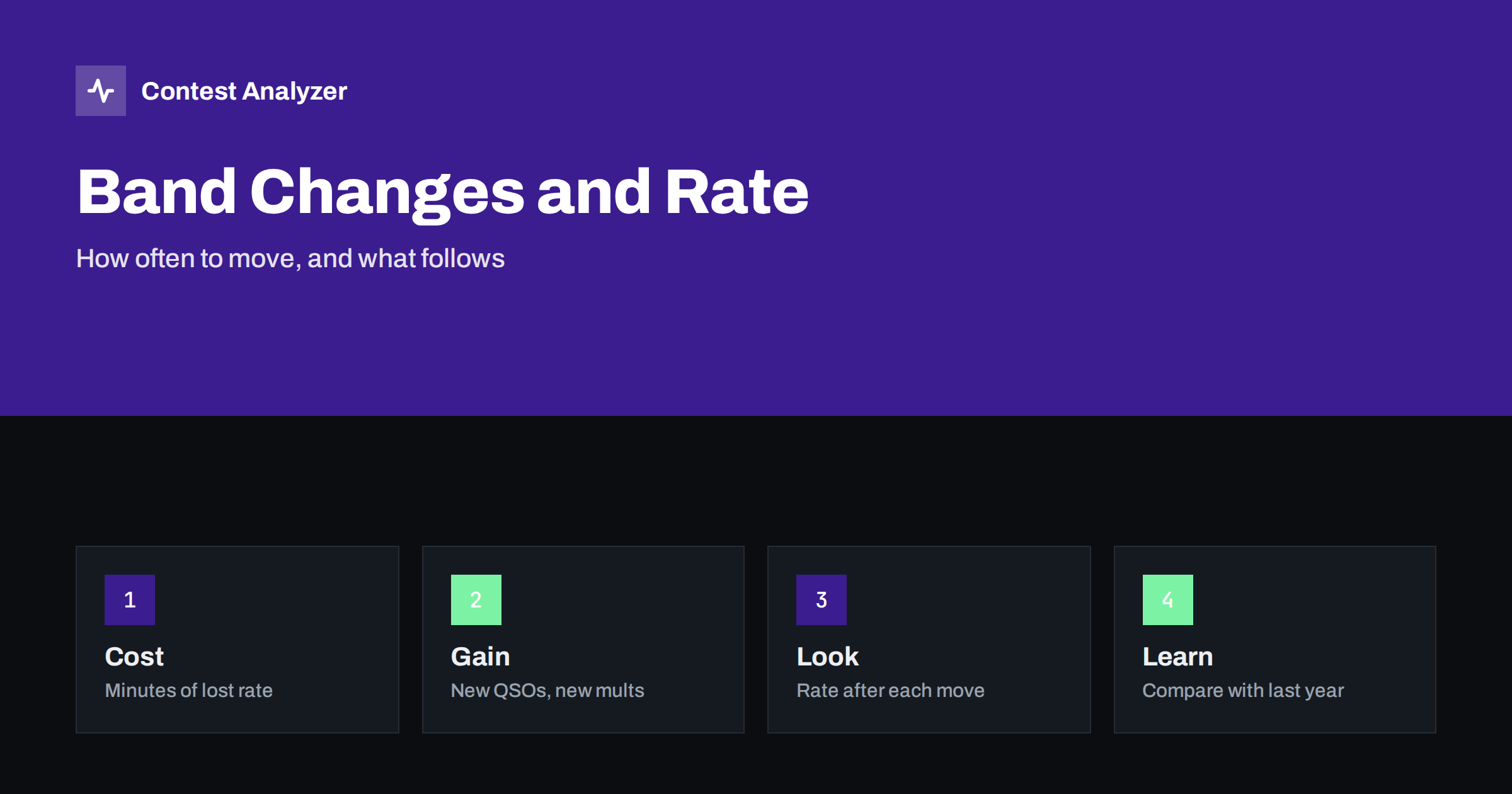
Short answer: A band change costs time, because you must find a new frequency and wait for the first callers, but it can bring new stations and new multipliers. There is no universal answer to how often to move. Your own statistics show the answer: look at the rate in the hour before and after each change, and compare the results of the years. If the rate regularly falls and does not recover, you move too often. If you stay too long and the rate decays, you move too little.
What a band change costs
When you leave a band, you stop a rate that you know. On the new band, the first minutes bring a smaller rate: you must find a clear frequency, call CQ, wait for callers and, in many cases, search to find who is on the band. In a contest where you run, the time before the rate returns to a good level can be a few minutes or more than ten. Together with the time that you spend with the antennas, the filters and the amplifier, a band change of a typical station costs a part of an hour of full rate. If you change band ten times in a contest, the cost is considerable, and it is paid every time.
The cost is not only time. It is also the risk of mistakes. After a change, the logger must follow the new band; if it does not, the QSOs get a wrong frequency, as described in the article on the Cabrillo frequency field. A look at the logger after each change is a small price.
What a band change gives
On the other side, a band change gives access to stations that cannot be worked on the band you leave. When a band is open to a continent that you have not worked, the QSOs come quickly, and the multipliers are new in many contests, since a multiplier is counted per band. Also, a frequency with strong competition may be replaced by a free one. The best band changes are those where the band you leave is declining and the one you go to is rising, so you lose little and gain much.
It is worth remembering that a band that does not change is also changing: the propagation moves, the stations that called you earlier have already been worked, and the number of new callers falls. This is the pattern that you see in the rate meter, which is discussed in the article on the rate meter during a contest. A rate that falls steadily on one band is the signal to think about moving.
How to read the rate around a change
Take the log and find the times at which you changed band, which is the point where the band of consecutive QSOs changes. For each change, look at three numbers: the rate in the hour before, the rate in the first twenty minutes after, and the rate in the hour after. Do the same for all changes. You may notice some patterns.
- The rate falls and recovers. This is the usual and healthy pattern. The change had a cost, and the new band repaid it.
- The rate falls and stays low. The band you moved to was worse than the one you left, or you were not set up well on it. Look at the time of the day and at the antenna.
- The rate rises at once. The move was well timed. Note the time and the bands, because the same pattern may repeat next year.
- A series of short stays. You moved many times in a short period, and the rate was low during all of it. This is a sign of searching for a band without finding one, and the article on band strategy by hour helps to avoid it.
A simple way to estimate the cost
For each band change, estimate the number of QSOs you lost during the move by comparing the QSOs in the twenty minutes after the change with the number that the rate before the change would have given. The difference is the cost of the move. Then look at the QSOs and the new multipliers made on the new band in the next hour. If the gain is larger than the cost, the change was right. The calculation is not precise, since the rate on the old band would also have fallen. But it gives an order of magnitude and shows whether your changes are of the right kind.
A pattern appears if you do this for a whole contest. Changes at the right times, for example when a band is closing, cost little. Changes in the middle of a good run cost a lot. Changes after a long period of falling rate gain a lot. An operator who sees this in his own numbers can plan the moves better in the next contest.
A made-up example to show the method
Suppose that on one band you were making 120 QSOs per hour, and that after a change the first twenty minutes on the new band gave 25 QSOs, where the old rate would have given 40. The cost of the move is about fifteen QSOs. If in the next hour the new band gave 130 QSOs and six new multipliers, the change paid for itself many times over. If it gave 90 QSOs and no new multipliers, the change cost you more than the fifteen QSOs, because you also lost the difference in the following hour. The numbers here are only an illustration, but the method works with the real numbers of your own log, and it takes only a few minutes in a spreadsheet or in the report.
One more point: do not judge a change by the first ten minutes alone. A new band often starts slowly and then builds up, because your CQ is heard by more and more stations, and callers need time to find you. Look at the whole hour before you decide that a change was wrong, and note any technical cause, such as an antenna that was not pointing in the right direction.
Planned and unplanned changes
Many experienced operators plan their band changes in advance, using the sunrise and sunset times on their own path and on the paths to the main areas, and the experience from earlier years. They make a table with the planned band for each hour, and then adjust it to what they hear. This is the approach explained in the article on planning your contest schedule in UTC. The plan reduces the number of unplanned changes, which are the changes made because you did not know what else to do. A plan is only a starting point, but it helps to keep the changes few and purposeful.
Unplanned changes are not bad in themselves. A sudden opening to a rare area is a good reason to move at once. What the statistics should tell you is whether your unplanned changes had good results. If most of them did not, you may be moving out of impatience, not because of an opportunity.
Single-band and multi-band: different questions
In a single-band entry, there are no band changes, and the question becomes how to keep the rate on one band for the whole contest. The article on single-band entries discusses the choice of the band. In a multi-band entry, there are rules in some contests about the number of band changes or about the time that must be spent on a band, in particular in the multi-operator categories; the article on multi-operator band-change rules explains the principle. Check the current rules of your contest and category before you plan the changes.
What Contest Analyzer shows
The statistics in Contest Analyzer give you the data for this work: QSOs by hour and band, rates, countries, continents, CQ and ITU zones, WPX prefixes, distance, beam heading, breaks and off time and callsign length and structure. With the year-on-year comparison against your own earlier logs, you can see in one place how the pattern of changes and the rate differed between years. The tool also checks every callsign and every zone against official license databases and several independent reference sources and shows only the few QSOs worth a second look. You can edit calls or zones in the report and download a corrected Cabrillo. It works with Cabrillo from N1MM Logger+, DXLog and Win-Test, supports 22 contests (see the contests page) and is available in 25 languages. The conclusions about your own decisions, and the decision about how often to move, remain with you.
Related reading
The bottom line
A band change always costs some rate and sometimes pays back much more. Read the rate before and after each move in your own statistics, find the pattern and plan your changes for the times when the old band is falling and the new one is rising. Repeat the comparison every year.
FAQ
How many band changes are too many?
There is no fixed number. If your rate regularly falls after the changes and does not recover, you probably move too often.
How long does a band change cost?
From a few minutes to more than ten, depending on the station and on how quickly you find a clear frequency and callers.
Should I plan band changes in advance?
Yes, as a starting point. Use the sunrise and sunset times on your paths and your earlier statistics, and adjust to what you hear.
Do the rules limit band changes?
In some categories, yes. Check the current rules of the contest and of your category.
Is a single-band entry free of this problem?
There are no band changes, but the rate on one band still changes over time, and the same statistics help you read it.