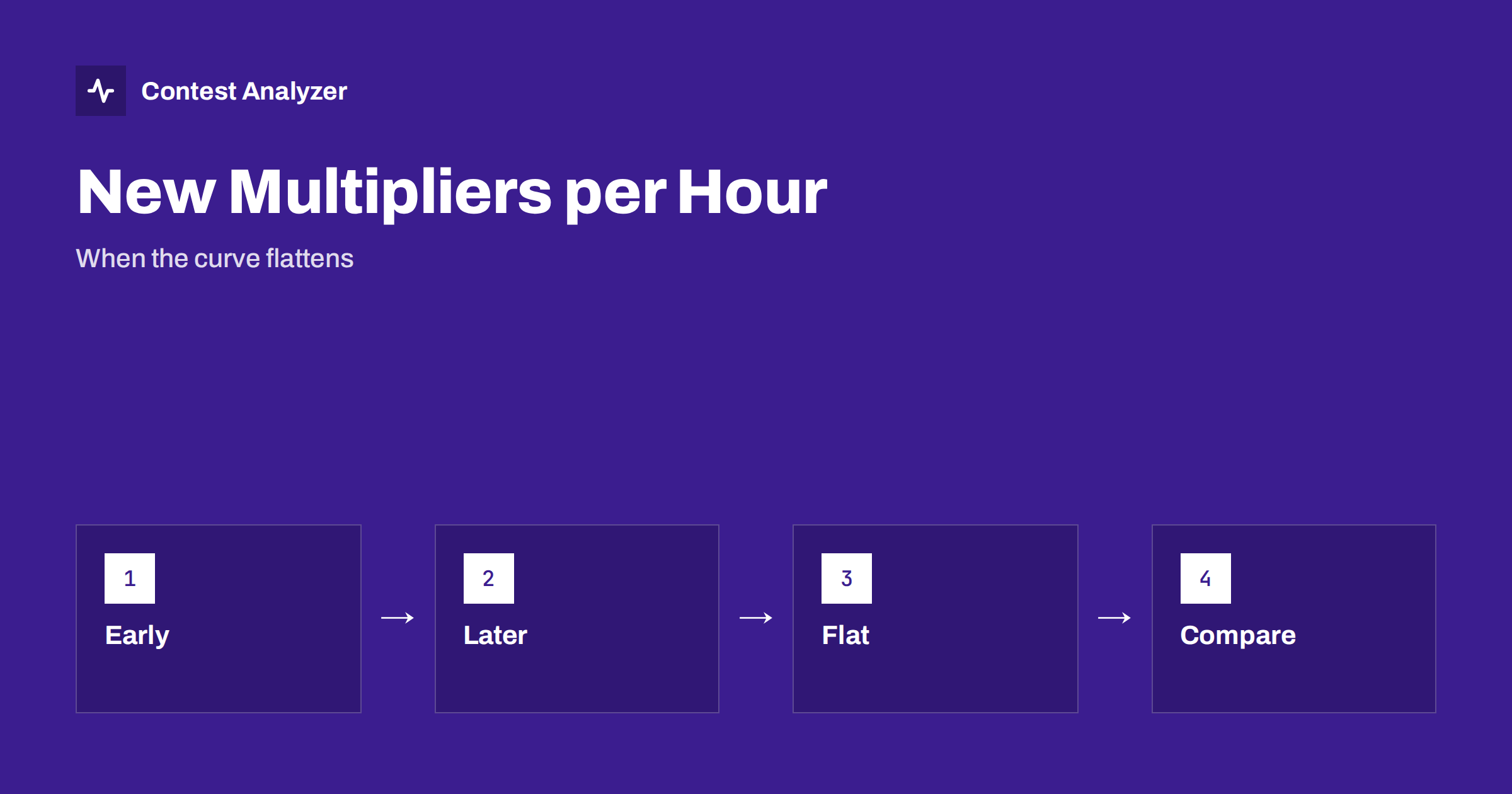
Short answer: In most contests, new multipliers come quickly in the first hours and more slowly afterwards, so the curve of multipliers over time rises steeply and then flattens. This is normal. What matters is how and when it flattens, because the shape tells you whether to keep running, to change band or to hunt for the missing multipliers. Look at new multipliers per hour together with the rate and compare with your own earlier years.
What the curve is
Take your log, count the multipliers that you had at the end of each hour, and draw them as a line. In a contest with zones and countries, such as CQ WW, a multiplier is counted for each zone and each country on each band, according to the rules. The line starts at zero, rises quickly in the first hours as the easy ones come in, and then rises more and more slowly. The difference between one hour and the next, the number of new multipliers in that hour, is the second way to look at the same data, and it often shows the pattern more clearly: a high number in the first hours, then a falling number, and then a few small peaks at times when a band opens.
The reason is simple. The pool of possible multipliers is limited. In the first hours, almost every station that you work is new. As the contest goes on, you have worked many of the zones and countries, so a new station is less likely to bring a new one. The stations that remain are the rare ones, and they are found only with effort or at particular times.
Why it is useful to look at it per hour
The total number of multipliers at the end says how good the result was. The number per hour says what happened and when. A strong first hour followed by two hours with none can mean that you stayed on one band while the others were open, that you were running with no time left to search, or that the band simply gave nothing new. A new multiplier in the middle of the night can be a sign that a band opened in a direction that you had not worked before. Each of these is something that you can act on in the next contest, or in the next hours of this one.
The statistics by hour and the sheet view are explained in the article on hour-by-hour analysis, and the general idea of multipliers in CQ WW is in the multiplier strategy article. The present article looks at one point: the moment when the curve flattens.
Three shapes of the curve
- Smooth and steady flattening. This is the normal pattern. New multipliers fall gradually as the pool is used up. The result is predictable, and the changes you can make are small ones.
- A sudden flat part. The curve rises and then stops for several hours. This often means a problem: a band was closed, a bad choice of band or a long stay on one frequency, or a break that was longer than planned. Look at what you were doing in those hours.
- Several steps. The curve has a series of small steps. Each step is a new band opening or a change to a new band, so the operator who changes band at the right times keeps the curve moving.
When you compare the curve of this year with the curve of last year, the differences in shape are more useful than the difference in the final number. If the curve of this year is flat for two hours at a time when the curve of last year was rising, the next question is why.
What to do when the curve flattens
When new multipliers fall to almost nothing, there are several options, and the right one depends on the contest and on the time left.
- Change band. Each band has its own multipliers in many contests, so a band that you have not used for some time offers new ones. This is the main reason that operators make planned band changes, and the article on band strategy by hour shows how to plan them.
- Switch from running to searching. If you have been calling CQ, then new multipliers come only when they happen to call you. A period of search and pounce, with the aim of finding specific stations, can bring more multipliers per hour, even if the number of QSOs falls. The comparison of the two is explained in run versus search and pounce.
- Look at what is missing. List the zones and countries that you have not yet worked on each band, and compare them with the openings that are likely at the current time. Do not chase a multiplier that cannot be heard at that hour.
- Stay and run. Sometimes the best action is to continue with a high rate. If the rate is high enough, the QSO points from the rate may be worth more than the few multipliers that a search would bring. The last hours may favour one or the other, as discussed in the article on the last hours.
Balance with the rate
New multipliers per hour must always be read together with the QSO rate. A multiplier increases the score by a share of the total, and the amount depends on the number of multipliers you already have: the tenth multiplier changes the result more than the hundredth. A QSO adds its points to the base. A simple way to think about it is to ask which gives a larger increase of the final score in the next hour: another hour of high rate or an hour of search with a lower rate and a few new multipliers. You can estimate this from your own statistics. Look at the points per QSO in your contest, at your multipliers so far, and at the rate in the different modes of operation.
Do not trust an estimate too much, since propagation changes. But the exercise teaches an important lesson: the answer is different in the first half and in the second half of a contest. In the first half, the multipliers are cheap and numerous. In the second half, they are rare, and a rare one may be worth a lot of effort.
Reading the statistics after the contest
After the contest, put the three pieces together: new multipliers per hour, the rate per hour and the band in use. The pattern shows which hours were productive for which reason. Contest Analyzer gives the full statistics of your log, including rates, QSOs by hour and band, countries, continents, CQ and ITU zones and WPX prefixes, distance, beam heading, breaks and off time and callsign length and structure, with comparison with your own logs from earlier years. With the year-on-year comparison, you can see on one page whether the multiplier curve of this year was better or worse than that of last year, and in which hours. The tool also checks every callsign and every zone against official license databases and several independent reference sources and shows only the few QSOs worth a second look, so that a multiplier is not counted from a busted call or a wrong zone; you can edit calls or zones in the report and download a corrected Cabrillo. It works with Cabrillo from N1MM Logger+, DXLog and Win-Test and supports 22 contests (see the contests page).
Take care with the correction of zones. A multiplier that comes from a wrong zone is not a real multiplier, and the committee may remove it. This is another reason to look at the QSOs that carry a new multiplier first: they are the ones where an error costs most. The article on zone errors with multi-zone countries gives examples.
Practical notes for your next contest
- Keep a note of the time when the multipliers slow down, and what you did next.
- Plan one or two band changes for the hours when you expect the curve to flatten.
- Prepare a list of the multipliers that you usually miss, and watch for them at the right times.
- After the contest, compare the curve with last year’s and write one sentence on the main difference.
Related reading
- Multiplier strategy in CQ WW
- Hour-by-hour analysis of a contest log
- Compare contest results year on year
The bottom line
A flattening multiplier curve is normal. Read when and how it flattens, together with the rate and the band, and decide whether to change band, to search or to keep running. Compare with last year and let the shape of the curve, not only the final number, guide your plan.
FAQ
Is it a problem if new multipliers fall in the second day?
No, it is the normal pattern, because the pool of possible multipliers is limited and you have already worked many.
Should I always change band when the curve flattens?
Not always. Check the openings and the rate first. A band that gives no new ones may still give a good rate.
How do I compare two years fairly?
Compare the shape of the curve and the hours of the changes, and remember that propagation differs between years.
Are multipliers from busted calls valid?
No. A multiplier from a wrong callsign or zone can be removed, so check the QSOs that carry a new one.
Does the same advice apply to all contests?
The idea is general, but the multipliers differ by contest. Read the current rules to see what counts.