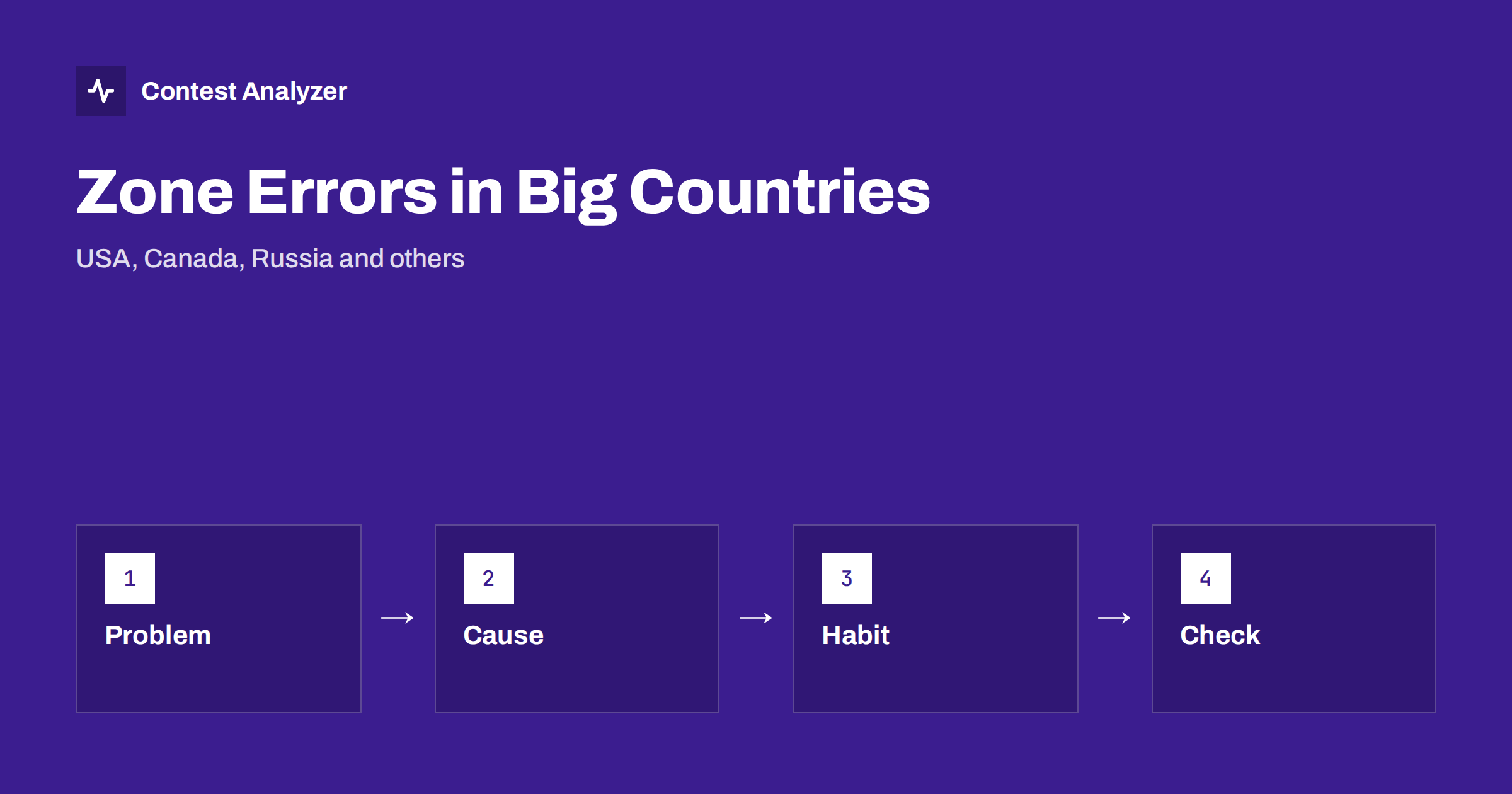
Short answer: In contests where the zone is part of the exchange, errors cluster around stations from large countries that span several zones. The callsign alone does not always tell you the zone, so operators guess from the prefix or from habit. The remedy is to log the zone that the station actually sends, to know which countries are split, to watch for stations that operate away from home and to review unusual zone and callsign combinations after the contest. Check the current rules of each contest for the exact zone system used.
One country, many zones
Most countries lie within one CQ zone. A station from a small or medium country sends the same zone every time, and an operator who works it once will remember the number. But some countries are so large that they extend over several zones, and the same prefix can belong to stations in different zones. The United States, Canada and Russia are well-known examples, and similar situations exist elsewhere, including large countries in South America and Asia. For the exact assignments, use the official zone lists and maps, which are updated by the organisers.
The same applies to ITU zones, which are used in the IARU HF Championship. The two systems are different, and a station may belong to one CQ zone and to another number in the ITU system. The article on ITU zones in the IARU HF Championship explains the difference, and CQ zones explained covers the CQ system.
Why mistakes are so common
- The prefix does not give the zone. In a large country, a call with the same prefix may be in any of several zones, and the number in the call does not always correspond to a particular zone.
- Habit and assumption. The operator knows that most stations of a country are in one zone and fills it in automatically. This is right most of the time, and wrong when the station is in another part of the country.
- The logger fills the field. Many programmes preset the zone from the country or from a call history. The field looks correct, and the operator does not listen for the actual number.
- Stations away from home. A station may operate portable, or from a holiday location, or may have moved, and the zone it sends is not the one the prefix suggests.
- The sender’s mistake. Occasionally the other station sends the wrong zone, either by habit or because it uses a wrong default in its logger.
The stations that cause the most trouble are those whose home zone is the minority one in their country, because they are the exception to the rule that the operator has formed.
What the error costs
In a contest where the zone is part of the exchange, a wrong zone can invalidate the QSO in the log check, and it can also affect the multiplier count, because zones are usually multipliers. If the contest uses the zone as a multiplier on each band, one wrong zone may cost a QSO and a multiplier at the same time. Even if the committee treats the error leniently, the log will lose points, and the claimed and final scores will differ. See claimed and final score for how such differences appear.
The risk grows with the size of the country. A station from a very large country may be heard often, and each QSO gives the same chance of an error. In a contest such as CQ WW DX, the stations of the biggest countries are among the most frequent on the air, so the mistakes are repeated many times.
The rule: log what is sent
The simplest and most important rule is to log the zone that the other station sends. Do not log the zone that you expect. Do not correct it from the prefix. If a station from a country that is usually in one zone sends another number, ask for a repeat. If the number is confirmed, log it. It is more likely that the station is in another zone than that the station made a mistake, and if it did make a mistake, the committee will see the same number in the other log.
Some further habits help:
- Turn off automatic filling of the zone in your logger, if possible, or at least pay attention to the field and compare it with what you heard.
- Know the split countries. Keep a short list of the countries that span several zones and give them extra attention.
- Listen for the zone as a number and not as a “usual” value. If you caught it as part of the pattern, ask again.
- Use a zone map. A printed or on-screen map of the zones is quick to consult when a station sends an unexpected number.
- Treat portable calls with care. A call with a /P, /M or another indicator may be in a different zone from the one suggested by the base call. See portable and maritime stations and zones.
Reading the zone from the callsign: when it works
Experienced operators often know the zone from the call, and this is fine for small countries. For the large ones, the callsign area, such as the number in the call, may help to estimate the region, but it is not a rule that is valid everywhere. In some countries, people keep their callsign when they move, so the number in the call does not show where the station is today. The estimate is a guide for expectation, not for logging. If the exchange you hear contradicts the estimate, believe the exchange.
The same approach works for the country as well as the zone. If you want to understand more about how countries are identified, the article on country lists: DXCC and WAE describes the lists that contests use.
How to spot zone errors in the log
After the contest, look for the combinations that are unusual. Examples include a station from a split country with a zone that is rare in that country, a sequence of QSOs with the same zone from stations that you would expect in different zones and zones that are in conflict with the continent or the country of the call. Contest Analyzer checks every callsign and every zone against official license databases and several independent reference sources and shows only the few QSOs worth a second look. It is especially useful for the zones of stations in split countries, because the list contains only the doubtful ones and you do not need to look through the whole log. For each flagged QSO, think about what you heard, and edit the call or the zone in the report if you are sure that you wrote it wrongly. Then download a corrected Cabrillo. If you were not sure, leave the entry as you logged it and consider the rules of the contest. The report also gives full statistics, with rates, QSOs by hour and band, countries, continents, CQ and ITU zones, WPX prefixes, distance, beam heading, breaks and off time and callsign length and structure. It works with Cabrillo from N1MM Logger+, DXLog and Win-Test, supports 22 contests (see the contests page) and lets you compare with your own logs from earlier years. Serial numbers are not checked and dupes are not errors.
Learning from your own zone statistics
The zone table of your log tells you which zones you worked and how many QSOs came from each. If you see an unexpected zone, such as a zone with a single QSO from a country that normally has many in another zone, it is worth checking that QSO. If the zones of your log are very different from last year, look for an explanation: propagation, activity or a logging problem. The comparison with earlier years, described in comparing contest results between years, helps to separate the real changes from the errors.
If a large country appears in your zone table with a wider spread than before, you may have worked a wider variety of stations, but also you may have recorded the wrong zone for some of them. Check and decide.
Station and organiser side
If you are the station that sends the zone, also pay attention. A mistake in the zone you send creates errors in many logs at once. Check that the zone in your logger is the zone of your location according to the official list, and not the zone that your callsign suggests. If you operate from another place than usual, change it before the contest, and write it into your station notes. The Cabrillo header may also contain a location field, and it should match. See the Cabrillo header guide for the fields.
Related reading
- CQ zones and CQ WW explained
- ITU zones in the IARU HF Championship
- Portable and maritime stations: zones and countries
The bottom line
Zone errors are common because the system is simple for most countries and awkward for the largest ones. Log the zone that you hear, learn which countries are split, treat stations away from home with care and review the unusual combinations in your log after the contest. With these habits, the zone becomes a reliable part of your exchange and not a source of lost multipliers.
FAQ
Which countries have several zones?
Large countries such as the USA, Canada and Russia are common examples. Use the official zone lists and maps for the exact assignments.
Can I take the zone from the callsign?
Only as a guess. For split countries, log the zone that the station sends.
What if the station sends the wrong zone?
Ask for a repeat. If it is the same, log what was sent, because the other log will show the same number.
Are ITU zones the same as CQ zones?
No, they are different systems. Check which one the contest uses.
Does the review check zones?
Yes, it checks every zone and shows the few QSOs worth a second look. You can edit them in the report.