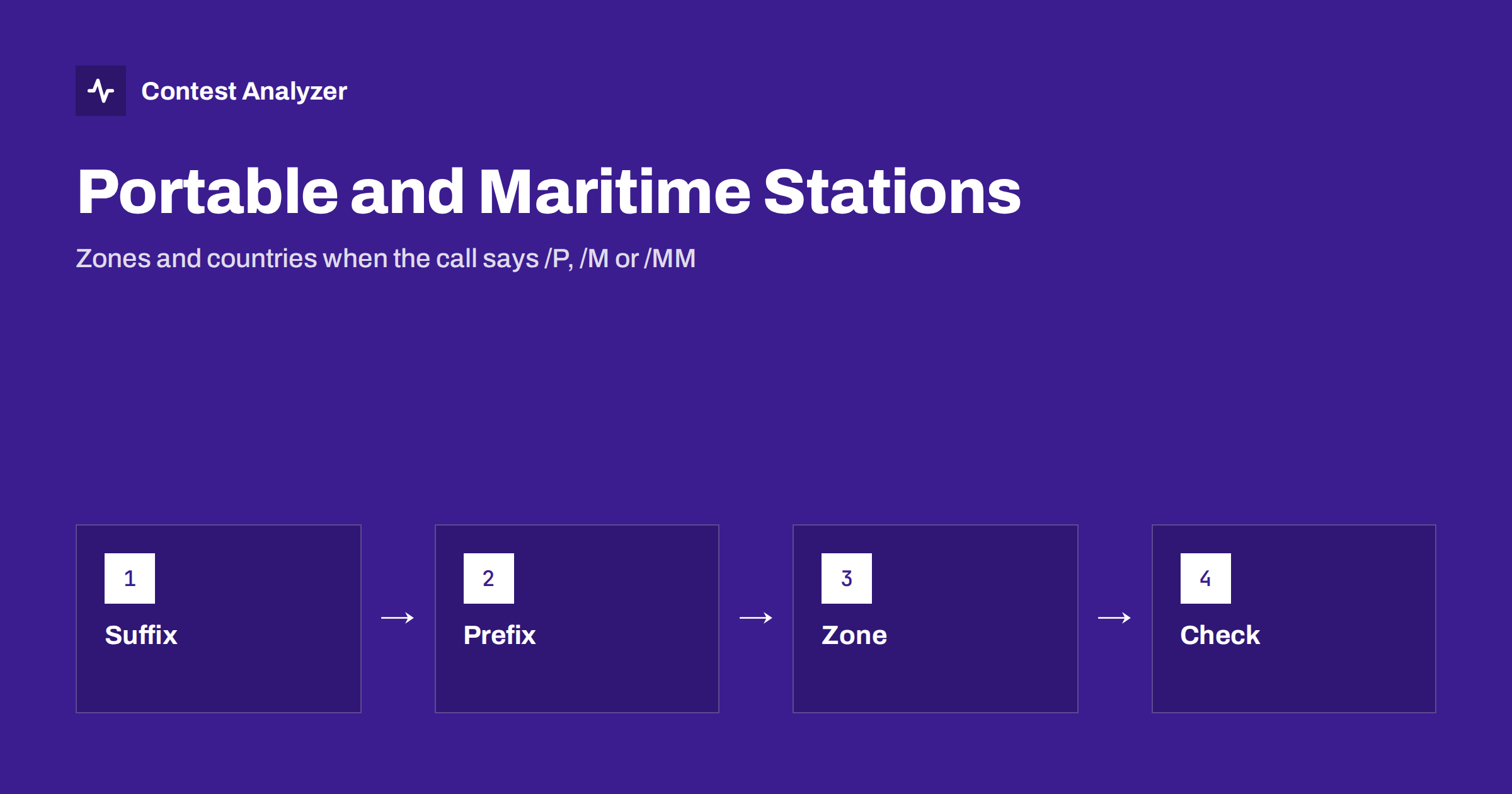
Short answer: A callsign with a slash tells you something about how or where a station is operating, but it rarely tells you the zone. A /P or /M suffix says the station is portable or mobile, a /MM suffix says maritime mobile, and a prefix before the slash usually shows the country where the operator is located. For the zone, log what the other station sends, and for the country, follow the rules of your contest. When a call is unusual, confirm it before you log it, because more characters mean more chances for a mistake.
Why slash calls cause problems
Most contest calls are plain: a prefix, a digit and a suffix. These are easy to copy and easy to look up. A slash call adds extra information in front or behind, and each part has a meaning. Operators often use them in contests, particularly in DX expeditions, in field-day operations, in mobile stations and in stations that visit another country for the weekend.
Problems start when the extra part is mistaken for something else or left out. The slash may be lost in copying, the extra letters may be misheard, or the logger may treat the call in a way you did not expect. Because zones and countries are multipliers in many contests, a wrong assumption about where a station is located can cost multipliers as well as QSOs.
Suffixes: /P, /M, /MM and others
A suffix after the slash describes the type of operation. The most common are these:
- /P, portable. The station is operating away from its usual location. The suffix does not change the country by itself, but the station may be in a different zone from the one you expect from its home callsign.
- /M, mobile. The station is in a vehicle. As it moves, its location can change during the contest, sometimes across a zone boundary.
- /MM, maritime mobile. The station is on a ship or boat in international waters. It has no home country in the usual sense, and the rules of each contest say how a maritime mobile station counts, if at all.
- /A, /QRP and other tags. Some operators add descriptive suffixes. They are informal, and the contest usually does not treat them as part of the exchange.
- A digit after the slash. In some countries a digit shows the call area in which the operator is located, and this can matter for the location element of the exchange.
The important point is that the suffix describes the operation and not the zone. Contest rules decide what the suffix means for scoring, so read the rules for the contest you are entering.
Prefixes: operating from another country
When an operator visits another country, the usual practice is to put the prefix of that country in front of the home callsign, with a slash, for example a prefix followed by a slash and the home call. The prefix then shows the country where the station is operating, and the contest treats the station as being in that country, not in the country of the home callsign. In prefix contests such as CQ WPX, the prefix also changes the multiplier. We discuss this in our article on WPX prefixes.
For logging, the consequence is plain. The country follows the prefix in the call you copied, so a wrong prefix means a wrong country. Be careful with prefixes that look alike, with prefixes that you hear rarely and with calls where the prefix is sent quickly before the main call.
Zones are not in the callsign
A callsign does not tell you the CQ zone, the ITU zone or the state of the station. In a country that is entirely in one zone, a logger can fill in the zone from the prefix with confidence. In countries with several zones, such as the USA, Canada, Russia, Brazil and China, the zone depends on where the station really is. A portable or mobile station can be in a different zone from its home address, and a station with a prefix of another country is in that country’s zone, not its own.
The rule is the same as for any station: log the zone that was sent. When your contest has a zone exchange, the other operator tells you the zone, and that is the one that counts. When the exchange does not contain a zone, as in some contests, the zone is not part of your log, and you only need the call. Our article on CQ zones in CQ WW has the full explanation of the zone system, and the guide to ITU zones in the IARU HF Championship covers the other zone system.
Maritime mobile and other special cases
Maritime mobile stations are the most unusual. A ship at sea is not in any country, and the contest rules decide what that means for you. In some contests a maritime mobile station may count toward a zone multiplier, but not toward a country multiplier, while in others it may not count at all. The zone depends on where the ship is, so the operator must tell you the zone, and you should log it as sent. We do not give a general rule here because the details differ between contests and between years: read the rules.
The same applies to other special cases. An operator on an island, an operator in a territory with its own prefix and an operator in a place that changes administration all create situations where the call is not enough. If you are unsure, ask for the exchange, confirm the call and decide afterwards, using the current country list in your logger.
Copying slash calls without errors
Slash calls are longer, so they have more places for a copying error. A few habits reduce the risk:
- Listen for the full call before you reply. Do not answer when you have only the main call; the prefix or the suffix may change the meaning.
- Confirm the whole call. Send what you copied, including the prefix or suffix, and wait for the confirmation.
- Enter the call exactly. Type the slash and all letters. A call that is entered without its slash is a different call.
- Do not rely on the logger’s guess. A logger can suggest the country from the prefix, but a wrong suggestion looks as plausible as a right one.
- Update the country data. Prefixes and entities change from time to time. A recent country file helps, and our article on setting up N1MM Logger+ for CQ WW mentions it among the settings to check.
More on the general habits is in the article on busted callsigns.
Your own portable operation
If you operate portable, mobile or from another country in a contest, check the rules before you enter the category. Several things need attention:
- The callsign you use. It must be valid in the place where you operate, and it should be the same in the log and on the air.
- Your own zone. Look up the zone of your actual location and enter it in the logger, instead of your home zone.
- The header. The callsign and the location in the Cabrillo header must match what you did. See our Cabrillo header guide.
- The station location in the log. If you move during the contest, which is typical for a mobile, note the changes.
Three situations you will meet
It helps to think of a few typical situations, so that you recognize them on the air.
A visitor with a foreign prefix. You hear a call with a prefix you know from a nearby country, followed by a slash and a longer call. The prefix tells you where the station is, so the country in your log is the one that belongs to the prefix, and not the one the main call suggests. The zone is whatever the station sends, and for a country with only one zone you can check that it matches the zone you expect.
A mobile on a long drive. A /M station can be in one zone at the start of the contest and in another a few hours later. This is the situation in which the zone really must be listened for every time. Do not copy the zone from an earlier QSO with the same station, since it may have changed. If you work the mobile again on another band, the zone may be different.
A ship at sea. A /MM station is rare in most contests, so you are unlikely to meet it often. When you do, confirm the call, copy the zone, and read the rules afterwards to see how the QSO counts. Do not assume that it counts as a country.
In all three cases the safe course is the same: copy everything that is sent, confirm the callsign and let the log reflect the facts, not your expectations.
Checking slash calls in the log
After the contest, read through the QSOs with slash calls, because they have the most room for error. Contest Analyzer checks every callsign and every zone against official license databases and several independent reference sources and shows only the few QSOs worth a second look. You can edit calls and zones in the report and download a corrected Cabrillo. Serial numbers are not checked and dupes are not errors. The contests page lists the supported contests.
Related reading
- CQ zones in CQ WW explained
- WPX prefixes explained
- Busted callsigns in contest logs
- IARU HF Championship and ITU zones
The bottom line
A slash in a callsign is a signal to listen carefully. The suffix describes the operation, the prefix usually describes the country, and neither tells you the zone. Log the zone that is sent, copy the full call, and check the rules of your contest for portable, mobile and maritime stations.
FAQ
Does /P change the country of a station?
Not by itself. The prefix before the slash is what normally shows the country where the station is operating.
Can I tell the zone from a portable callsign?
No. The zone depends on the actual location. Log the zone that the other station sends.
How do maritime mobile stations count?
It depends on the contest. Some count them for zones but not for countries. Check the current rules.
Should I type the slash in the log?
Yes. The call must be entered exactly as the station used it, including any prefix or suffix.
What if I am not sure about a slash call?
Ask the station to repeat it before you log the QSO. A short repeat is cheaper than a wrong call.