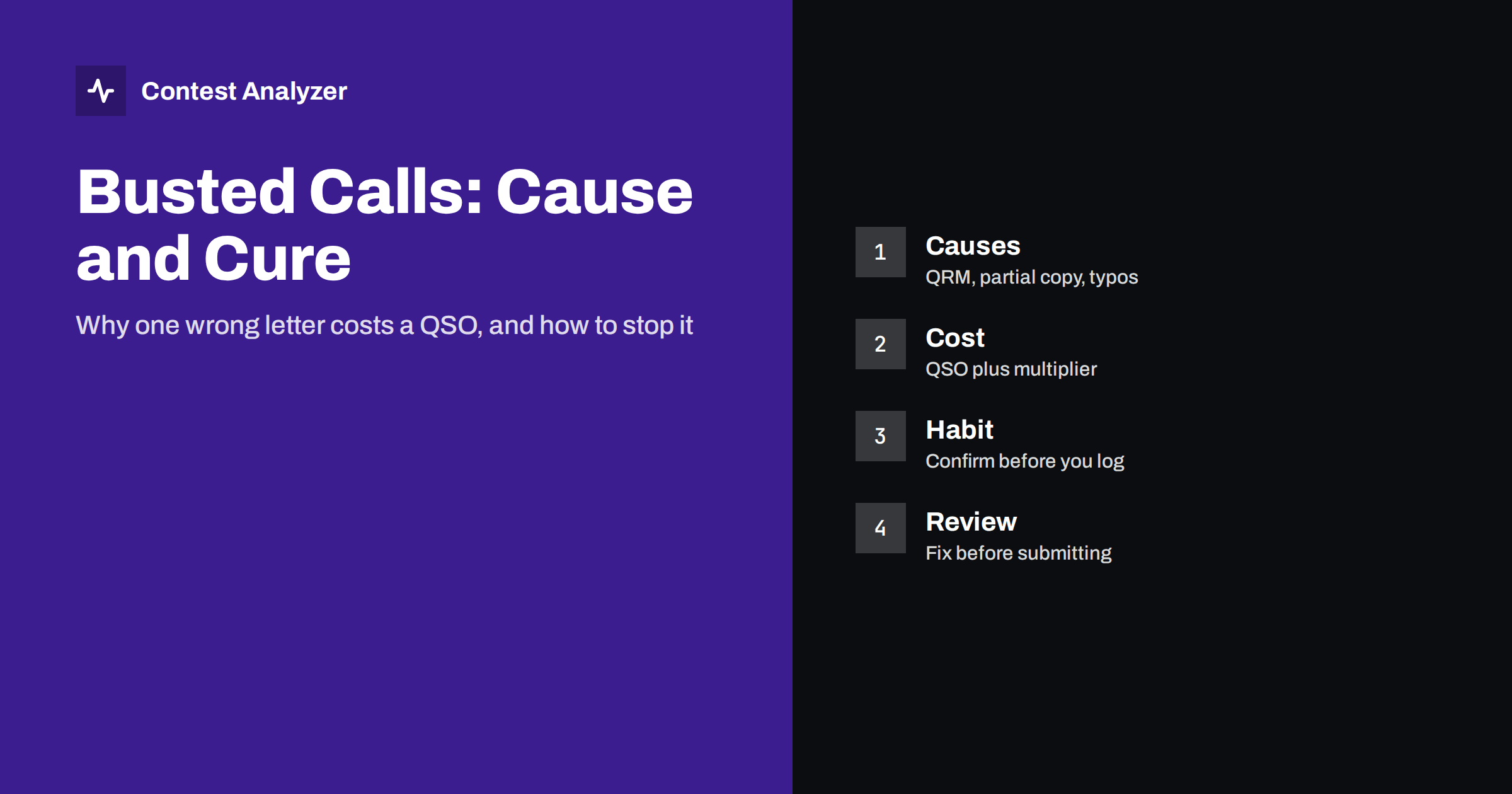
Short answer: A busted callsign is a call logged with one or more wrong characters, so it does not match the station you actually worked. It usually costs you the QSO, and if that station was also a new multiplier, it can cost you the multiplier as well. The causes are mostly human: noise and interference, partial copy, cut or confusing characters, and typing under pressure. Most of them can be reduced with a few operating habits and a calm review of the log before you submit.
What a busted call is
Contest committees compare what you logged with what the other station logged. If you wrote DL1ABC and the station was DL1ABD, your QSO does not match, and the committee treats it as a busted call. The word “busted” is used for the callsign you copied wrongly. The contact itself did take place, but it cannot be credited to you because it cannot be matched to anyone.
It is worth being precise about the term. A call can be wrong because of a single character, because two characters were swapped, because a letter was dropped or because a prefix was guessed. The result is the same for scoring, but the cure differs. A dropped letter points to copying under noise. A swapped pair points to typing. A wrong prefix points to expectation: you heard part of the call and your brain filled in the rest.
Why busted calls happen
Noise, QRM and fading
On crowded bands the other signal is often partly covered by someone else. In SSB, the weakest part of a call is usually a single phonetic that blends into the interference. In CW, a dit lost in a fade turns one letter into another. These errors are almost never visible to you when you log, because the part you heard sounded right.
Partial copy and guessing
If you hear “…ABC” and know that DL1ABC was spotted earlier or is in your head from a previous contest, you may log it without hearing the first half again. This is the most common source of systematic busts, because it feels like confirmation. It is not. The call you expected and the call that was sent can differ by a digit.
Confusing characters
Some pairs are routinely mistaken. In CW, V and 4, B and 6, 5 and H, and shortened numbers sent in cut form are classic examples. In SSB, the letters B, D, P and T, or M and N, often sound alike on a poor signal. Suffixes such as /P, /M and /QRP add more characters to get wrong, and a prefix that looks familiar can hide a different country altogether.
Typing errors
Fast operators make typing mistakes. The most common are an adjacent key, a transposed pair and a repeated letter. Programs with callsign-completion features can reduce these, but they can also introduce a different problem: the program suggests a known call and you accept it without listening again.
Late changes
The station repeats its call after you have already logged and moved on, and you leave the entry as it was. The correction you meant to make never reaches the log.
What a busted call costs
The direct cost is the QSO. In most contests the committee removes it, and many contests add a penalty on top. The penalty rules differ, so read the current rules for your contest; some remove only the contact, others remove extra points as well.
The indirect cost can be larger. In contests that reward multipliers, one bad call that was your only contact with a new country, zone or prefix can remove that multiplier from your score. Because the score is a product of QSO points and multipliers, losing one multiplier on a single band has a real effect, and it falls on the part of the log where you worked hardest to find a rare station.
There is also a second-order cost to the other station. If you log DL1ABD, your wrong entry may make the real DL1ABC look like a station with a missing contact in your log, and the person on the other end loses a QSO, too. Contest results are a shared effort, and every busted call hurts two entrants.
| Type of error | Typical cause | Most likely cure |
|---|---|---|
| Dropped or added character | Interference, fading | Ask for the call again before logging. |
| Wrong letter or digit | Similar sounds, cut numbers | Listen to the repeat. Use phonetics. |
| Wrong prefix, right suffix | Guessing from memory | Do not log from expectation. |
| Transposed characters | Typing speed | Look at the entry before pressing Enter. |
| Correct call, wrong portable suffix | Ignored /P, /M or /QRP | Confirm the full call as sent. |
Operating habits that prevent busts
- Do not log what you did not hear. If the call is only partly copied, ask for it again. One extra exchange costs seconds; a bust costs the QSO.
- Write the call before you answer. Enter it in the logger while the other station is still sending, and read the entry back to yourself.
- Use phonetics for the doubtful letter only. Repeating “Delta” for a D resolves a doubt faster than sending the entire call.
- Wait for confirmation. If the other station corrects you, change the entry immediately. Do not rely on remembering to fix it later.
- Be suspicious of familiar calls. If the call is one you worked last year, listen to it as a new call. Habit is the most dangerous kind of guess.
- Slow down when it costs nothing. A call you can hear clearly at a steady pace does not need any extra checking. A call that arrives with a pile-up behind it deserves a repeat.
Logging programs offer a call-history or partial-call feature during operating, such as Super Check Partial in several programs, which suggests known calls while you type. Used well, it flags a call that does not look like anything seen before. Used badly, it nudges you to accept a lookalike. Treat its suggestion as a hint, never as the answer.
Habits for after the contest
Most busted calls are caught, or missed, in the hour after the contest, not during it. A short, structured review is worth more than reading the whole log.
- Sort the log by callsign and look at adjacent entries. Two calls that differ by one character are suspicious, especially if one of them has only a single QSO.
- Look at calls that appear once in the entire log, especially those from rare countries that you do not remember working.
- Look at the calls with unusual structure: very short calls, calls with a long suffix, calls with a slash.
- Look at QSOs just before or after a band change, when you were working quickly.
Do this review while the contest is still fresh in your head. A week later you will not remember whether the signal was strong or whether you heard the call twice.
Letting software narrow the review
Reading thousands of QSOs for an odd character is slow and unreliable. Contest Analyzer reads a Cabrillo file from N1MM Logger+, DXLog or Win-Test and checks every callsign and every zone against official license databases and several independent reference sources. It does not ask you to inspect the whole log: it shows only the few QSOs that deserve a second look. You can correct calls and zones in the report and download a corrected Cabrillo to send to the sponsor. Serial numbers are not checked, and dupes are not treated as errors, because both are decisions that belong to you and to the rules of the contest. No tool can know what you heard, so the final decision on each flagged QSO is always yours. The contests page lists the 22 supported contests.
What to do with a flagged call
When a report flags a QSO, work through it in order. First, listen to your memory of the exchange: did the other station repeat the call, and did it match? Second, look at the context in your own log. Did you work the same station on another band, with a different spelling? That is a strong clue. Third, if you are still unsure and the contest rules allow it, leave the original. A wrong correction is as bad as a bust. The goal is a log you can defend, not a log with every entry changed.
Keep a short list of your own recurring mistakes. Most operators have two or three: a letter pair they always confuse, a country prefix they always shorten, a suffix they always forget. Reading that list before the next contest is the cheapest improvement you can make. A related look at how committees report these errors is in the article about the UBN report.
Related reading
- What a UBN report is and how to read it
- How to check a contest log before you submit it
- CQ zones explained for CQ WW
The bottom line
Busted calls are a human problem with a practical answer. Log only what you heard, confirm the doubtful characters, fix errors at once, and review the log soon after the contest. The few minutes that takes will save more points than any amount of extra hours on the air.
FAQ
Is a busted call the same as a NIL?
No. A busted call is a QSO where your logged callsign is wrong. NIL means not in log: the other station has no matching QSO with you. A busted call often shows up as a NIL, but a NIL can also arise when the other station simply did not log the contact.
Do busted calls count against my score?
In most contests the QSO is removed, and some add a penalty. The details differ by contest and by year, so check the current official rules for the contest you entered.
Should I correct a call after the contest?
Yes, if you are confident of the right call, for example because the same station appears elsewhere in your log. If you are guessing, leave the entry as it is.
Can a call-completion feature cause busts?
It can, if you accept a suggested call without listening again. Used as a hint it helps, but it is not a replacement for copying the call.
Does Contest Analyzer find every busted call?
No tool can promise that. It highlights the few QSOs that look doubtful so that you can spend your time on them, and the decision to change an entry stays with you.