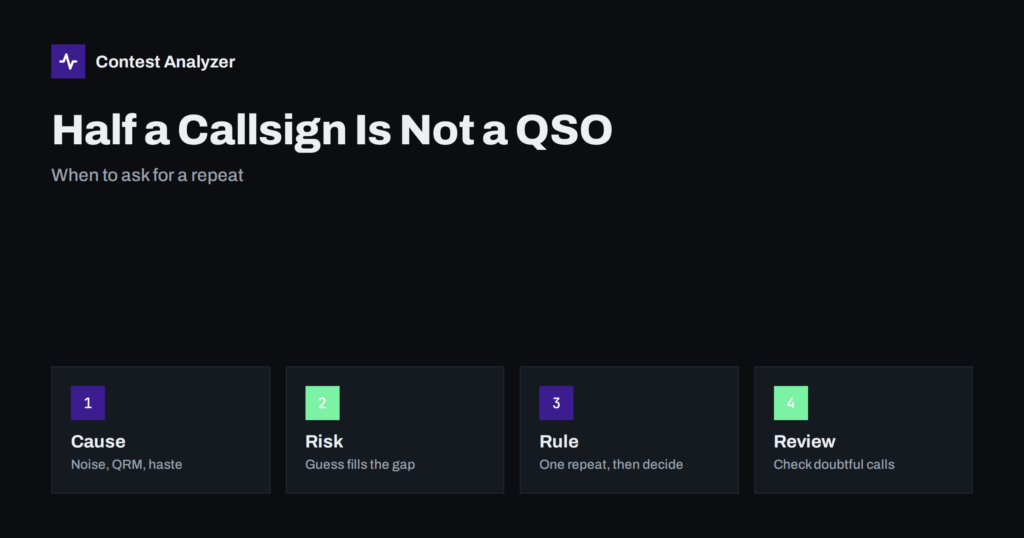
Short answer: On SSB, many letters sound much alike, especially in poor conditions: B, D, E, P, T and V form one family, M and N another, and F and S a third. In a contest, these pairs are the source of many busted callsigns. The best protection is to use the standard phonetic alphabet consistently, to confirm the callsign back to the other station and to ask for a repeat of the doubtful letter instead of guessing. After the contest, check the calls with letters from these groups first.
Why letters sound alike
A human voice carries information in many frequencies, but an SSB transmission is limited to a narrow audio band, typically a few kilohertz. In good conditions, this is enough for clear speech. In a contest, the signal passes through noise, fading and sometimes interference from nearby stations, and the receiver may use filters that remove more of the audio. What remains is the part of the sound that carries the vowels and the rough shape of the consonants, while the fine details that separate similar consonants are the first to be lost.
The letters that are confused are those whose spoken forms differ only in these details. The ones in the group B, D, E, P, T, V all end in the same “ee” sound, and what separates them is the short consonant at the beginning. The nasal sounds in M and N differ only by a tiny change in the lips and the nose. The “f” and the “s” are both hissing sounds, and one of them is easily mistaken for the other when high frequencies are weak.
The usual groups
- B, C, D, E, G, P, T, V (and Z in some accents). All finish with the same “ee” sound. Of these, B, D, P, T and V are the most often mixed up.
- M and N. The difference is subtle, and noise makes it nearly impossible.
- F and S. Both are hissing sounds; weak high audio makes them look the same.
- A and 8, and some numbers. Accents and speed can make numbers sound like other numbers or like letters.
- I and Y, Q and U, and others. These pairs depend on the language and the accent of the operator.
It is not a coincidence that the phonetic alphabet exists. Each word in it is chosen so that it is easy to tell apart from the others, even in poor conditions. In a contest, this is the most important tool for SSB operators.
Use the phonetic alphabet properly
Many operators use the standard phonetic alphabet, but not all of them use it consistently. When a call is sent in a mixture of standard words and made-up words, the other operator may misunderstand it. Inventive words are fine for friends in a casual QSO, but in a contest the standard alphabet is better, because everybody knows it and the words have been chosen to be understood.
- Send the call in phonetics when conditions are poor. In a strong, clean signal, a straight call is faster, but in noise, use the words.
- Use the same words every time. The other operator learns the pattern, and the call becomes easier to recognise.
- Slow down for the doubtful letters. A word said clearly and a little slower is better than a quick one.
- Do not use phonetics for the whole exchange every time. A long phonetic call slows the QSO. Use it where it is needed and, in a pile-up, at the start of your own call.
The article on SSB phonetics and confirming callsigns quickly goes further into the practice of confirming the call during the QSO.
Confirm back, do not guess
When you copy a call that contains one of the confusing letters, the most dependable method is to repeat the call back, with the doubtful letter in phonetics. For example, you can say the call and then the letter with the word, with a rising voice to make it a question. The other station will confirm or correct it in a couple of seconds. This is a normal habit and not a sign of weakness, and in a long contest it is a mark of good operating.
If the other operator uses non-standard phonetics, you may need to ask him to spell the letter in another way. Two or three ways of saying the same letter are available in the alphabet used by hams, and most people can repeat the call with another word if asked. The aim is to leave the QSO with the correct call and not with a plausible one.
Let the logger help, but do not trust it blindly
Loggers often show similar calls that fit the characters you typed. This is helpful when you are not sure between two possible calls that differ in a letter from a confusing group. But a suggestion is only a statement of what might exist. It is not what the other station sent. See the article on Super Check Partial for the way to use such help during the contest, and for the limits of it.
In the same way, a call that is in your call history file may fit the letters you copy, but the operator may be someone else in a club station, or a portable operator with a different call. Always confirm what you hear.
How the errors appear in the review
When a call is busted by a confusing letter, the result is usually a call that looks real: one letter is changed, and the new call belongs to some other station, or does not belong to anyone. In the review after the contest, the most likely candidates for errors are calls in which a letter from one of the groups is present. Contest Analyzer checks every callsign and every zone against official license databases and several independent reference sources and shows only the few QSOs worth a second look. Look at the calls in the list and think about what you heard. Ask whether the call could be a similar one with another letter from the same group. You can edit calls or zones in the report and download a corrected Cabrillo. Besides the review, the report gives full statistics, with rates, QSOs by hour and band, countries, continents, CQ and ITU zones, WPX prefixes, distance, beam heading, breaks and off time and callsign length and structure, and you can compare with your own logs from earlier years. It works with Cabrillo from N1MM Logger+, DXLog and Win-Test and supports 22 contests, which the contests page lists. Serial numbers are not checked and dupes are not errors.
For a general view of the effect of such errors on the score, see busted callsigns and claimed versus final score.
Voice and equipment
The way you speak and the way your signal sounds also affect how well the other side can copy. A clear voice at a moderate speed, a microphone at the right distance and an audio setting that does not clip are all important. A signal with too much compression or too much bass makes the consonants harder to understand. Listen to a recording of your own transmissions, if you can, and adjust the audio so that the consonants are bright. The article on recording audio for log checking describes how recordings can help with checking afterwards. On the receive side, a headset with a good response and a moderate filter bandwidth is usually better than a very narrow filter that removes the information that separates the letters.
Accents, languages and numbers
SSB contests are international, and the pronunciation of the phonetic words differs from one country to another. A word that is clear to a native speaker may be difficult for an operator whose first language is different. The letters that suffer most are those where the language has no similar sound, for example the “th” sound or the difference between “v” and “w”. Where you know that the other station is from a country with a strong accent, speak a little more slowly and repeat the call in the standard form. Where you are the one with the accent, practise the words that you find difficult, and choose an alternative if the standard word causes problems for those who copy you.
Numbers also need care. Many operators say “niner” for nine and “fife” for five when the signal is weak, which makes the words more distinct, but this is not required in every contest and depends on the habits of the operator. What is more important is that the number in the callsign is said clearly and at the same speed as the letters. A call in which the number is slurred is a frequent cause of a bust, because the number changes the whole prefix.
Practise outside the contest
The habits that prevent errors are best learnt before the contest. A few minutes of practice each week can make a difference: read random callsigns aloud in phonetics, record yourself and listen to the result. Another way is to listen to a contest on a band without taking part, and to write down the calls you hear. Compare your notes with the stations’ claims later, if you can. This type of training shows you where your own ears are weakest, and which groups of letters you should watch in a real contest.
Operators who are new to contesting can also use the quieter contests for practice. A smaller event gives more time to ask for repeats and to try new habits, and the lessons are the same in the big ones. If you are at the beginning, the article on your first HF contest gives advice on how to choose a contest and keep the log clean.
Related reading
- SSB phonetics and confirming callsigns quickly
- Busted callsigns in contest logs
- CW copying accuracy in contests
The bottom line
Similar-sounding letters are an unavoidable part of SSB. You cannot change the physics, but you can change how you say and confirm calls. Use the standard phonetic alphabet, repeat the doubtful letters, do not accept the logger’s guess as a fact and look at these letters first when you review the log.
FAQ
Which letters are confused most often on SSB?
B, D, E, P, T and V are the largest group, followed by M and N and by F and S.
Should I always use phonetics in a contest?
Not for every call. Use them when conditions are poor or when a call is in doubt, and keep the QSO short when the signal is strong.
Can I invent my own phonetic words?
It is better to use the standard alphabet, because other operators know it and the words were chosen to be easy to tell apart.
What if the other station does not use phonetics?
Ask for the doubtful letter in phonetics, or send your copy and wait for confirmation.
Where should I look first in the log review?
Look first at calls that contain letters from the confusing groups, especially in the weakest hours.