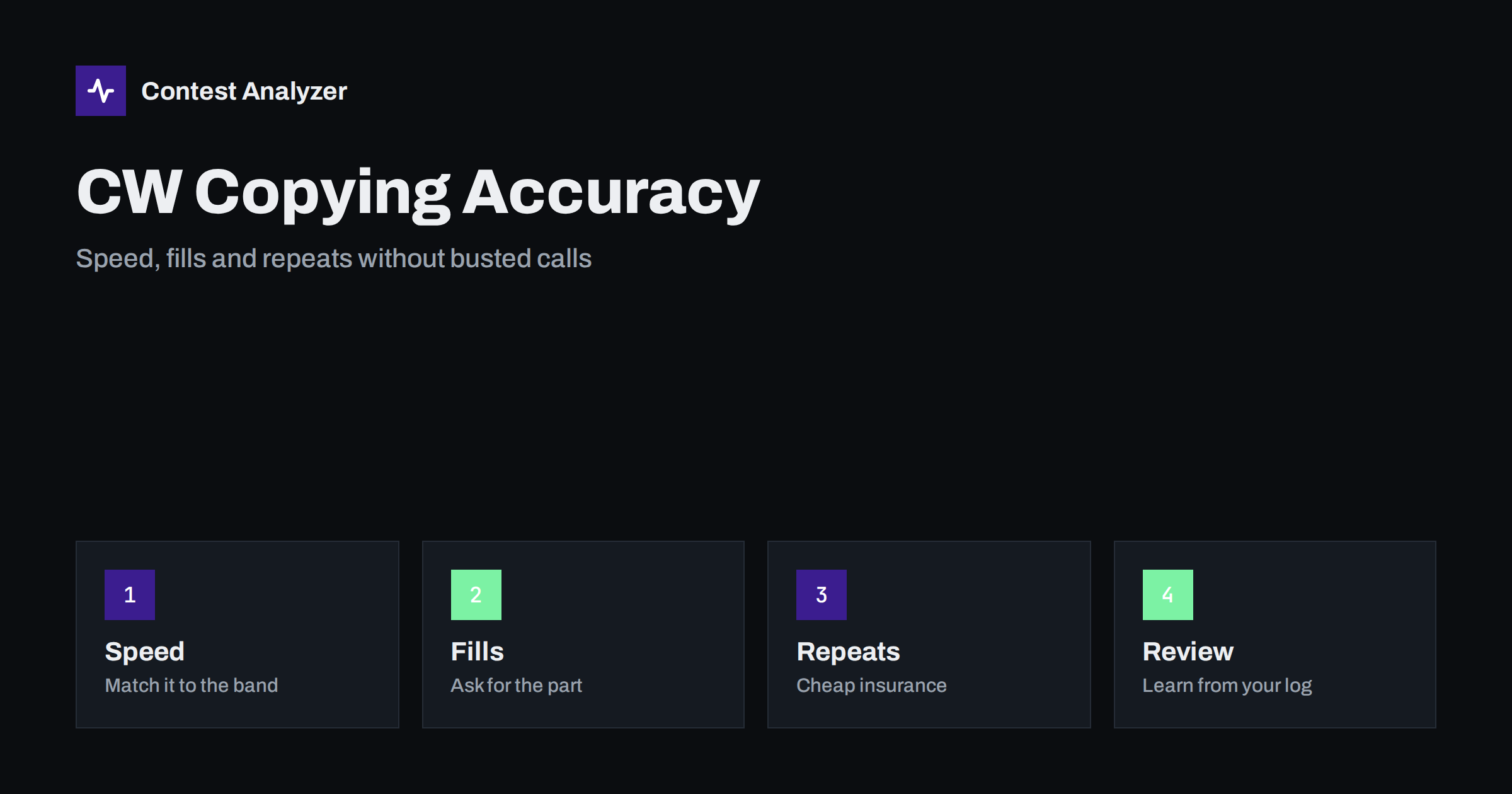
Short answer: In a CW contest, accuracy is mostly decided by three habits: running at a speed you can copy under real conditions, asking for a fill or a repeat the moment you are not sure, and confirming the callsign by sending it back. A repeat costs a few seconds. A busted call can cost the QSO and sometimes a multiplier, and you will not know about it until long after the contest.
Why CW calls get busted
Copying a callsign in CW is a short, high-pressure task. You hear a string of perhaps five or six characters, often once, often with a second station calling at the same time, and you have to decide what it was before the exchange moves on. Under those conditions the brain fills gaps with what it expects. If you hear “K1” and a scrap of something, and a station with a similar call worked you an hour ago, it is very easy to write down the familiar call instead of the real one.
Most CW busts fall into a few families. A character is dropped or added. Two characters swap places. A letter is replaced by another letter of similar rhythm. A digit is replaced by a neighbouring digit. A suffix is lost because the sending ended while you were still writing the prefix. Knowing the families helps, because you can build a small defence against each of them. If you want the wider picture of why busts happen and what they cost, the article on busted callsigns in contest logs covers it from the beginning.
Choose a speed you can copy, not one you can send
Many operators send faster than they copy comfortably. In a pile-up this does not show, because you can answer the callers quickly. It shows when you try to take down a call at the end of a long night, and when you try to read a fast station sending calls at a speed that was fine for you at 18:00 but is not at 04:00.
A practical rule is to run at the speed at which you can copy a callsign on the first try nearly every time, not at the highest speed you can sustain. Test it honestly. Look at the first fifty QSOs of a session and count how many needed a repeat. If more than a handful did, the speed is too high for the conditions, or the band is noisier than you think. If almost none did, you have room to go faster, and the rate gain from a few words per minute is real.
When a caller is slower than you, matching their speed often saves time. A station that sends at 20 words per minute and gets an answer at 32 may struggle to copy the report, ask for a repeat, and cost you more than the slower pace would have. Many experienced operators drop their speed a little when they sense hesitation, then go back up after the contact.
Fills and repeats: ask early, ask precisely
The two most useful tools for accuracy are the partial fill and the repeat. They are cheap and they are used far less than they should be.
- Ask for the part you missed. If you copied “DL” and a digit but lost the suffix, send the part you have followed by a question mark. The other station needs only to send the suffix. This is much faster than a full repeat, and the other side understands exactly what is missing.
- Ask for the full call when the whole thing is uncertain. A short “call?” macro (some operators prefer “AGN” or “?”) is the standard approach. Do not guess and hope. A guess that is wrong costs the contact; a repeat costs seconds.
- Repeat what you copied, and wait. Sending the callsign back before the exchange gives the other station a chance to correct you. If the call is wrong, a good operator will correct it, and you will hear the correction as an extra character or a different call.
- Do not assume silence means correct. On a busy band a station may be cut off by a stronger signal, and you may not hear the correction. If you are unsure, repeat the call once more with the report.
Keep the fill messages short and make sure they are on keyboard keys or function keys you can reach without thinking. A good logger lets you send the partial call that you have already typed, and this is a common feature in N1MM Logger+, DXLog and Win-Test. Check how your own software handles this before the contest, not during it.
Letter and digit confusions to know
Everyone has pairs of characters that sound alike in their own head. Make a list for yourself, but the usual suspects are well known:
- Letters with similar rhythm, such as B and 6 when sent as cut numbers, or V and 4, S and H, U and V.
- Digits that become cut numbers at speed. In many exchanges T stands for 0, N for 9, A for 1 and U for 2. If you hear a letter where you expect a digit, think of this.
- Suffixes with repeated characters, such as a call ending in “EE” that may be copied as a single E or three.
- Prefixes where the digit comes after one or two letters. Missing the digit changes the whole call.
The point is not to memorise a table, but to catch your own errors. When you copy something that has one of these ambiguous characters, treat it as a flag and confirm that part with the other station.
Headcopy, paper and typing
There is no single best method. Some contesters copy the call into the logger as they hear it; others use head copy and type after the character string has ended. The method matters less than the discipline around it. If you type as you hear, you can end up committing a wrong character early and not going back to correct it. If you hold the call in your head, you can lose the first characters while you are writing the exchange.
A useful compromise is to type what you are sure of immediately, leave the uncertain character as a placeholder, and resolve it with a fill before you send the exchange. Many loggers show a list of matching callsigns while you type, which is a help during operating, but treat it as a prompt and not as proof. The article on using Super Check Partial while operating explains both the benefit and the trap.
Fatigue, noise and the second half of the contest
Accuracy usually degrades before rate does. In a 48-hour contest you often see the error rate rise in the small hours of the second night, long before you notice that you are tired. The same is true of crowded band conditions. A band full of loud stations means that you hear more partial calls, copy more overlapping signals, and have to ask for more repeats.
If you know that your accuracy falls at a certain time, plan for it. Lower the speed a notch. Switch to a band where there are fewer simultaneous callers. Take a short break. A short rest often recovers more QSOs per hour than it costs. For a closer look at rest planning, see the article on off time and breaks, which explains how rest counts in the rules.
Practice that helps
You do not need a contest to improve copying. Short, regular practice with a contest simulator or recorded contest audio improves the speed at which you decode callsigns, and it gives you a chance to see which characters you miss. A free program such as Morse Runner is widely used for this: it simulates pile-ups and lets you control speed and noise. The same applies to listening to a contest without transmitting and writing down every call you can copy. Afterwards, compare what you wrote with the actual activity you heard.
It is also worth practising the exchanges for the contest in question. In CQ WW the exchange is RST and the CQ zone, in CQ WPX it is RST and a serial number. The fewer decisions you have to make about the exchange, the more attention you have for the callsign.
Learning from your own log
The best evidence about your copying accuracy is your own contest log. After the contest, look at the callsigns that were flagged as doubtful, and ask what kind of mistake each one was. Was it a missing character? A swapped pair? A call that you had on the screen from an earlier contact? Group the cases. You will probably find that two or three patterns account for most of them.
Contest Analyzer can help you do this before you send the log. You upload the Cabrillo from N1MM Logger+, DXLog or Win-Test, and it checks every callsign and every zone against official license databases and several independent reference sources. It shows only the few QSOs worth a second look. You can correct callsigns and zones in the report and download a corrected Cabrillo. Serial numbers are not checked, and dupes are not shown as errors. The statistics in the same report, including QSOs by hour and band, let you see whether your trouble spots cluster in the late hours or on a particular band. For the wider routine, see checking a contest log before you submit.
Related reading
- Busted callsigns in contest logs
- CQ WW DX CW checklist
- Not-in-log QSOs: typical causes
- How to check a contest log before you submit it
The bottom line
CW accuracy is not a gift; it is a set of small habits. Copy at a speed you can sustain, ask for a fill or repeat the moment you are in doubt, send the call back, and treat your own error patterns as a training plan. A few seconds spent on a repeat is almost always cheaper than a busted call that you discover in the results.
FAQ
Is it better to ask for a repeat or to guess?
Ask. A repeat costs a few seconds, while a wrong guess can cost the QSO and possibly a multiplier. Confident guessing is only sensible when the call is familiar and the rest of the signal was clean.
How fast should I send in a CW contest?
At a speed at which you can copy callers reliably, not the fastest speed you can send. Matching a hesitant caller’s speed often saves time overall.
Should I type the callsign while I listen?
Either method works if you use it with discipline. Type what you are sure of, mark what you are not, and resolve the doubtful part with a fill before you send the exchange.
Does a logger’s callsign suggestion list prove that my copy is right?
No. It is a prompt. A call that looks familiar can still be wrong, especially when similar calls are active in the same contest.
Can I check my CW log for copying errors before I submit?
Yes. A pre-submission check, such as Contest Analyzer, flags the few QSOs that deserve a second look so you can correct callsigns and zones before the log goes in.