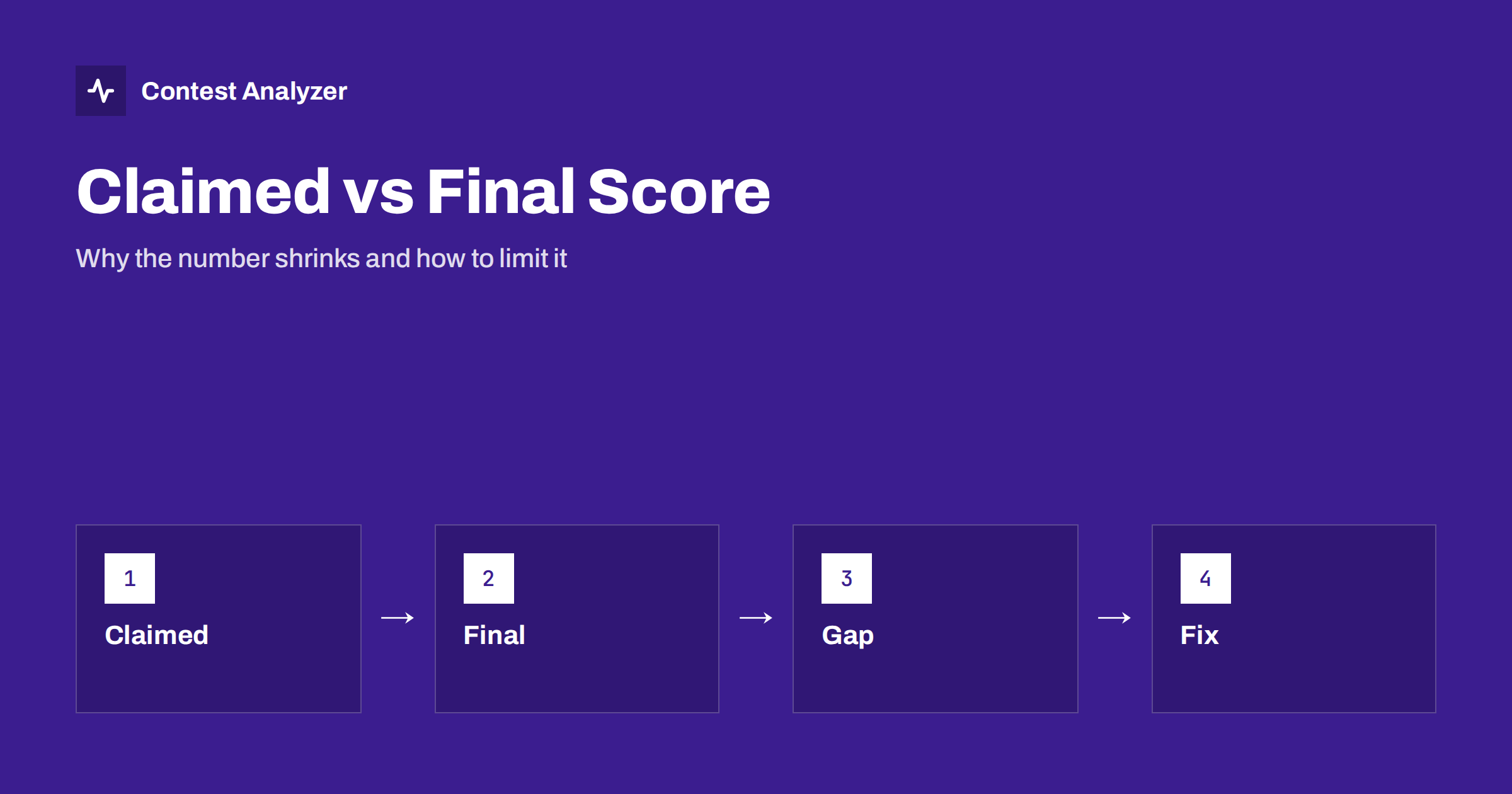
Short answer: The claimed score is what your own logger calculates from your log. The final score is what the contest committee arrives at after checking it. The difference comes mostly from removed QSOs, lost multipliers and rule issues such as wrong category, band or period. You cannot change the committee’s checks, but you can shrink the gap by cleaning callsigns, zones and the header before you send the log.
Two numbers, two different jobs
When you finish a contest, your logging program shows a total. That is the claimed score: the points for your QSOs multiplied by your multipliers, calculated by the program according to the scoring rules it has been set up with. You put it in the Cabrillo header as CLAIMED-SCORE, and it is the number you quote to friends on the Monday after the contest. The header field is explained in the article on the Cabrillo log header.
The final score is a different thing. It is produced by the committee after it has checked your log and applied the rules of the contest. If everything in your log is correct, the two numbers are the same. In practice they rarely are, and the gap between them says something about the quality of the log. Whether a contest publishes both numbers, only the final, or something in between differs from contest to contest, so check the current official rules and results pages.
What makes the final score lower
There are several distinct reasons, and it is useful to keep them apart, because they have different cures.
- QSOs removed because of errors. A busted callsign, an incorrect exchange or a contact that the other station’s log does not support can be removed. The exact treatment, and any extra penalty, depends on the contest. Read the rules rather than assuming.
- Multipliers lost. If a QSO that gave you a country, zone or prefix multiplier is removed, the multiplier may go with it. Because a multiplier is worth many QSOs, this is often the most costly effect of a single error. The article on busted callsigns explains why.
- Dupes. A duplicate contact usually earns no extra points. In most contests this simply means the second QSO is not counted; the details depend on the rules, and the article on dupes in contest logs covers the principle.
- Time and band issues. QSOs outside the contest period, on bands not allowed, or logged in the wrong mode can be removed. A wrong clock in the computer is a frequent cause, as the article on UTC clock errors explains.
- Category and operating rules. Off-time requirements, power limits, assistance and band-change rules can change a result or move you to another category. If you broke a rule, the committee may reclassify the log.
- Late or incomplete submission. A log that arrives after the deadline may be treated as a check log or not counted. Deadlines vary, as discussed in the article on contest log deadlines.
Some contests also apply specific penalties for certain kinds of error. The size of those penalties is a rule of the individual contest and can change, so look them up in the current rules, not in someone’s memory of a past year.
Errors that are yours, and errors that are not
It is useful to ask which part of the gap you could have prevented. Some of it is clearly your own: a callsign you copied wrongly, a zone you logged incorrectly, a dupe you accepted. Some of it is shared: a contact that is not matched by the other station’s log may be their error. And some is outside your control altogether, such as a station that did not send a log, or a rule you did not read correctly.
Separating the categories matters because only the first one is entirely in your hands. If you treat the whole gap as bad luck, you will learn nothing. If you treat it all as your fault, you may waste effort chasing causes you cannot change. Compare the types of removed QSOs, count how many were plain errors on your side, and focus your effort on those.
Errors in your own scoring
There is another source of difference that has nothing to do with the committee: your own logger. The claimed score depends on the logger’s contest definition, its country file, and the settings you chose. If the country file is out of date, a recently changed entity or prefix may be assigned incorrectly. If the contest module has points or multiplier rules that differ from the current year’s rules, the claimed score will differ from the committee’s score even for a perfect log.
Before each contest, update the country file and the contest definition in your logger, check the version, and read the current rules for any changes. The article on setting up N1MM Logger+ for CQ WW shows a typical setup routine. Afterwards, if you find a large unexplained difference between the claimed and final scores, check whether some of it can be traced to the configuration.
A worked way to look at it
Take two imaginary contests to see how the numbers can mislead. In the first, you claim a high score with a long run of QSOs, but the gap to the final score is wide because many callsigns were wrong. In the second, you claim a lower score because you rested more, but the final score is almost the same as the claim. The first operator has the better claimed result and the second has the cleaner log. Which approach is better for the next contest depends on your goals, but the comparison is only possible if you look at both numbers and at the reasons behind the difference. A wide gap that comes from a few multiplier losses calls for different action than a narrow gap that is spread over many small corrections.
It also helps to separate the points lost to errors from the points you never had. A QSO that was removed was once part of your claim; a QSO you never made was never there. Do not let the first drive you to operate more cautiously than the contest requires. The aim is a log that holds up, not a log that is slow.
How large a gap is normal?
There is no universal figure, and anyone who quotes one without naming a contest and a year is guessing. The gap depends on the contest, the band conditions, the mode, the category and the operator. Phone contests with crowded bands tend to produce more disagreement than quiet CW contests; high-rate operators often have more errors in absolute terms than slow ones, though their share can be similar.
What matters is your own trend. Keep a note of the claimed and final scores for each contest you enter, calculate the difference as a percentage, and watch it over several years. If it grows, something in your operating or your logging has changed. If it shrinks, the changes you have made are working. The article on comparing contest results year on year explains how to place these numbers in a fair context.
How to keep the gap small
- Copy carefully and confirm. Repeat the call back and ask for fills. This prevents the single most common cause of removed QSOs.
- Know the exchange. Use the correct zone or other element for the contest and the station. Where a country has split zones, check them.
- Keep the clock right. Set up time synchronisation before the contest and check it during.
- Read the rules. Category, power, bands, off time, and the submission procedure.
- Review the log before you send it. Look at every flagged callsign and zone, and fix what you can.
- Check the Cabrillo. Open the exported file, check the header and a sample of the QSO lines, and make sure the claimed score matches your records.
- Submit on time. Do not leave it until the last minutes of the deadline.
Using a pre-submission check
A pre-submission check can shorten the gap because it catches the errors that you can still fix. Contest Analyzer works with Cabrillo files from N1MM Logger+, DXLog and Win-Test, and checks every callsign and every zone against official license databases and several independent reference sources. It shows only the few QSOs worth a second look, and you can edit callsigns and zones in the report and download a corrected Cabrillo. It supports 22 contests and 25 languages. Serial numbers are not checked, and dupes are not treated as errors.
It is not a prediction of the final score and it does not reproduce the committee’s checks; it simply gives you a chance to find the things you could have found yourself with more time. The step-by-step routine is in the article on checking a contest log before you submit, and plans start at €7 per month plus VAT, as shown on the pricing page.
Related reading
- How to check a contest log before you submit it
- UBN report explained
- Cabrillo log header guide
- Comparing contest results year on year
The bottom line
The claimed score is your calculation and the final score is the committee’s, and the gap between them is a measure of log quality. Part of it you can prevent: careful copying, correct zones, a right clock, a configured logger and a log checked before submission. Track the gap over the years and let the trend, not any single result, tell you whether your habits are improving.
FAQ
Why is my final score lower than my claimed score?
Because the committee removes QSOs and multipliers that fail its checks and applies the rules to your category, band and time. Even with a careful log, some difference is normal.
Do all contests publish the claimed and final scores?
No. Some publish both, some only the final, and the timing differs. Check the contest’s current rules and results pages.
Can my logger give a wrong claimed score?
Yes. An outdated country file or contest definition can assign countries or points incorrectly. Update both before each contest and read the current rules.
How big should the gap be?
There is no standard figure. Track your own claimed and final scores over several contests and look at the trend instead of a single number.
Can I reduce the gap after the contest has ended?
Only before you submit. After that the committee does the checking. A review of the log before submission, for example with Contest Analyzer, is the last practical chance to fix callsigns and zones.