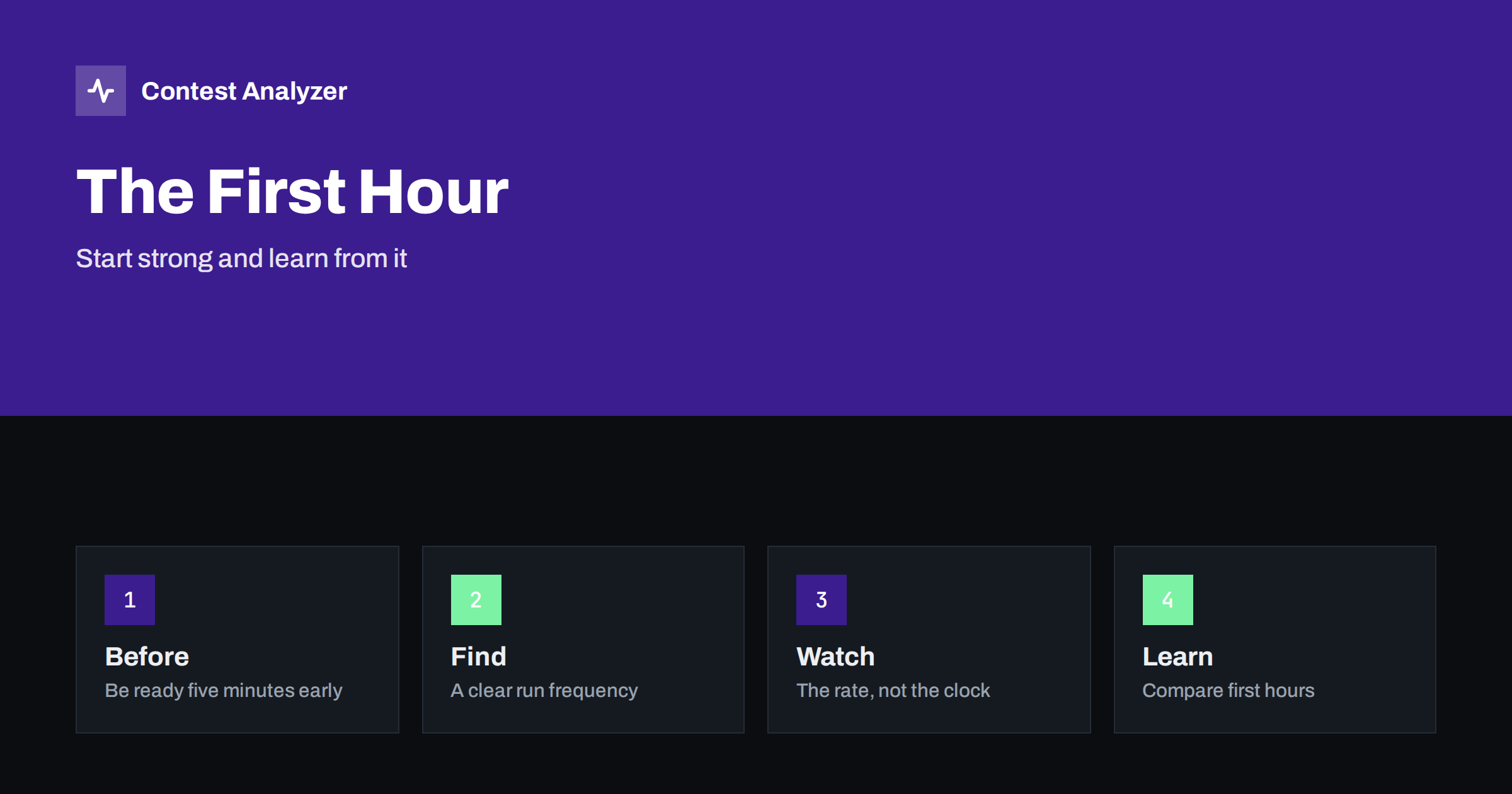
Short answer: The first hour of a contest is not decisive for the final score, but it is the hour in which many operators lose time, because the station, the logger or the plan is not quite ready. A good start means being ready before the clock begins, finding a clean run frequency or a good band quickly and keeping the logging clean. After the contest, the statistics of the first hour show how well the plan worked, and comparing them with earlier years is one of the best ways to improve.
Why the first hour matters
A contest that lasts 24 or 48 hours can seem too long for a single hour to matter. In terms of the final score, this is mostly true: one slow hour can be recovered. But the first hour has a particular importance for two reasons. The first is that the rate of the whole contest often depends on the frequencies and the bands you choose at the start, because a good run frequency, once found and held, can serve for hours. The second is that the first hour is when everything is new: the headset, the keyboard, the antennas and your own concentration are tested at once, and any weakness appears immediately.
Many contesters say that a clean, confident first hour sets the mood of the whole weekend. It is less about the number of QSOs than about the quality of the start.
Be ready before the start
The best way to improve the first hour is to do the preparation earlier. Several things should be done at least an hour before the start, not in the last minutes:
- Logger and contest. The right contest is selected, the exchange fields are correct and your own details, such as the zone or the starting serial number, are set. See the articles on setting up N1MM Logger+ for CQ WW and WPX prefixes as examples of what to check.
- Clock. The computer clock is set and synchronised. A wrong clock is a problem that is easy to prevent and hard to repair later; see UTC clock errors.
- Backup. Automatic backups are on, and the destination works. See backups during the contest.
- Macros and keyer. Messages are loaded, the keyer speed is sensible and the voice memories, if used, are tested.
- Station. Antennas, rotator, amplifier and filters are tested, with a quick listen on every band.
- Comfort. Water, food, light and a chair that you can sit in for hours.
With these things done, the last ten minutes can be used for listening and planning and not for fixing.
The last ten minutes before the start
The last ten minutes are best used for quiet work. Check that the logger accepts a test call and that the first serial number or zone is right, then delete the test entry in the way the logger recommends, so that no dummy QSO is left in the log. Look at the time display once more and compare it with an independent time source. Tune across the bands with the antenna you plan to use first and note where the strongest signals are, because early in the contest the stations that are already on the air tell you where the activity will be. Write the first two or three frequencies on a piece of paper, so that you can move quickly if the first choice is busy.
Decide, too, in advance what you will do in the case of a technical problem in the first hour. If a rotator does not turn or a filter fails, which band is next? A short written plan removes the need to think at the moment when the contest has begun and the pressure is highest. Experienced operators often say that the contest is won in the preparation, and the first hour is the place where this is most clearly visible.
Choosing the band and the frequency
The first hour is also the hour of decisions. On which band do you start? The answer depends on the contest, the time of day and the propagation. If you have experience from earlier years, use it: your own statistics for the first hour, by band, tell you which band gave the best result at that time in the past. If you have no history yet, start on the band that is most likely to be open to the main target area, and listen first.
In the minutes before the start, many operators scan the bands and note which frequencies are quiet. A clear frequency is worth something, because every operator who wants to run will look for one at the start. Once the contest begins, you claim it by calling CQ regularly, and others will keep away if you hold it. If the frequency is not good, for example if a strong neighbour makes it hard to work, do not stay out of stubbornness. Moving a few kilohertz in the first minutes costs less than losing rate for an hour.
The rate in the first hour
Most contesters see the rate rise through the first hour as they settle in. In the first minutes it is common for the numbers to be modest, because stations are still tuning up and moving, and the first calls come slowly. A good run frequency and steady calling will push the rate up. Look at the rate meter, as described in the article on the rate meter during a contest, but do not let it dominate your attention. A rate that is lower than you hoped is not a reason for panic. In the first hour, the goal is to find your rhythm.
The difference between running and search and pounce is also important in the first hour. Some operators begin by running on the best band, others begin with a few minutes of search and pounce to collect multipliers while others are finding their frequencies. The right choice depends on the contest and on you. The article on run versus search and pounce explains how to measure both in your statistics.
Keep the logging clean
Speed in the first hour is tempting, because the stations are many and the rate seems to be a priority. But a few busted calls in the first hour cost as much as in any other hour, and the excitement of the start is exactly when attention is divided. Ask for repeats when the call is not clear, and check each exchange before pressing Enter. The article on busted callsigns is a good reminder of the habits that prevent errors.
What your statistics say afterwards
After the contest, the first hour of your log can be read like a small experiment. Look at the QSOs by band, the rate for each ten or sixty minutes and the time at which the rate settled. How long did it take to reach the level of the second hour? Which band gave the best start? Did you move between bands, and was it worth it? In which direction did the first QSOs come?
Contest Analyzer gives these figures after the review. It checks every callsign and every zone against official license databases and several independent reference sources and shows only the few QSOs worth a second look. Besides that, it provides full statistics, with rates, QSOs by hour and band, countries, continents, CQ and ITU zones, WPX prefixes, distance, beam heading, breaks and off time and callsign length and structure. You can edit calls or zones in the report and download a corrected Cabrillo, and you can compare with your own logs from earlier years. It works with Cabrillo from N1MM Logger+, DXLog and Win-Test, and the 22 supported contests are listed on the contests page. Serial numbers are not checked and dupes are not errors.
Comparing first hours between years
A single first hour is a small sample. Several first hours, from the same contest in different years, are a much better one. Keep a few figures: the number of QSOs, the band on which you started, the rate at the end of the hour and the number of multipliers. When you compare, ask what changed: the bands, the time of day if the contest start was different, the antennas or the way you operated. The method is the same as the one in the article on comparing contest results between years. Over time, you will see how much of the start is due to preparation and how much to conditions.
Do not forget the human side. Some operators are slower at the start, and become faster as the hours go on, and some begin at full speed and tire early. Your hourly statistics, as described in the hour-by-hour analysis, will show your own pattern, and you can plan around it.
Related reading
- The rate meter during a contest
- Hour-by-hour analysis of a contest log
- Contest rates and QSOs per hour
The bottom line
The first hour is a small part of the contest but a large part of your preparation. Be ready before the start, find a good band and frequency quickly, keep the logging clean and do not panic about the early rate. Afterwards, use the statistics of the first hour to compare years and to improve the plan for the next contest.
FAQ
Should I start by running or by search and pounce?
It depends on the contest and your station. Many operators start by running on the best band, others begin with a short search and pounce. Your own statistics will show which works better for you.
How long should I stay on a poor frequency?
Not long. Moving a few kilohertz at the start costs less than an hour of low rate.
Is the rate in the first hour important?
It is a useful sign, but it normally grows as you settle in. Compare it with your earlier first hours, not with the later hours of the same contest.
What should I prepare earlier?
The logger, the clock, backups, macros and the station. Do the checks at least an hour before the start.
How can I compare first hours between years?
Note the QSOs, the band, the rate at the end of the hour and the multipliers each year, and look at what changed.