Short answer: CQ WW DX and CQ WPX are two of the biggest HF contests of the year and they look similar from the outside, but they ask different things from the operator. In CQ WW DX the exchange is a report and the CQ zone, and the multipliers are zones and countries. In CQ WPX the exchange is a report and a serial number, and the multiplier is the callsign prefix. Points, categories and dates change, so use this article as a map and check the current official rules before you plan your weekend.
Two contests from the same family
Both contests are organised under the CQ name, both run for a weekend and both have separate SSB and CW parts, and each has a large international following. Many operators take part in both and keep the same station and the same logger. The similarity ends at the level of the exchange and the idea of the score, and these differences change how you operate, how you log and how you read the results afterwards.
Think of CQ WW DX as a contest about geography: where in the world is the station, in which zone and in which country? Think of CQ WPX as a contest about callsigns: what is the prefix and how many different ones can you collect? The two ideas lead to different strategies, and also to different types of errors in the log.
The exchange
In CQ WW DX the exchange is a signal report and the CQ zone of the station. The zone is not a number you choose; it belongs to the location of the station. In CQ WPX the exchange is a signal report and a serial number that increases with each QSO. The serial number is your own count, so it must be kept in step with your log.
| Point | CQ WW DX | CQ WPX |
|---|---|---|
| Exchange | RST + CQ zone | RST + serial number |
| Main multiplier idea | Zones and countries | Callsign prefixes |
| What you must know | The zone of the other station and your own | Your own serial number and the prefix rules |
| Typical error | Wrong zone, busted call | Wrong or skipped number, busted call |
The consequence for the operator is that in CQ WW you listen for a zone and in CQ WPX you listen for a number. Both are easy to hear when conditions are good and difficult when conditions are poor. See CQ zones explained for the zone side and serial numbers in CQ WPX for the number side.
Multipliers
A multiplier is something that you can count once, band by band or overall depending on the rules, and which multiplies the points from your QSOs. In CQ WW DX, zones and countries are the multipliers, which pushes operators to look for stations in places they have not yet worked, on every band. In CQ WPX, each new prefix counts, which means that you might work a very common station and still gain something if the prefix is new to you, and that special prefixes and unusual calls become interesting.
The details, such as whether multipliers count once per band or once for the whole contest, are set by the current rules. Read them carefully, because they change the strategy: if multipliers count per band, it is worth moving between bands to collect the same zone again, and if they count once, you have to find each one as early as possible and then concentrate on rate. The article on multiplier strategy in CQ WW and the one on WPX prefixes explain the two sides in more detail.
The idea of the points
In both contests, the QSOs give points and the points are multiplied by the number of multipliers. The number of points per QSO depends on the distance between continents or on whether the contact is with the same country, and the table of values is different in each contest. The values are not repeated here because they are part of the rules and can be changed; see QSO points in CQ WW explained for the general approach, and look at the current rules for the numbers. What is useful to remember is that in both contests a contact with a distant station is usually worth more than one with a neighbour, which gives the operator a reason to look for DX instead of working only the local stations.
Differences in operating
- Run frequency and rate. In CQ WPX, the serial number makes each QSO a little longer than a simple report, while in CQ WW DX the zone is a short, known number for the caller. The rate is affected by the exchange and by the type of stations that call you.
- Search and pounce. In CQ WW DX, you are hunting for zones and countries. In CQ WPX, you are hunting for prefixes. The same station can be important in one contest and unimportant in the other.
- Memory. In CQ WW DX you need a good idea of the zone map. In CQ WPX you need a good idea of what makes a prefix. Both are helped by the software, but should be understood by the operator.
- Station preparation. A multiband station with good low-band antennas helps in both, but CQ WW DX has a stronger focus on bands where distant zones can be reached at the right time.
The article on CQ WW DX SSB and the one on CQ WW DX CW cover the preparation of the first contest, and the CQ WPX articles in the series cover the second. Operators who enter both can use the same station notes with some changes.
Differences in logging errors
The kind of mistake changes with the exchange. In CQ WW DX, a wrong zone can be copied correctly but logged wrongly, or the station may be in a country that spans several zones, and the operator guesses. In CQ WPX, a serial number can be mistyped or skipped, or the number you send may not match the one in your log. Both contests share the most frequent error, the busted callsign. If you want a short checklist for each, the articles on busted callsigns and UBN reports are the best starting points.
It is useful to remember that the logging software helps differently in each contest. In CQ WW it can check a zone against a country, and in CQ WPX it can advance the serial number automatically. Neither help replaces the operator’s ear.
Reading the statistics of each
After the contest, the statistics give a different story for each of the two. In CQ WW DX you would look at countries, CQ zones, continents and QSOs by band. In CQ WPX you would look at WPX prefixes, the number of QSOs and the callsign structure, as well as the rate by hour. Contest Analyzer checks every callsign and every zone against official license databases and several independent reference sources and shows only the few QSOs worth a second look. It gives full statistics, with rates, QSOs by hour and band, countries, continents, CQ and ITU zones, WPX prefixes, distance, beam heading, breaks and off time and callsign length and structure. You can edit calls or zones in the report and download a corrected Cabrillo, and compare with your own logs from earlier years. It works with Cabrillo from N1MM Logger+, DXLog and Win-Test, and the contests page lists the 22 supported contests. Serial numbers are not checked and dupes are not errors, so in CQ WPX the numbers remain your own responsibility.
Which one to choose
If you like geography and long-distance work, and you have good antennas for the low bands, CQ WW DX will give you a lot to do. If you like callsigns, if you enjoy a fast rate with many stations and if you want a contest in which a modest station can still gain by finding new prefixes, CQ WPX can be more attractive. Many contesters enjoy both, and treat one as the main event of the season and the other as a second chance. Whichever you choose, read the current rules at the CQ WW rules page or the CQ WPX rules page, because that is where dates, categories and scoring are kept up to date.
Related reading
- CQ zones and CQ WW explained
- WPX prefixes as multipliers
- QSO points in CQ WW explained
- Multiplier strategy in CQ WW
The bottom line
CQ WW DX is a game about zones and countries, and CQ WPX is a game about prefixes and serial numbers. They share the same family name, the same long weekends and the same enemy, the busted callsign, but they ask the operator to listen for different things and to plan differently. Know the exchange and the multipliers of the one you enter, check the current rules and review your log after the contest.
FAQ
Which contest is easier for a beginner?
Both are suitable. CQ WPX has a simpler exchange for many people, while CQ WW DX requires knowing zones. Choose by the time you can spend and your antennas.
Is the scoring the same?
The principle is the same, points multiplied by multipliers, but the values and the multipliers are different. Check the current rules for the details.
Do the same loggers work for both?
Common loggers such as N1MM Logger+, DXLog and Win-Test normally support both. Select the right contest before the start.
Which has the log deadline of 48 hours?
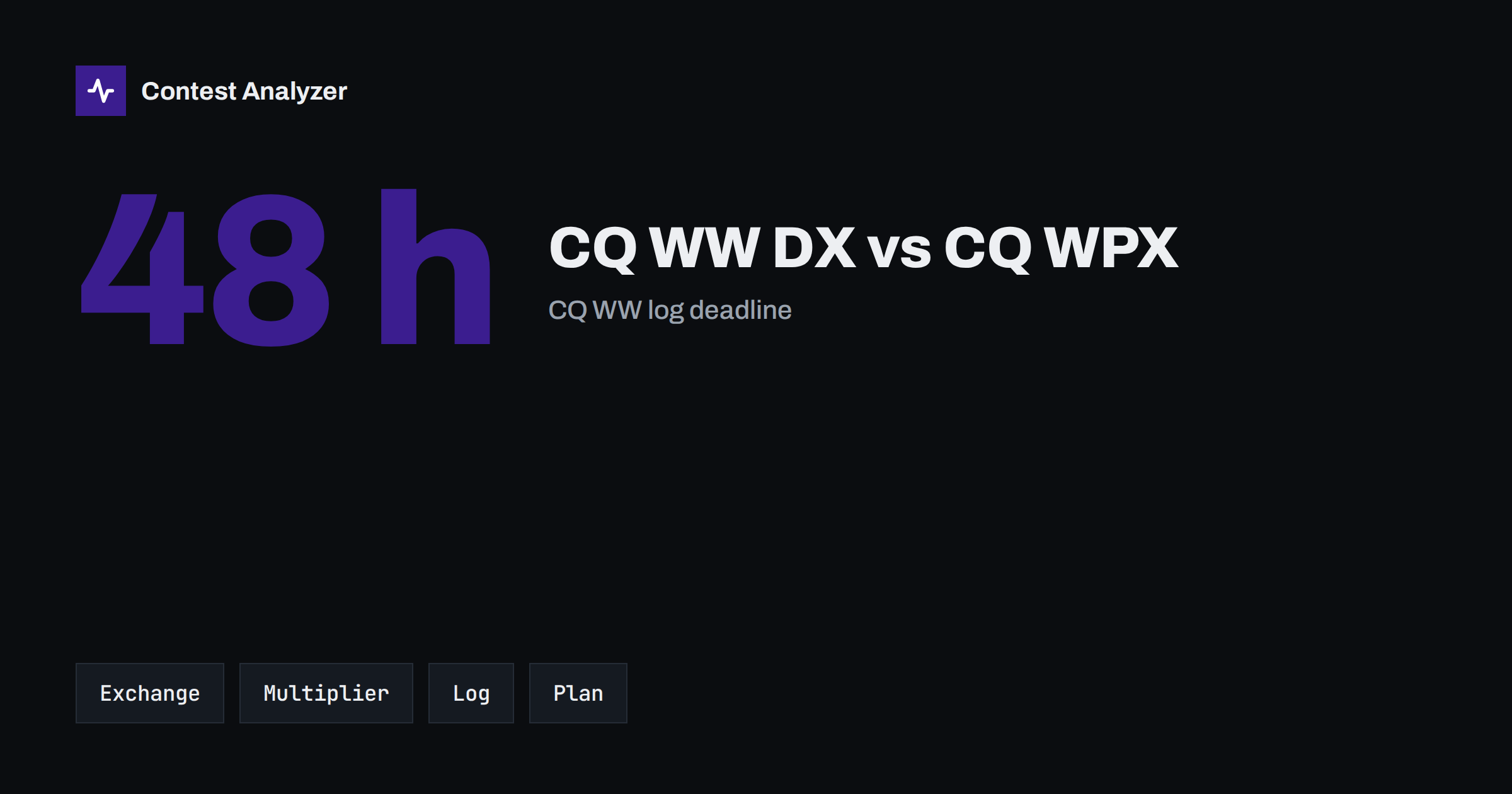
For CQ WW the current rule is 48 hours after the end of the contest. For CQ WPX and others, check the current rules.
Can Contest Analyzer be used for both?
Yes, both are among the supported contests; see the contests page for the full list.