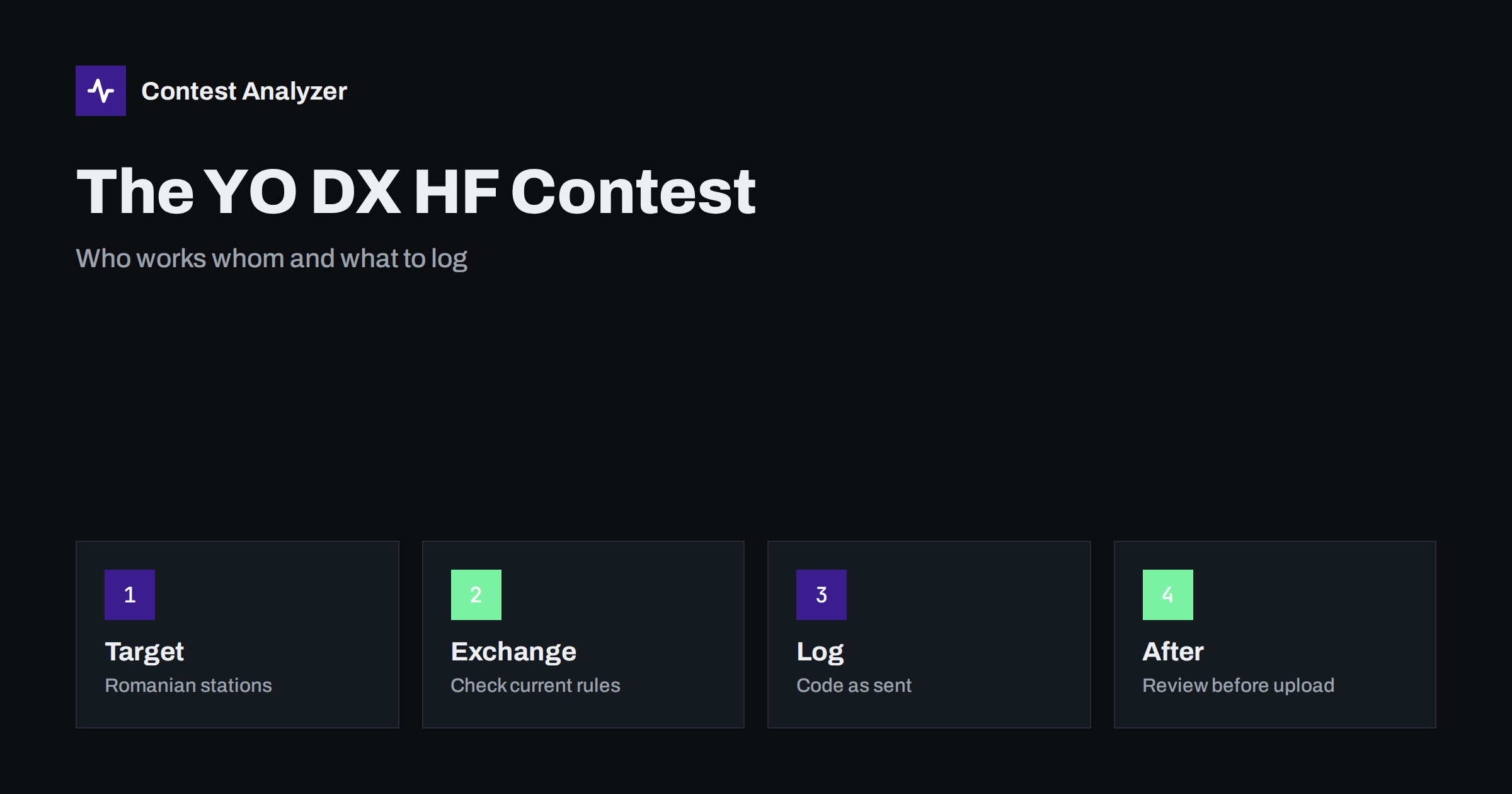
Short answer: The YO DX HF Contest is an international HF event in which Romanian stations are the main target for the rest of the world. In general terms, stations in Romania send a county code and everyone else sends something different, usually a serial number, but the exact exchange, the bands, the modes and the categories must always be checked in the current official rules. The practical advice is simple: log exactly what you hear, learn the county codes before the contest starts and review the log before you submit it.
What kind of contest it is
The YO DX HF Contest belongs to the group of contests organised by a national society to bring activity to its own country. The organisers invite stations from all over the world to work Romanian stations, and the Romanian stations work each other and the visitors. For a contester outside Romania, this makes the event a convenient chance to collect a large number of new contacts with one country, and for many operators it is also a chance to pick up multipliers that are tied to Romanian regions.
It is not one of the giant weekends where thousands of stations fight for a place in the top ten, so the pace is usually more relaxed. That is an advantage for logging: there is time to ask for a repeat, to check a code and to write down what you really heard. It is also a good contest for practising habits that you will need in a bigger event later in the season.
Who works whom
As in many national contests, the rules distinguish between home stations and visitors. The usual principle is that Romanian stations can work everybody, while stations in other countries are expected to work Romanian stations. Whether contacts between two non-Romanian stations count, and whether Romanian stations may work each other for points, is a question for the current rules. Do not rely on a memory of an older year: such details are exactly the kind of thing that organisers adjust from time to time.
Before you begin, read three things in the rules. First, which stations count as valid contacts for your category. Second, which bands and modes are allowed and whether the contest has separate parts. Third, whether a station can be worked again on another band or another mode and still count. The answers decide how you plan the weekend and how your logger should be set up.
The exchange in general terms
The idea behind the exchange is that the Romanian stations send a code that tells you the county they are in, while the visiting stations send a report with a number. The county code is what makes the contest interesting for multiplier hunters, because the number of different counties you work can be part of the score. The details, such as the format of the code, the way the report is sent and the way the result is calculated, are set in the current rules. Check them well before the start, and print or save the page, so that you can look at it during the contest.
When you are logging, remember that the exchange is not only a formality. A county code is a short group of letters. It is easy to mishear, easy to mistype and, in a pile-up, easy to fill in from memory because you “know” the station. If you ask the operator to repeat the code once, it costs a couple of seconds. If you log it wrongly, you may lose the QSO or the multiplier.
Learning the county codes
A short list of the Romanian county abbreviations, taken from the official rules, is worth keeping next to the keyboard. You do not need to memorise all of them, but you should be able to recognise the common ones quickly and to see when something you typed does not exist. Many loggers can check the exchange against a list that is built in or loaded from the contest settings, and they will warn you if the code is not in the list. Use this help, but do not trust it blindly: a code can exist and still be the wrong one for that station.
- Write the code as it is sent. Do not correct it from your own knowledge of where the station should be located. A station may operate away from its home address.
- Listen to the full exchange. If the operator sends the code twice, use the second repeat to confirm the first.
- Use the same format every time. Capital letters, no extra spaces and no punctuation make the Cabrillo file cleaner.
- Keep a note of codes you were unsure of. It saves time in the review after the contest.
Logging tips for the contest
The same habits that work in any contest apply here. Set the contest in your logging software before the start, check that the exchange fields match the rules and make a short test with a few made-up QSOs to see how they appear in the exported file. If you use the logger of your choice, such as N1MM Logger+, DXLog or Win-Test, look for the contest in the list of supported events, and if it is not there, check whether a user-supplied definition is recommended by the programme’s documentation. Do not improvise a configuration in the last hour before the start.
Keep the clock correct, because the time of every QSO is part of the log. A wrong clock can make a QSO fall outside the contest period, or can make a good QSO look like a mismatch for the other station’s log. The article on UTC clock errors explains what to check. If you are interested in how serial numbers should be sent and logged in a contest that uses them, read serial numbers in CQ WPX, as the principles are the same.
Common slips
- A wrong county code. The code is copied from memory, from a call history or from the previous QSO, not from the exchange just heard.
- A shifted serial number. The number you send is not what the logger shows, usually because of a QSO that was deleted or logged late.
- A busted call. One letter wrong in a callsign. The article on busted callsigns gives habits that reduce them.
- The wrong category. An operator who used help from outside decides to enter as unassisted. See assisted and unassisted categories.
- A missing header field. The Cabrillo header has a wrong or empty field. The article on the Cabrillo header lists the fields.
Reviewing the log before you submit
After the contest, give yourself a little time. Export the Cabrillo file from your logger, open it and look at the first lines, the number of QSOs and a few lines in the middle. Then run the review. Contest Analyzer checks every callsign and every zone against official license databases and several independent reference sources and shows only the few QSOs worth a second look. It also gives full statistics, including rates, QSOs by hour and band, countries, continents, CQ and ITU zones, WPX prefixes, distance, beam heading, breaks and off time and callsign length and structure. You can edit calls or zones in the report and download a corrected Cabrillo, and compare with your own logs from earlier years. It works with Cabrillo from N1MM Logger+, DXLog and Win-Test. Serial numbers are not checked, so the exchange fields still need your own attention, and dupes are not treated as errors. The list of supported contests shows which of the 22 contests are covered, and it is worth checking it before you upload.
For the step-by-step routine, see how to check a contest log before you submit it. When you are ready to send the file, read the notes on submitting a Cabrillo log and the information on log deadlines, because each contest sets its own date.
What to learn from the numbers
A national contest of this kind is a good place to learn something about your station. Look at the QSOs by band and by hour, at the continents and at the beam heading. Which band gave the best rate? When did you work most of the Romanian counties? Did you lose time on a band that was empty? Compare the figures with your result in the next national contest, and keep the notes. The articles on band strategy by hour and contest goals from statistics show how to turn the numbers into a plan.
Related reading
- How to check a contest log before you submit it
- Russian DX Contest: oblast codes and serial numbers
- Contest log deadlines and how to meet them
The bottom line
The YO DX HF Contest rewards operators who listen carefully and log what they really hear. Learn from the current rules who works whom and what the exchange is, keep the county codes close at hand and ask for a repeat when a code is in doubt. After the contest, review the log and the statistics before you submit, and keep your notes for next year.
FAQ
Is the exchange the same for every station?
Usually not. In general, Romanian stations and visitors send different things, but the exact exchange is set in the current rules, so check them before you start.
Do I have to know all the county codes?
No, but a list from the official rules next to your keyboard helps you to recognise codes quickly and to ask for a repeat when something sounds wrong.
Can I work the same station on several bands?
Many contests allow it, and each band counts separately, but the rules decide. Read the section on valid contacts and dupes in the current rules.
Does Contest Analyzer check the county code?
It checks callsigns and zones against official license databases and several independent reference sources. Serial numbers are not checked, so check the exchange yourself.
Where do I find the dates and the log deadline?
On the organiser’s official page for the current year. Dates and deadlines change, so do not rely on older information.