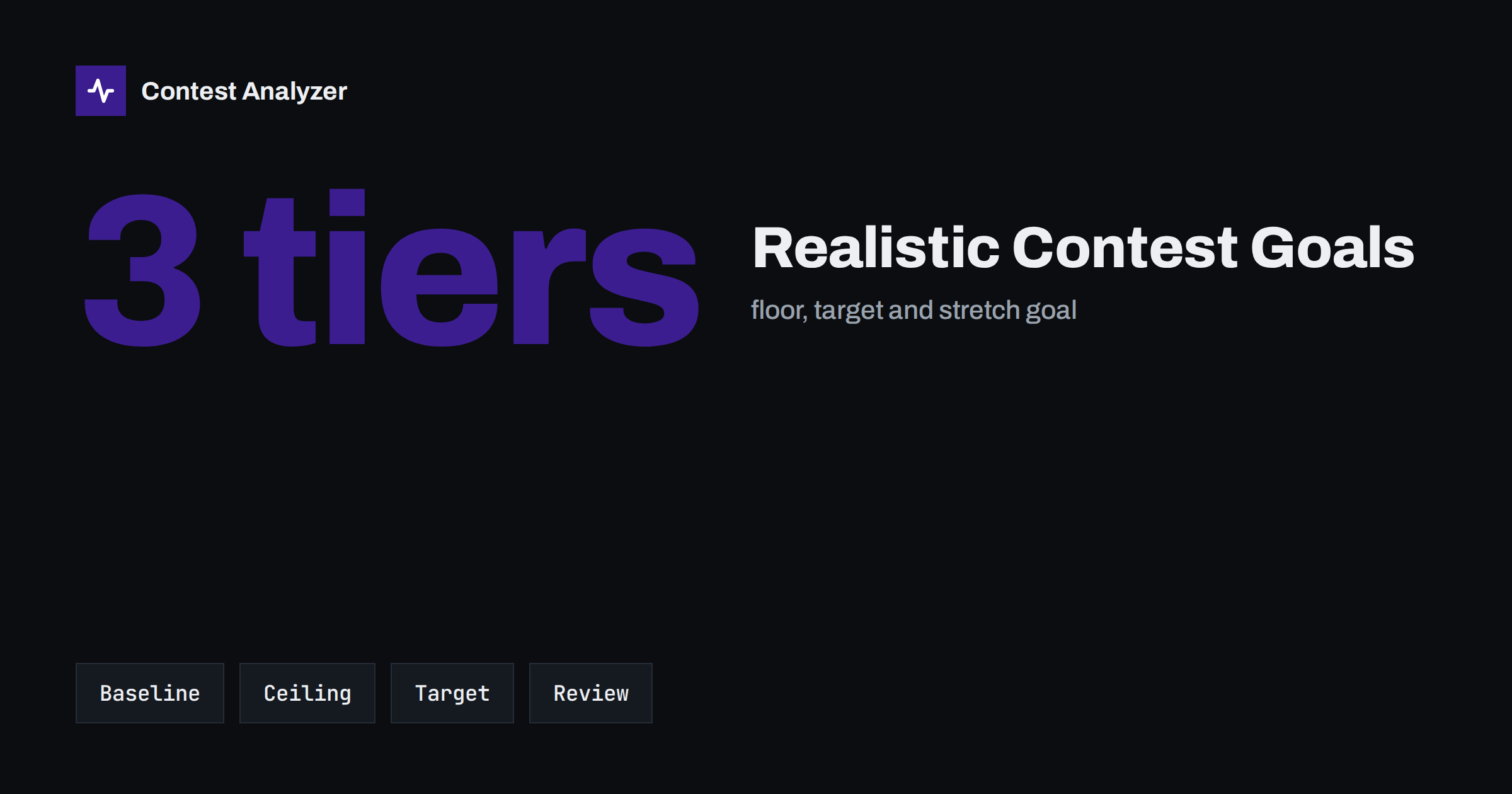
Short answer: A realistic contest goal starts with last year’s numbers, not with a score you would like to see. Take your QSOs, multipliers, hourly rates and hours operated as the baseline, look at your best hours to see what your station can do, choose one or two specific changes, and write down a floor, a target and a stretch goal. Compare the same numbers after the contest and allow for propagation.
Why a score is a poor goal
“I want to beat last year’s score” sounds like a clear goal, but it hides several things you do not control. The score depends on solar conditions, on how many stations are on the air, on the weather at the antenna and on the hours you can spare. If the bands are better, you may beat last year without doing anything differently. If they are worse, you can operate better and still score less.
A good goal is one that you can influence and measure. That generally means goals about what you do, such as the number of hours you operate, the rate in your best hours, the number of multipliers on a particular band or the number of doubtful callsigns in your log. Results then follow from the process, and you can see which part of the process worked even if the score does not tell the story.
Step 1: build the baseline
Open the statistics of your last contest of the same type (same contest, same mode, same category if possible) and write down a short list of figures.
- Total QSOs and the number of hours you actually operated, taking breaks and off time into account.
- Average QSOs per operating hour, and your best 10-minute and 60-minute rates.
- Multipliers per band and in total.
- QSOs by band, and by hour.
- Continents or countries worked, depending on the contest.
- The number of QSOs that were questioned or corrected in your review, as a percentage of the total.
If you have the logs of two or three years, put them side by side. The article on comparing contest results year on year explains how to make the comparison fair. If you have only one year, that is fine: it will be your baseline and the next contest will be the first comparison.
Step 2: find your ceiling
The baseline tells you the average. To set a goal you also need an idea of what is possible at your station, which is shown by your best hours. Look at the hour with the highest rate and ask what was special about it. Was it a good band opening? A long run on a single frequency? Was it in the early hours of the contest, when activity is greatest? The article on contest rates shows how to read these peaks.
The ceiling is not a target for every hour, because your best hour benefits from conditions that will not last. But it tells you what is physically possible with your antennas, your power and your operating skill, and it keeps your target honest. If the best hour produced a given number of QSOs, a goal of doubling the average across the whole contest is unrealistic. A goal of raising the average by lifting the weak hours towards the middle is not.
Step 3: find the biggest gap
Next, look for the place where the distance between your average and your ceiling is greatest. A few typical places to find it:
- Weak hours. If the hours at a certain time of day are far below the others, they may be the best target: a different band, a different strategy or a planned rest. The article on band strategy hour by hour shows how to read the QSOs-by-hour and band view.
- Unused bands. A band with very few QSOs is worth a look. Was propagation poor, or did you just not go there?
- Multipliers. If your multiplier count is low for your QSO count, a deliberate multiplier hunt could add more than extra QSOs.
- Accuracy. If many QSOs were flagged in your review, a target to reduce them by a certain share is often the cheapest gain. The article on UBN reports shows what such errors cost.
- Operating hours. If you stopped early, simply adding a few hours may be the largest improvement available.
Choose the one or two gaps that matter most and that you can do something about.
Step 4: write the goals as three levels
Instead of a single number, write three: a floor, a target and a stretch. The floor is what you expect if conditions are poor or life interferes. The target is what you expect if things go normally. The stretch is what is possible if everything goes right. Three levels have two advantages. They prepare you for the range of outcomes, and they stop a poor propagation weekend from feeling like a failure when you have in fact met the floor.
An example, using invented figures only to show the form: suppose last year you operated for 30 hours and your average was 80 QSOs per hour with a weak stretch in the small hours. A set of goals might be: floor, the same hours with the same average; target, add the multiplier count on one band by visiting it at a time when it opened last year; stretch, lift the average in the weakest block by shifting rest there. These goals are tied to what you saw in the log, and each can be checked afterwards.
Goals that are about accuracy and habits
Not all goals need to be about rate and multipliers. Process goals are valuable, particularly in the first years of contesting. For example:
- “Ask for a fill whenever I am unsure of a suffix.”
- “Have fewer corrections in the pre-submission review than last year.”
- “Take the planned rest, even if the rate is good.”
- “Submit the log within a day of the contest ending.”
These goals are modest, specific and in your control. They also feed the main numbers: fewer errors raise the final score, a planned rest improves later hours, and an early submission leaves time for the checks. Deadlines differ by contest, as the article on log submission deadlines explains.
Allow for conditions
The largest uncontrollable factor in HF contesting is propagation. Solar activity changes the bands from year to year and from weekend to weekend, and a comparison that ignores this can be unfair to you or to your station. When you review a contest against your goals, take into account what the bands did. The article on solar flux and contest results explains how to do that without over-reading the numbers. One way is to focus on relative measures, such as QSOs per hour compared with your own best hours that year, rather than on absolute totals alone.
Keep the goals visible
A goal that lives only in your head tends to be forgotten at three in the morning. Write the floor, target and stretch levels on a card and put it where you can see it from the operating position. Add the two or three process habits next to them. During the contest you do not need to check the numbers constantly, and a glance every few hours is enough to notice whether you are on course. If you are far from the floor early on, that is a signal to change something now, while there is still time.
Review after the contest
The review closes the loop. Within a few days of the contest, while you still remember it, compare the same list of figures against the baseline and against your goals. Note what you reached, what you missed and why. Write two or three sentences for the notebook: “Rest in the early hours worked; the 15-metre visit paid off; the error rate on the last evening was higher than I wanted.”
Contest Analyzer supplies the figures for this review. From a Cabrillo file from N1MM Logger+, DXLog or Win-Test, it gives full statistics: rates, QSOs by hour and band, countries, continents, CQ and ITU zones, WPX prefixes, distance and beam heading, breaks and off time, and callsign length and structure. It compares with your own logs from earlier years. It also checks every callsign and every zone against official license databases and several independent reference sources and shows only the few QSOs worth a second look, so the accuracy figures are easy to track. Serial numbers are not checked and dupes are not shown as errors. The pricing page lists plans from €7 per month plus VAT.
Related reading
- Comparing contest results year on year
- Contest rates: QSOs per hour
- Band strategy hour by hour
- Solar flux and contest results
The bottom line
Good contest goals come from last year’s data: a baseline, a ceiling from your best hours, a gap you can address, and a floor, target and stretch level for each. Add some process goals about accuracy and habits, allow for propagation, and review with the same numbers afterwards. Small, specific improvements repeated each year add up to a result that no single big goal can promise.
FAQ
Should my goal be to beat last year’s score?
It is a poor goal on its own because propagation and activity change the score. Use measurable goals about hours, rates, multipliers and accuracy, and read the score in that light.
How many goals should I set?
One or two main goals and a few process habits. More than that spreads attention thin during the contest.
What if I have only one previous log?
Use it as the baseline. The next contest will give you the first real comparison, and the figures will be more useful each year.
How do I allow for bad propagation?
Compare relative figures, such as your rate in an average hour against your best hours of the same contest, and keep a floor goal that you can reach even in poor conditions.
Which statistics are best for setting goals?
Hours operated, QSOs per hour, best-hour rates, multipliers per band, QSOs by hour and band, and the share of QSOs corrected in the review.