Short answer: In CQ WW DX a QSO is worth different points depending on where the other station is compared with you: the same country, the same continent or a different continent. The current rules also treat North America specially. The pattern is that distant contacts are worth more than near ones, and contacts in your own country add nothing to the points, although they can still be multipliers. The exact values belong to the official rules of that year, so confirm them at the sponsor’s website before you plan.
Points and multipliers are two different things
The CQ WW score has two parts, and every strategic decision comes from how they relate. The first part is QSO points, which you earn for each valid contact according to its type. The second part is the multiplier, which counts the number of different zones and countries you worked on each band. The final score is the sum of the QSO points multiplied by the sum of the multipliers.
That formula explains why a single contact can matter in two ways. It adds points, and if it is the first time you have worked that zone or country on that band, it also adds one to the multiplier count. A contact with a very rare country on a new band can lift the score more than ten ordinary contacts, even if the QSO itself is worth only a few points. This is the reason why QSO points and multipliers have to be read together and why multiplier strategy is a topic of its own.
The three kinds of contact
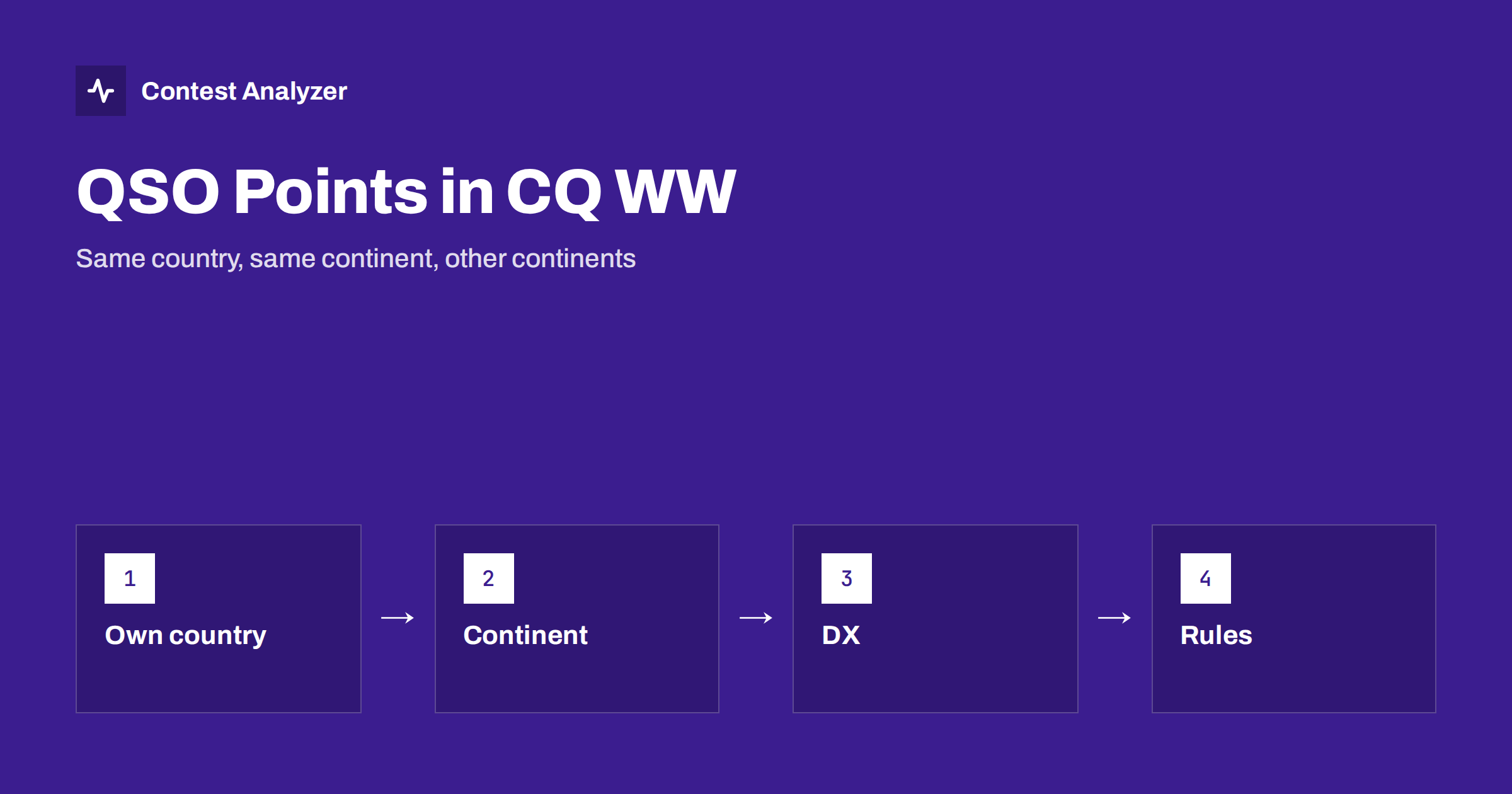
For the point values, think in three groups, defined by where the other station is relative to you. In the rules that have been in use for many years, the principle is as follows. Please treat the numbers as an orientation and look them up in the current text on the CQ WW rules page.
- Same country. A contact with a station in your own country is worth no QSO points. It is still a valid QSO, and it can count as a zone or country multiplier if that zone or country is new on that band, which is very relevant in countries that contain more than one zone.
- Same continent, different country. This is worth a small number of points. In North America the rules traditionally give more points to a contact with another North American station than to a contact within other continents.
- Different continent. This is the most valuable type and normally earns the highest number of points per QSO.
Notice what this does to the idea of what counts as a good contact. A very strong signal from a neighbour two hundred kilometres away has limited value, while a weak signal from another continent is worth several times more. The same effect appears in the way propagation is used: on a day when the band is long, the high-value QSOs are easy to find and the rate may stay high; when the band is short, you earn fewer points per hour even if the number of contacts per hour is the same.
Why the continent rule matters for your location
The same rule gives different results depending on where you are. A station in Europe has many other European countries close by, which are worth only a small amount each, and has to reach across the ocean for the high-value contacts. A station in North America has a different mix. A station in a more isolated place has most of its contacts on other continents, and its average number of points per QSO is higher.
This is the reason why comparing raw QSO counts between stations in different parts of the world does not tell you much, and it is also why the average points per QSO is an interesting figure in your own log. It tells you how much of your activity came from valuable contacts, and it can be compared from one year to the next. You can read how to do this in the article on comparing contest results between years.
What this means for strategy
Understanding the point structure leads to some practical consequences.
- Do not stop running because the callers are near. A near caller still counts as a QSO, and for the multiplier count a near station may be the only one from a particular zone. But if your goal is points, a caller on a distant continent is worth more, so know when the band is open in that direction.
- Use the high-value hours. The hours when the long paths are open give the best points per hour. These depend on the band and the season. The article on band strategy by hour shows how to read them from your own log.
- Weigh a rate against its value. Eighty contacts with nearby stations in an hour can be worth less than fifty with stations on other continents. A rate meter that counts only QSOs hides this difference.
- Use the same-country QSOs for multipliers. If your country has several zones or if the neighbouring stations are in different zones, a contact in your own country can still be needed. Check your zone and country map before you decide that a nearby station is of no use.
- Do not neglect the new multiplier on a new band. The same zone or country is counted again on every band, so a station you worked on 20 metres may be needed again on 15 metres.
Dupes, invalid QSOs and what the points rule does not forgive
The point value is attached to a valid QSO. A contact that is a dupe on the same band is not counted again, and a contact with a busted callsign or a wrong exchange may be removed or penalised under the rules, so you lose both the QSO points and the multiplier if it was one. Because the highest-value contacts are the most distant ones, and distant signals are usually the weakest, they are also the ones most likely to be copied wrongly. A QSO that is worth the most is also the one that most deserves a repeat or a fill. See the article on busted callsigns for the usual causes.
Dupes themselves are not errors; they are simply contacts that do not score again, and the rules tell you whether you need to log them. The guide to dupes in contest logs goes through the practical side.
Reading your own log for points per QSO
After the contest it is useful to look at how your points were built. You can answer questions like these from the log:
- How many of my QSOs were with my own country, my own continent and other continents?
- On which bands and in which hours did the highest-value contacts come?
- Did I use the best hours for distant contacts, or did I spend them on near ones?
- How does my average points per QSO compare with last year?
Contest Analyzer can help with the second and third question, since it gives a breakdown by hour and band, by continent, by country and by CQ and ITU zone, and it adds distance and beam heading statistics. You can compare the result with your own logs from earlier years. At the same time it checks every callsign and every zone against official license databases and several independent reference sources and shows only the few QSOs worth a second look. You can edit the calls or zones in the report and download a corrected Cabrillo before you send it to the contest. The tool works with Cabrillo from N1MM Logger+, DXLog and Win-Test, and the contest list shows the 22 contests it supports.
Check the rules every season
Point values, the treatment of different continents and the multiplier definitions are part of the contest rules, and rules can be revised. Also note that the SSB, CW and RTTY parts of CQ WW are separate contests with their own rules pages, even though they share a general structure. Read the page for the mode and year you are entering, and keep a copy of the version you used.
It is a good idea to check the points and multiplier rules at the same time as you check the exchange and the log deadline. The checklist in the CQ WW DX SSB article is a good place to start, and the CW version of it is in the CQ WW DX CW checklist.
Related reading
The bottom line
QSO points reward distance, and multipliers reward variety. The two work together in the CQ WW score, and a good plan uses both: a steady supply of valuable contacts and a deliberate hunt for new zones and countries on each band. Get the numbers from the current official rules, read your own log by continent and band after the event and let that decide how you spend the best hours next time.
FAQ
Do contacts within my own country count in CQ WW?
They are valid QSOs, but under the long-standing rules they give no QSO points. They can still count as multipliers if the zone or country is new on that band.
Why are North American contacts treated differently?
The rules traditionally give them a separate value for same-continent contacts. Check the current rules for the exact numbers.
Is a multiplier worth more than a QSO?
The score multiplies QSO points by the number of multipliers, so a new multiplier raises the whole total. How much it helps depends on how many of each you already have.
Do the point values change between SSB and CW?
The structure is generally shared, but each mode has its own rules page. Always read the current text for the mode you enter.
Can I see how my points were distributed?
Yes. A continent and country breakdown of your log shows how many QSOs came from each group, and a year-on-year comparison shows whether the mix improved.