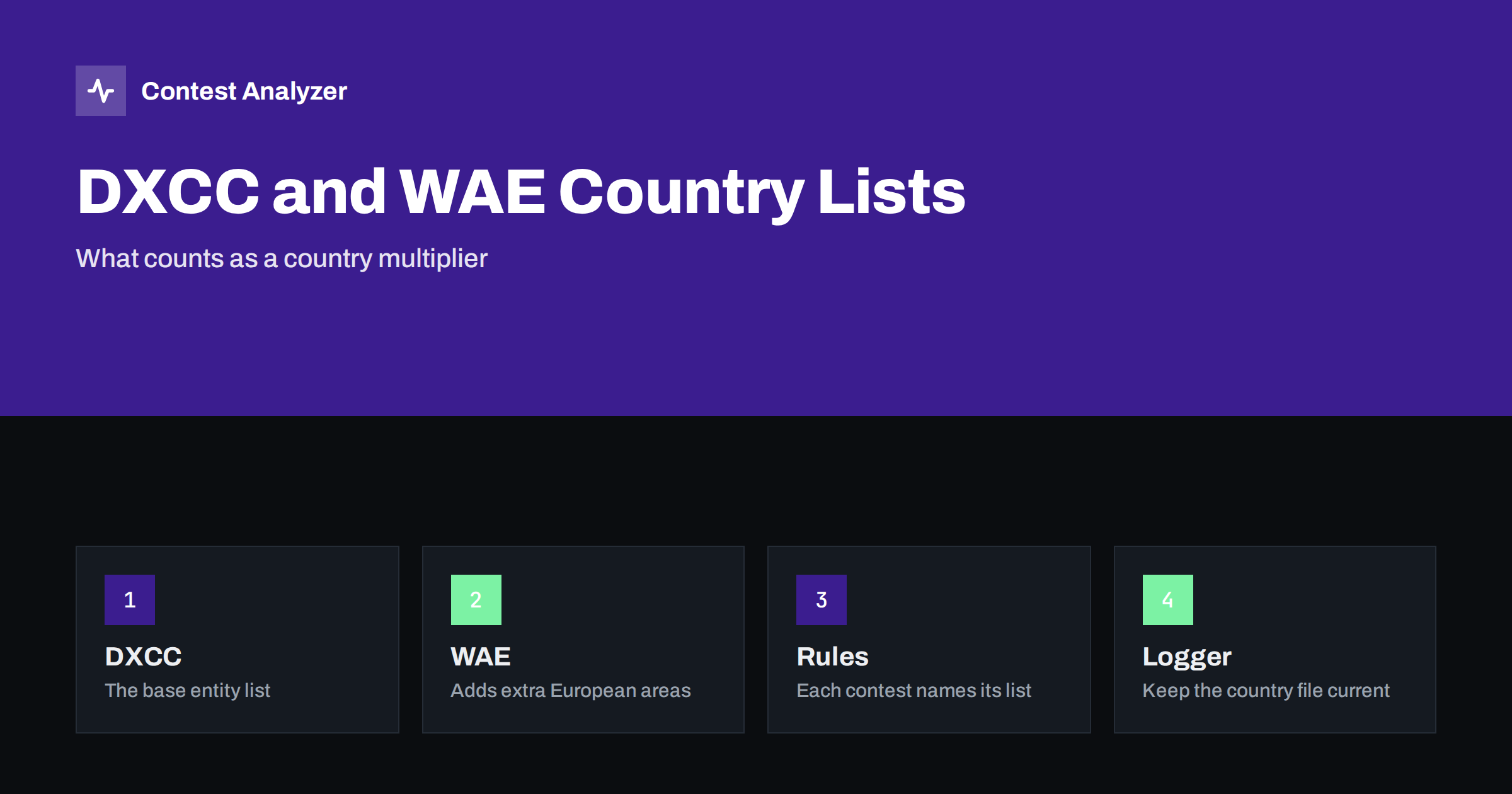
Short answer: In most HF contests a “country” is not a political state but an entity from a published list. The base is the DXCC list. CQ WW DX also uses the WAE country list, which adds a number of areas that are not separate DXCC entities, mostly in Europe. Which list applies is written in each contest’s rules, so confirm it for the contest and the year, and keep the country file in your logger up to date so that the prefix lookup agrees with the list the contest uses.
Why a contest needs a country list
Many contests award a multiplier for each country worked, either once per contest or once per band. For that to be fair, every participant must agree on what a country is. Political maps do not help, because a small island territory can be a separate entity for radio purposes while belonging to a larger state, and a large state can be one entity or several. So sponsors refer to a list maintained by somebody else.
The most widely used one is the DXCC list. It names the entities on which countries are counted in the DXCC award programme, with a set of criteria for what makes a place count as its own entity, such as geographical separation or a particular legal status. When a contest says “countries according to the DXCC list”, it means that list in its current form.
The second list that matters in the world of HF contests is the WAE list. It originates from the Worked All Europe award, and it is related to the DXCC list but differs from it in a few places. For contest purposes, its main role is in contests that choose to include it, with CQ WW DX being the best-known example.
What the WAE list adds
The WAE list contains the DXCC entities in Europe and, in addition, a small number of areas that are not DXCC entities of their own. These are generally parts of a larger entity that are treated separately because of geography, for example islands or regions that are well known to European operators. The WAE list also contains entries which, for the purposes of the Europe award, are treated differently from the DXCC list.
The exact entries, their prefixes and the details of the differences are not something to learn from an article. They are published by the organisations that maintain the lists, and they are included in the country files that logging programs use. The practical point is this: when a contest includes the WAE list, there are extra multipliers available in Europe, and the extra areas are only counted if the rules of that contest say so. Contests that do not mention the WAE list do not use it.
Because the extra WAE entries sit inside larger DXCC entities, a station in such an area counts for the larger entity as normal, and in a contest that uses the WAE list it may also provide an additional country multiplier. How exactly this is counted, for example whether it is once per band, is part of the rules. Do not guess it from memory; read the section of the rules on multipliers.
Which contests use which list
This is where care is necessary, because rules are updated and this article is not a rule book. In general terms:
- CQ WW DX uses a country list that is based on the DXCC list together with the WAE list. Read the multiplier section of the current rules for the exact wording.
- The WAE DX Contest is built around the WAE list, because that is the point of it. Our article on WAE DX and QTC traffic covers the contest itself.
- CQ WPX does not use a country multiplier; its multiplier is the prefix, which is a different thing. See WPX prefixes explained.
- Other contests may use the DXCC list, a variant of it, or their own list of areas. The ARRL DX Contest, for instance, has its own definition of who counts for whom. Look at the contest’s rules every time.
If you operate in several contests in the same season, write down for each one: the list, whether multipliers are counted per band, and any special additions or exclusions. A one-page note saves a lot of confusion when you plan, and when you read your log afterwards.
How a logger uses the list
You do not look up countries by hand during the contest. Your logging program does it for you, using a country file, often distributed in the format known as CTY, that maps callsign prefixes and exceptions to entities and zones. When you type a call, the program shows the country, the continent and the zone, and it marks a call as a new multiplier if it has not been worked on that band.
That is convenient, and it is also a point where errors enter the log. The country file is a snapshot. New entities are added, old ones are deleted and prefixes change. If your file is old, the program may give the wrong country for a new prefix or for a call from a place whose status has changed. Updating the country file before every important contest is therefore a basic habit, and the steps for N1MM Logger+ are in the article on setting up N1MM Logger+ for CQ WW.
Also check that the file you use reflects the list the contest uses. Some country files contain extra entries or flags for the WAE areas, and some programs have an option to treat them as separate multipliers for contests that need it. Find that setting, and check it against the contest rules. If you do not use a program with WAE support, you can still log the QSO normally; the question is only whether your live multiplier counter shows what the sponsor will count.
Where mistakes come from
- An outdated country file. A new prefix is shown as the wrong country, so you believe that you have worked a multiplier that you have not, or you overlook one that you have.
- A call that does not tell the truth. A station may sign with a prefix that belongs to a different place than the one it is in. The contest follows its rules for how to count such calls, and the logger follows the prefix. See the article on portable and maritime stations for the typical cases.
- Mixing up lists. You assume that a DXCC entity is a country in a contest that uses another list, or the opposite. This changes the multiplier count and the way you think about which stations are worth chasing.
- Mixing up countries with zones. A country multiplier and a zone multiplier are two different counts. The article on CQ zones explains the zone side.
- Trusting a live count without a final check. The logger’s multiplier counter is a guide. The sponsor counts according to the rules and the log you send.
Reading countries in your results
After the contest, the country list is useful for analysis. Looking at which countries you worked on each band, and which you missed, tells you about propagation and about your own habits. Did you ignore a group of rare multipliers because the pile-up was too strong? Did you work the same few entities on every band and miss others that were available? The article on multiplier strategy in CQ WW shows how to read these numbers.
Contest Analyzer shows the countries, continents and CQ and ITU zones of your log in its full statistics, together with rates, QSOs by hour and band, WPX prefixes, distance and beam heading. It also checks every callsign and every zone against official license databases and several independent reference sources and shows only the few QSOs worth a second look. You can edit calls and zones in the report and download a corrected Cabrillo. It works with Cabrillo from N1MM Logger+, DXLog and Win-Test for the 22 contests on the list.
A short preparation list
- Read the multiplier section of the current rules and note the list that applies.
- Update the country file in your logger a few days before the contest.
- Check the logger’s contest settings for any option about additional areas or per-band counting.
- Test a handful of calls from unusual places and see what the logger displays.
- After the contest, compare the logger’s multiplier count with the one in your report, and look into any difference.
Related reading
The bottom line
A country in a contest is whatever the contest’s list says it is. DXCC is the usual base, and CQ WW DX adds the WAE list for Europe. Learn which list applies to the contest you enter, keep your logger’s country file current and treat the live multiplier counter as a helper, not as the final word. The sponsor’s rules decide.
FAQ
Is every DXCC entity a country in CQ WW?
The CQ WW country list is based on the DXCC list together with the WAE list, so most are. The exact definition is in the multiplier section of the current rules.
What is the WAE list?
It is the country list of the Worked All Europe award. It matches the DXCC list for most of Europe and adds a few areas of its own.
Do I need to know the lists by heart?
No. Your logging program uses a country file to identify each call. What you need is to keep that file current and to know which list the contest uses.
Can the logger show a wrong country?
Yes, if the country file is old or if the call sign does not match the place where the station is. Check unusual calls by hand.
Is a country the same as a zone?
No. Countries and zones are separate multiplier types in CQ WW, each counted by its own definition.