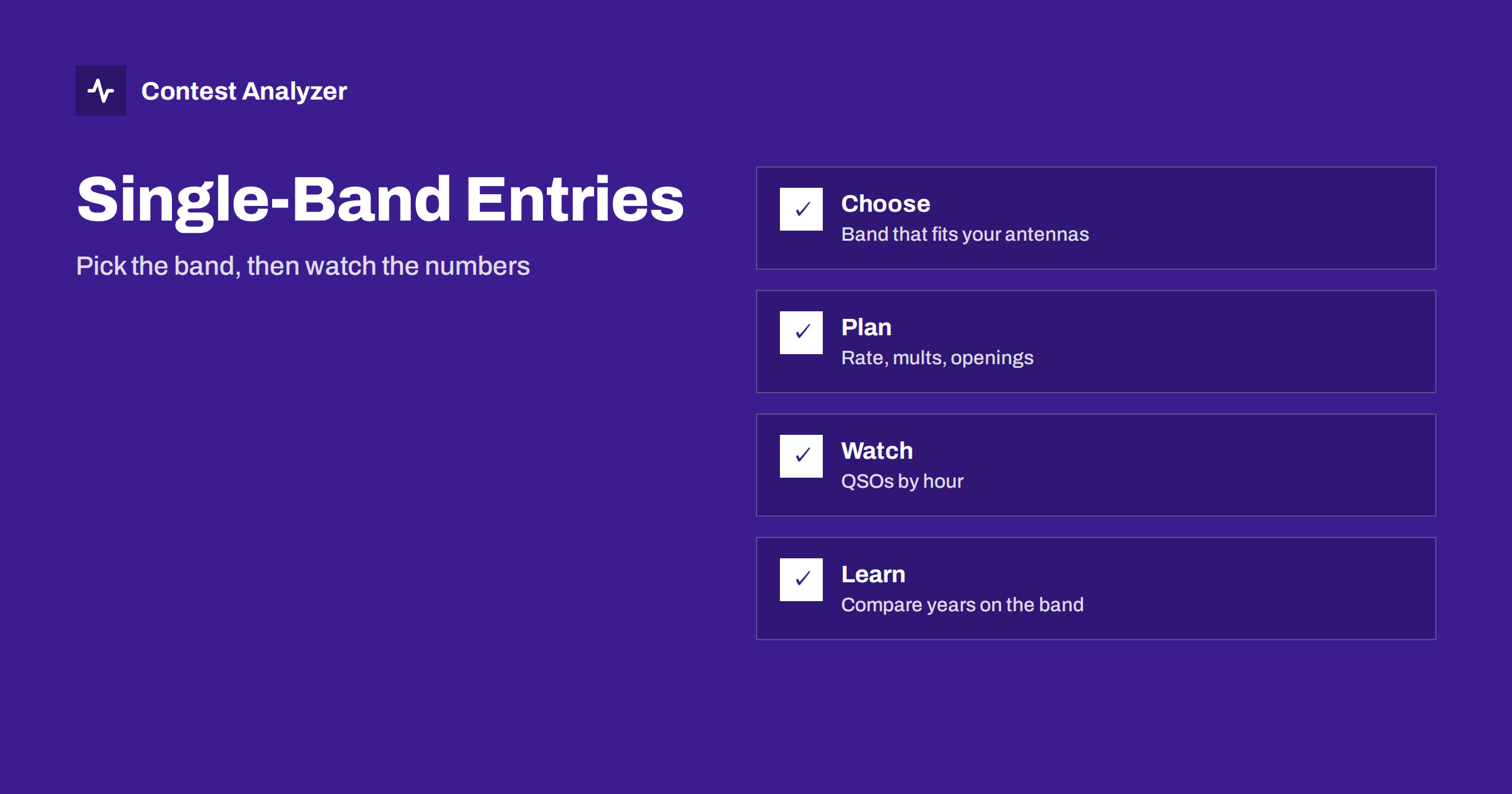
Short answer: In a single-band entry, you operate on one band for the whole contest, so the choice of the band is the most important decision you make. Choose the band on which your antenna is strongest and on which the propagation suits your location and the contest. During the contest, watch the hourly rate and the multipliers, because there is no other band to turn to when the band is poor. Afterwards, the statistics of that single band, compared from year to year, show how well your choice and your operating worked. Check the current rules for the categories and for any limits.
What a single-band entry is
Many contests allow an entry in which you use only one of the contest bands. The result is ranked among the other single-band entries, often with separate lists for each band. It is a good category for operators with a strong antenna on one band, for those with limited time or equipment and for those who like the focus of working one band intensively. The rules of each contest tell you which bands exist as single-band classes, whether the power classes apply as well and what happens if you use another band for a short time. Do not assume that you can make a few QSOs on another band: in most contests that would move you to the all-band category, so check the current rules.
The category suits both beginners and experienced operators. A beginner can learn one band thoroughly, and an experienced one can use the single-band class as a way of testing a new antenna. The article on assisted and unassisted categories and the one on QSO points in CQ WW help to understand the other elements of the classification and the scoring.
Choosing the band
Which band should you choose? The answer depends on several things, and it helps to consider each one separately.
- Your antenna. The most important factor. A band on which you have a good antenna, high above the ground and in a clear place, will give a better result than a band with a poor one.
- Your location. A band that works well for a station in one part of the world may work less well in another. Your own past logs show which bands have given you long paths and many continents.
- The time of the contest. The date of the contest and the time of the year affect the bands. A band that is open for many hours in one season may be open for few in another.
- The solar conditions. The higher bands need good solar activity, and the lower bands are more reliable in a quiet period. See solar flux and contest results for a way to think about it.
- Noise and interference. A band with a high noise level at your site is a bad choice for a long weekend.
- Your interest. You will operate for many hours. A band you enjoy gives you more energy.
When in doubt, use your own data. The statistics of earlier all-band logs, the QSOs by band, the continents and the rates show which bands were productive. The article on band strategy by hour explains how to read them.
How the contest changes
In an all-band contest, you move from band to band as the conditions change. In a single-band contest, you stay. The consequences are practical. First, the periods of low activity cannot be avoided by switching, and you must use them for rest or for a long search. Second, the multipliers on the band are the only ones you can get, so it is important to find them all while the band is open to the right places. Third, the rate is closely tied to the opening of the band, with peaks when the band is open to a large number of stations and valleys when it is not.
A single-band operator learns to listen for small changes in the band. A weak signal from a new direction can mean the beginning of an opening, and being the first to call a new multiplier can bring points. The skills of listening and of timing are more important than in many all-band entries.
Planning the hours
Because you cannot change band, you should plan the hours. Using the data from earlier years, mark the hours in which the band is usually good and those in which it is poor. The best hours are the time to work at full intensity. The poor hours are the time for rest, a meal, a change of operator or a long search for multipliers. If your category has rules on breaks, check them; the article on off time and breaks explains the general idea of how operating time is counted.
In some single-band contests, a station that operates only part of the time can still do well, because the band is only open for part of the contest. In others, the whole period is important. Look at the shape of the band’s activity over the contest, as shown by the QSOs by hour in your earlier logs.
Statistics to watch
- QSOs by hour. The main shape of your contest. Look at the peaks and the valleys and think about their causes.
- Rate in the best hours. The measure of how well you used the opening.
- Continents. The share of each continent and the hours in which they were worked.
- Multipliers. How many you have found, and how long it took to find the last ones.
- Run and search and pounce. The balance between the two. See run versus search and pounce.
- Breaks. The time in which you did not operate, and whether it was the right time.
On a single band, these figures are easier to read than on all bands, because they all refer to the same conditions. You can see the effect of a decision very clearly: a change of frequency, a change of antenna direction or a rest at a particular time.
Using the review and the report
The single-band log is smaller than an all-band log, so each QSO counts for more. A busted call or a wrong zone costs a larger part of the result. Contest Analyzer checks every callsign and every zone against official license databases and several independent reference sources and shows only the few QSOs worth a second look. The report gives full statistics, with rates, QSOs by hour and band, countries, continents, CQ and ITU zones, WPX prefixes, distance, beam heading, breaks and off time and callsign length and structure, and it lets you compare with your own logs from earlier years. That comparison is particularly good for a single-band entry: if you operate on the same band each year, the figures are directly comparable. You can edit calls or zones in the report and download a corrected Cabrillo. It works with Cabrillo from N1MM Logger+, DXLog and Win-Test and supports 22 contests, which are on the contests page. Serial numbers are not checked and dupes are not errors.
Remember also to declare the category correctly in the header of the file. The band field must be filled in as the contest expects, and the Cabrillo header guide describes the category fields. A wrong band value may place the entry in the wrong list.
Common mistakes in single-band entries
A few errors appear again and again. The first is to choose a band for the wrong reason, for example because it is the favourite band for casual operating, without checking whether the contest conditions on that band suit the location of the station. The second is to stay on a poor frequency because the band is the only one, forgetting that a few kilohertz can make a large difference in the quality of the run. The third is to ignore the rest: an operator who tries to work every hour of a long contest on one band, with no break, often gets worse results in the late hours because of fatigue and errors. The article on operator fatigue and breaks has practical advice.
A fourth mistake is to forget the multipliers in the quiet hours. When the rate is low, the best use of the time is usually to listen carefully across the band for stations that you have not worked and for zones or countries that are still missing. Many single-band entries are decided by the multipliers found in the hours when everybody else is resting. The fifth mistake is to overlook the log: with fewer QSOs, a few busted calls can change the result noticeably, so a review is not optional.
If you avoid these five, a single-band entry can be one of the most rewarding ways to take part in a contest, and one in which the statistics of your own log are especially easy to understand.
Learning from year to year
A single-band entry gives a clean experiment over the years. With the same band and the same contest, you can see how your result changes with the antenna, the solar conditions and the way you operate. The article on comparing contest results between years has a list of the figures to keep. After a few years, you may decide to change the band, either because the solar cycle has moved the best conditions or because you have improved another antenna. The statistics from the earlier years will tell you whether the change is a good idea.
A short note after each contest, with the band, the best hours, the multipliers that you found late and the changes you want to make, is the easiest way to keep this knowledge. It takes a few minutes and is worth much more a year later.
Related reading
- Band strategy hour by hour
- Reading the band ratio of a contest log
- Comparing contest results between years
The bottom line
A single-band entry is a focused way to contest. Choose the band that fits your antenna, your location and the contest, plan your hours around the openings, watch the hourly numbers and the multipliers and use the statistics of the band to learn from year to year. Read the current rules for the categories and the declaration in the log.
FAQ
Can I make a few QSOs on another band?
In most contests, that would change your category. Check the current rules before you do.
Which band is best?
The one on which your antenna is strongest and that suits your location and the time of the contest.
Is a single-band entry easier?
It is simpler in setup, but it requires patience and good timing, because you cannot change band.
How should I plan breaks?
In the hours in which the band is usually poor, as far as the rules allow.
How do I compare years?
Use the QSOs by hour, the rate in the best hours, the continents and the multipliers on the same band and the same contest.