Short answer: At night the low bands are where many contests are won or lost. 160 and 80 m open after dusk and give access to the multipliers that the high bands do not have, but the signals are weak, the noise is high and the operator is tired. Plan the hours when you will use the low bands, work them with the best copy discipline that you can and look at your night statistics after the contest to see what the hours really gave.
Why the low bands matter at night
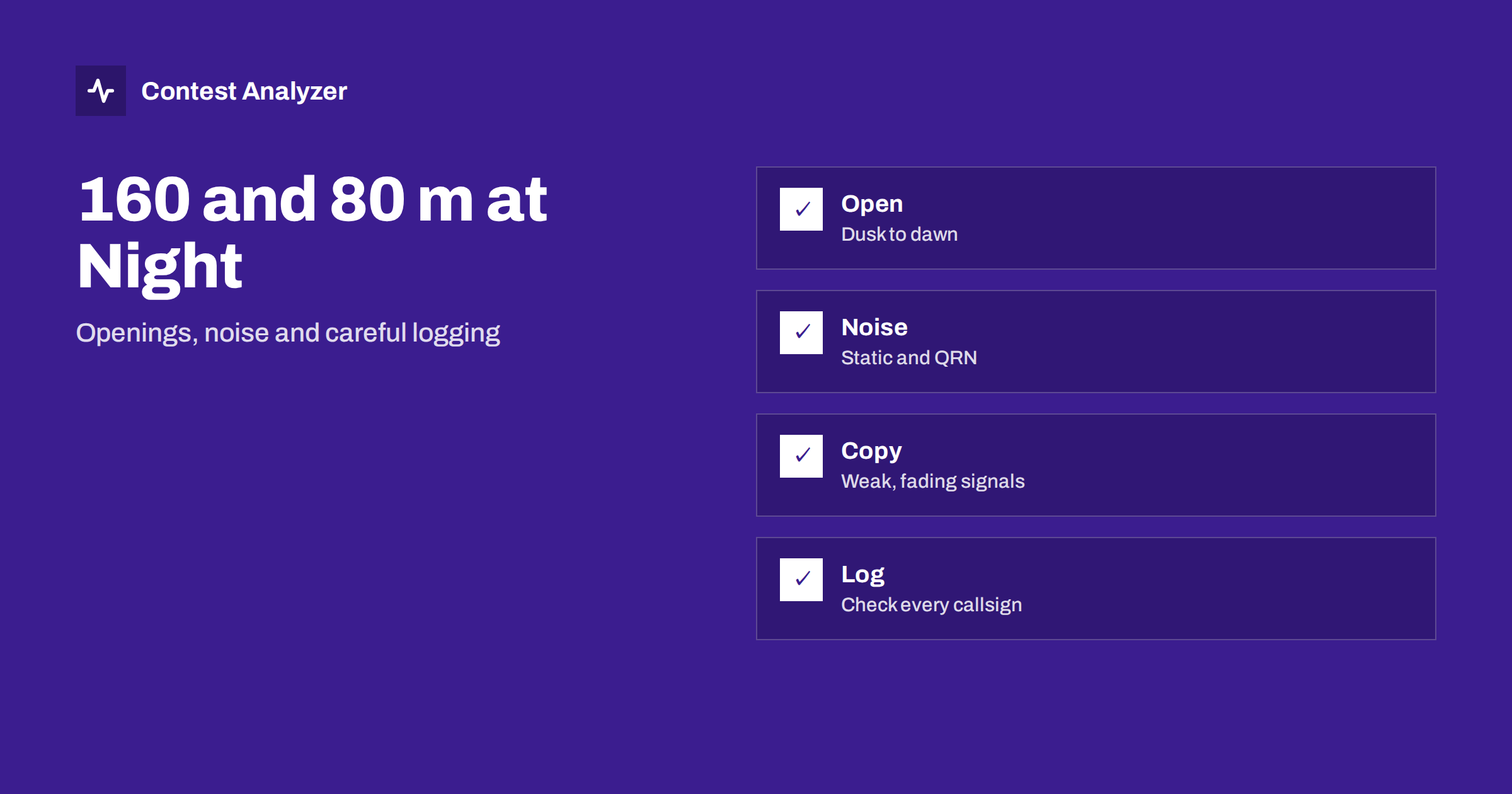
The low bands behave differently from the high ones. During the day, signals on 160 and 80 m are absorbed in the lower layers of the ionosphere, so the bands are good only for short distances. After sunset, the absorption falls, and the signals can travel much farther, so the bands open to long-distance paths and carry signals from other continents. The period around sunrise on the path is another time when the bands are often at their best. Because of this, a station that wants to work many zones and countries on the low bands must be active in the hours of darkness on the paths that matter.
In most contests with multipliers per band, the low bands offer new multipliers. In CQ WW DX, each zone and each country counts once on each band, so a night on 160 and 80 m can add a good number of multipliers, and these are relatively expensive to find in the daytime hours of other bands. This is why an experienced operator plans the night as a series of low-band periods, often with a rest in the hours when the paths to the main areas are closed.
Noise, fading and weak signals
The same night that opens the bands brings more noise. Atmospheric noise on the low bands is usually higher than on higher bands, especially in summer, and local noise from the neighbourhood can be strong. Signals fade, sometimes quickly and deeply, and a station that was loud a minute ago can become unreadable and return. Many signals are weak, so both receiving and logging are harder. Those who work the low bands well have usually spent time on the receiving side: a separate receiving antenna, a good filter, and good headphones.
The effect on the log is direct. In weak and fading signals, the operator is more likely to copy a callsign wrongly or to miss part of the exchange, and the rate of busted calls rises. The article on why logging errors cluster at night explains this, and the article on partial callsign copies shows how to deal with a call that is only partly heard. The best habit is to ask for a repeat of what you are not sure about, even if it costs a few seconds, since a QSO that is not logged correctly is lost and may cost more through a penalty than a QSO that is not made.
What to log with special care
- Callsigns that you heard only once. In weak signals, do not log a call that you only partly copied. Ask for a repeat.
- Zones and exchange items. A zone is easy to misread in noise; digits are confused as easily as letters. The article on cut numbers in CW contests explains one more source of mistakes.
- The time. In the long night, check once that the clock is still right. The article on UTC clock errors explains the effect of a wrong clock.
- The band and the frequency. A mistake after a band change is easy when you are tired; look at the logger.
- Stations that disappear during the QSO. If the signal fades before the exchange is complete, decide whether you have enough to log. If not, do not log it.
Reading your own night statistics
After the contest, look at the QSOs by hour and band, and compare the night hours with the day hours. Several questions are worth asking.
- How many QSOs did you make on 160 and 80 m, and how many new multipliers did they bring? The number of QSOs is usually lower than on the high bands, and the number of multipliers per QSO is higher.
- When were the best low-band hours? Often they are not in the middle of the night, but around dusk and around dawn. If your statistics show a peak near sunrise on the path to a main area, plan to be on that band at that time next year.
- When did the rate collapse? A period of very low rate in the middle of the night may be the best time for a rest, and the rest does not cost much.
- Did the errors rise at night? If you found more corrections in the night hours, plan the work and the breaks accordingly.
- How was the night different from last year? Propagation changes, but the comparison shows whether your station and your plan improved.
The articles on band strategy by hour and hour-by-hour analysis show how to read these numbers, and the one on the CQ 160-Meter Contest explains more about topband contesting.
Station habits that help at night
A few simple habits make the work on the low bands more comfortable. Keep a separate receiving antenna or a receiving setup ready, and learn how to compare it with the main antenna in a few seconds, because on these bands the best receiving direction is often not the best transmitting direction. Use the noise reduction and the filters that your radio offers with care, since they help against noise but can also remove the weak part of a callsign. Reduce the audio volume to a level that you can follow for hours, and place the headphones so that they do not press on the ears. Keep a drink and something to eat near the station, so that a short pause does not become a long walk.
It also helps to know your own limits. If you notice that you need to ask for repeats more often, or that you re-read a callsign on the screen several times, you are tired, and a break of ten minutes may restore the accuracy. A short note in the station notebook about what worked in the night is useful for the next year.
Plan the nights as a whole
A 48-hour contest has two nights, and the strategies for them are often different. On the first night you are fresh, so you may choose to work the low bands for a long time and to rest only for a short period. On the second night you are tired, and the benefit of staying on the low bands must be weighed against the risk of errors. Some operators prefer to sleep early in the second night and wake before dawn to use the best hours. The article on operator fatigue in 48-hour contests explains how rest affects the rate and the accuracy, and the article on off time and breaks reminds you of the rules of the categories in which the operating time is limited.
Write the plan in UTC and review it during the contest. A plan that depends on the propagation must be changed when the conditions change, for example on a night with a geomagnetic disturbance. In those nights, the low bands may be poor, and a plan that follows the conditions can save hours. The note on solar flux and the K index explains how to read the conditions, and how to compare years fairly.
A short night checklist
- Know the sunset and the sunrise times on the paths to your main target areas, in UTC.
- Decide the hours for 160 and 80 m and the hours for rest before the contest starts.
- Check the receiving antenna and the filters before the first night.
- Ask for a repeat whenever a callsign or a zone is uncertain.
- Look at the logger after each band change and at the clock once during the night.
- After the contest, compare the night hours with the day hours and with last year.
Where Contest Analyzer helps
Contest Analyzer gives you the statistics you need for this analysis: QSOs by hour and band, rates, countries, continents, CQ and ITU zones, WPX prefixes, distance, beam heading, breaks and off time, and callsign length and structure, together with the comparison with your own logs from earlier years. It checks every callsign and every zone against official license databases and several independent reference sources and shows only the few QSOs worth a second look. This is useful for the night log in particular, because the callsigns and zones copied in weak signals are the most doubtful in your whole log. You can edit calls or zones in the report and download a corrected Cabrillo. It works with Cabrillo from N1MM Logger+, DXLog and Win-Test, and it supports 22 contests, as the contests page shows.
Related reading
- CQ 160-Meter Contest guide
- Stew Perry Topband Challenge
- Openings to each continent hour by hour
- Why logging errors cluster at night
The bottom line
The low bands at night give multipliers that nothing else gives, and they also give weak signals, noise and tired ears. Plan your low-band hours, copy with extra discipline, ask for repeats and read your night statistics after the contest. They will tell you where the nights were won and where the errors came from.
FAQ
When are 160 and 80 m best in a contest?
Usually after dusk on the path and around sunrise on the path, but the conditions change from night to night.
Why are there more errors at night?
Weak and fading signals, noise and tired operators make copying harder. Ask for repeats and plan your breaks.
Should I sleep in the middle of the night?
Many operators rest when the rate is lowest. Your own statistics from last year show the best hours for it.
Do the low bands give more multipliers?
In contests with multipliers per band, they offer new ones, and often at a lower cost per multiplier than in the day.
How do I compare nights between years?
Look at QSOs, multipliers and errors by hour in each year, and remember that propagation is different every year.