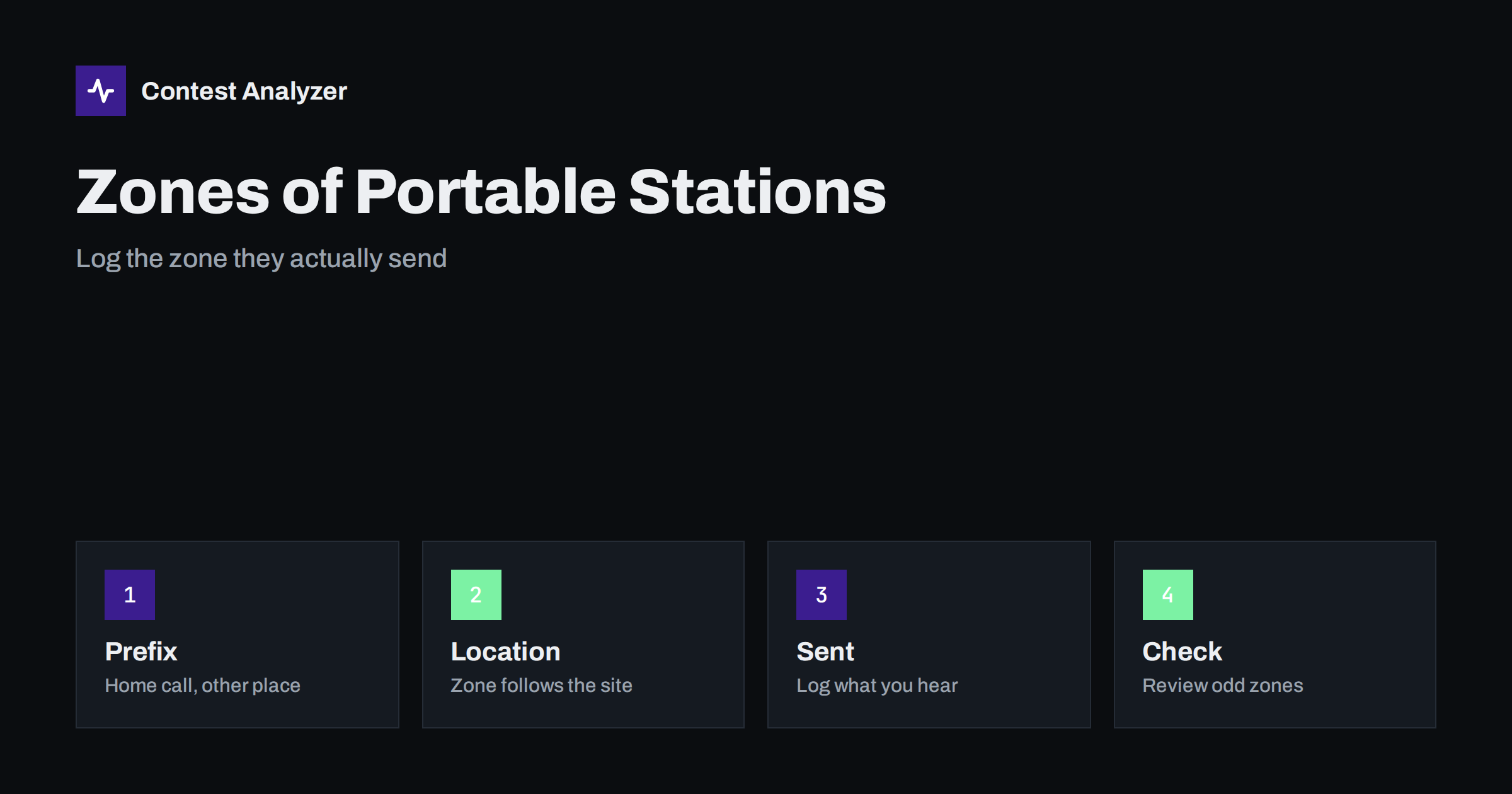
Short answer: A portable, mobile or maritime station may be far from the place that its callsign suggests, and the zone it sends belongs to where it is operating, as the rules of the contest define. The right way to log it is to copy the zone that the station actually sends, and not the zone that you expect from the prefix. A zone that looks wrong for the callsign is not always an error, so check the details before you correct it.
Why the callsign does not tell the whole story
A callsign shows where the licence was issued, not necessarily where the station is today. A station that uses a suffix such as /P or /M, or a different prefix in front of its home call, may be in another country or even on another continent. A ship or an aircraft can be anywhere, and a maritime station can be in a zone that has nothing to do with its prefix. Your logger, which predicts the zone from the prefix, does not know this. It offers the home zone, and the operator who accepts it without listening creates a false entry.
This is a normal situation in contests, and many QSOs of this kind are correct and valuable. The rules of the contest usually say which zone a portable station should send. Check the current rules, since they can differ between contests and between categories. The article on /P, /M, /MM and /AM in contests describes the indicators, and portable and maritime stations: zones and countries in the log gives the general background. This article concentrates on the zone as it appears in the exchange.
What zone should such a station send
As a general principle, the zone belongs to the place where the station is operating at the time of the QSO. A station on a trip sends the zone of its current location, and a station that moves from one zone to another during the contest should change the zone when it crosses the border. For maritime stations the rules often have a special approach, for example the zone of the position of the ship or a rule for a ship in the open sea. Read the current rules for the exact definition, and do not assume that the same rule applies to all contests.
This means that two QSOs with the same callsign can have two different zones, if the station moved between them. Both can be correct. Your log must show the zone that was sent each time, and a later check should not treat the second as an error just because it differs from the first. The article on CQ zones explained describes the zone map and the difficult areas.
Copying the zone you hear
The key rule is simple: log what you hear. If a station with a European prefix sends a zone that belongs to another continent, copy it and, if you are not sure, ask for a repeat. A surprise in the zone is often a sign that the station is portable, and a clear repeat is worth a few seconds. Do not replace the zone with the one that the logger shows, and do not “correct” it on your own. If the logger shows a warning that the zone does not fit the prefix, treat it as a prompt to listen again, and not as an order to change.
The articles on callsign history and zones and zone errors in multi-zone countries show the typical traps with automatic fill-in. The same care applies with portable stations, where the fill-in is wrong more often than usual.
Mobile stations that change zones
A mobile station that drives through several zones is an interesting case. In a long contest, such a station may change zone several times, and each change gives you a chance for a new multiplier. For the operator who wants to use it, the practical question is how to know the current zone. The station should send it every time, and you should listen for changes. If the same station worked on the same band appears with another zone, work it again if the rules allow, and log the new zone.
If the rules treat a QSO with the same station on the same band as a dupe, the second QSO does not count, whatever the zone. Check the current rules for how they handle this case, as some contests are more flexible than others. In any case, do not remove a QSO from the log because the zone differs from an earlier one: both are valid records of what was sent.
False errors and how to avoid them
A checking process that compares the zone with the callsign without looking at suffixes can find false errors. It may flag a portable station whose zone is correct, and it may accept a zone that is wrong, if it matches the home zone. That is why a human look at the unusual cases is necessary. Contest Analyzer checks every callsign and every zone against official license databases and several independent reference sources and shows only the few QSOs worth a second look. For a portable station, the zone you copied may be exactly the reason for the flag, and your audio shows what was really sent.
In the report you can edit calls, zones, time and frequency, mark QSOs checked in your own audio recording, and download a corrected Cabrillo. This is the right place to settle the doubtful cases: listen to the exchange, confirm the zone that you hear and mark the QSO as checked. It works with Cabrillo from N1MM Logger+, DXLog and Win-Test, and shows full statistics, including CQ and ITU zones. See the contests page for the list of supported contests.
Practical rules for the operator
- Listen first: copy the zone from the air, and use the logger only as a hint.
- Ask for the zone only: a short repeat request is faster than a full repeat.
- Do not merge two zones: if the station sent two different zones, log each QSO with the zone that was sent.
- Write a note: mark the unusual ones in the log with a short comment, so that you can find them later.
- Use your recording: a few seconds of audio settle most doubts.
These steps cost little during the contest and help a lot in the check afterwards. See also zone exchange mistakes in SSB for the same family of errors on phone, and cut numbers and zone errors in CW exchanges for CW.
Your own station when you are portable
The same rules apply when you are the portable station. If you operate from a place that is in another zone than your home, send the zone of the place, as the rules of the contest require. Set the macro and the logger before the start, and test the exchange with a recording. Many portable operators forget this and send the home zone out of habit, which creates errors in the logs of everyone who works them. A check at the beginning of the contest, and again whenever you change location, prevents the problem.
Also mark your callsign correctly in the header, with the portable suffix or prefix as the rules require, and check that the category and location lines fit. The article on the Cabrillo log header guide helps with the lines. A portable operation done carefully is a pleasure for the stations who work you, and a source of valuable multipliers.
Spotting the pattern in a log review
When you review your log after the contest, sort the QSOs by callsign and look at the stations that have a portable indicator or an unusual prefix. For each of them, compare the zone in the log with the zone you would expect from the home country, and note the differences. Most will be real: a station that was away from home and sent the zone of the place. A few will be copying errors, where a zone was assumed from the prefix or misheard. The audio will tell you which is which.
Pay special attention to zones that are far from the prefix. A station with a prefix from one continent and a zone from another is either a genuinely portable station or a mistake, and both possibilities deserve a minute of attention. If the same station appears on several bands with the same unusual zone, that is a good sign that it is real. If a station appears once with a zone that does not fit, check it more carefully.
Keep a small list of the portable stations that you worked, with the place and the zone that each one sent. Next year, when you see the same call again, you will know what to expect, and you will recognise the situation faster. Many regular contesters keep such lists, and they use them to plan their own portable operations, too.
One more thing: do not be afraid of the odd zone. Many of the best multipliers in a contest come from portable and maritime stations, and an operator who knows how to log them correctly gains an advantage over those who avoid them because they seem complicated. A few careful habits turn a source of errors into a source of points.
Related reading
The bottom line
Log the zone that the station sends, not the zone that the prefix suggests. Treat odd zones as a reason to listen again, and check the current rules for how portable and maritime stations should choose theirs.
FAQ
Can the same callsign send different zones?
Yes, if the station changed location between QSOs. Log each one as sent.
Which zone does a maritime station use?
The rules of each contest define it. Read the current rules.
Is a zone that differs from the prefix an error?
Not necessarily. Check the audio and the callsign indicator before you correct it.
Should I trust the logger’s zone for a /P station?
Treat it as a hint only. Copy the zone from the air.
What should I send when I am portable?
The zone of the place where you operate, as the rules define it.