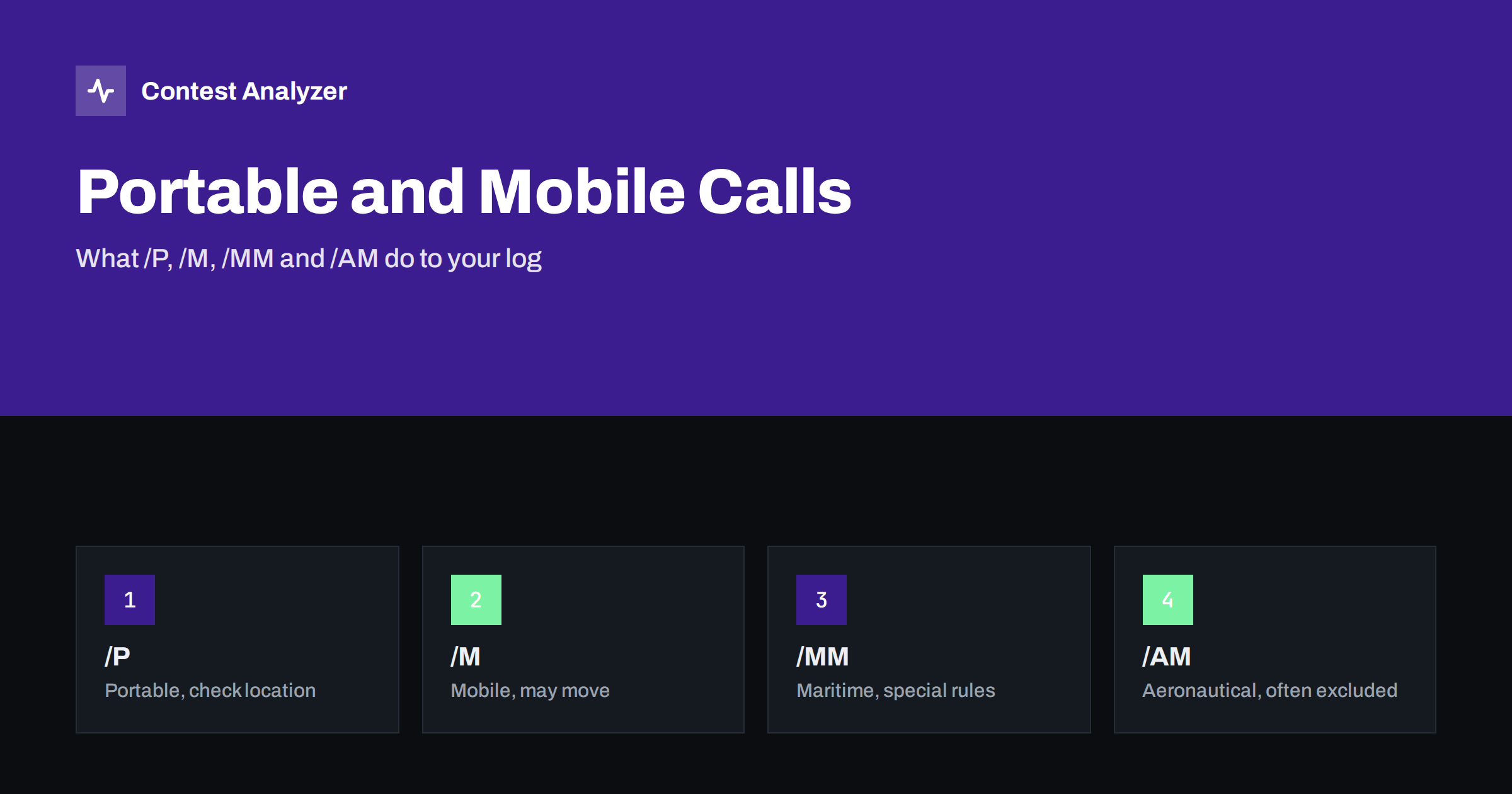
Short answer: A slash and a letter after a callsign tells you how a station operates: /P for portable, /M for mobile, /MM for maritime mobile and /AM for aeronautical mobile. These indicators do not decide the country or the zone by themselves. The place where the station is operating and the rules of the contest decide. For logging, copy exactly what the station sends, and for scoring, read the current rules, because the treatment of /MM and /AM in particular differs between contests.
What the indicators mean
An indicator after the slash is a convention that tells other operators about the type of operation. /P means that the station is portable, which is operating from a place other than its normal station address. /M means that the station is mobile, for example in a vehicle. /MM means maritime mobile, on a ship or a boat at sea, and /AM means aeronautical mobile, on an aircraft. Some countries use other indicators, and some administrations have their own rules about when an indicator is required or optional.
In a contest log the indicator is a part of the callsign. The call DL1ABC/P is not the same string as DL1ABC, and the checking of a log treats them in the way that the rules prescribe. For the structure of a call with indicators, see the article on how a callsign is built. In this article we look at what the indicators change for the countries and zones that you log.
The country and the zone depend on the place
A portable or mobile station is counted, in most contests, in the country where it is operating. If a German station operates /P from Austria with the call OE/DL1ABC, it is in Austria, and the QSO normally counts for Austria. If the call is DL1ABC/P and the station is in Germany, it counts for Germany. The indicator alone does not tell you where the station is. The prefix before the slash or the place that the operator gives does.
The same applies to zones. A station that moves between zones, for example a mobile in a large country, may be in different zones at different times. In such a case the operator should send the zone of the place where he is at that moment. As a listener, you should log the zone that you hear, even if it does not match the usual zone of the call. The article on zone errors in multi-zone countries describes why this is a common source of errors.
Maritime and aeronautical mobile
Stations at sea and in the air are a special case. In many contests, a maritime mobile station does not count as a country for the multiplier, but the QSO with it may count as a QSO and may be placed in a zone depending on the rules. Some contests give a specific treatment to such stations, and others do not accept them at all. The same is true, even more, for aeronautical mobile stations. These are rare in contests, and in many places the operation is not allowed or not practical.
The safe approach is to log what you hear exactly, with the indicator, and to read the rules for the special case. Do not assume that a /MM station is a new country. The article on portable and maritime stations and zones goes into more detail. Always check the current rules of the contest that you operate in, because the treatment can differ and can change from year to year.
What is allowed on your side
If you operate portable or mobile yourself, you have a double responsibility. First, you follow the rules of your licence, which may require an indicator or a prefix when you are away from your home address or in another country. Second, you follow the rules of the contest, which may define a category for portable or mobile operation, or treat your station like any other. Some contests ask you to state your location in the header of the Cabrillo file, for example in a location field. The article on the Cabrillo header lists such fields.
The exchange, especially the zone, must be the one of your actual location. If you drive from one zone to another during the contest, change the zone in your logger at the moment you cross the border, and write a note about it. This is the kind of detail that is hard to rebuild after the contest.
Logging calls with a slash
- Log the full string that the station sends, with the slash and the indicator or the prefix.
- Do not remove the indicator to make the call look simpler. A different string is a different call in the log.
- Type the slash correctly. Some loggers need a special key or a different character for it, and some change it in the export. Check a few QSOs in the Cabrillo file.
- Be careful with prefixes before the slash. A call such as EA8/DL1ABC means the operator is in the Canary Islands, which is a different country and a different zone from Germany.
- Use the country file. A logger with a recent file will show the country of such a call correctly in most cases. Check the version of the file in your program before the contest.
Special and unusual indicators
Besides the four classic ones, you may meet /QRP for low power, /A or /B in some countries, numbers as indicators and prefixes for special operations. They follow the same logic: the string is part of the call, and the place of operation decides the country. If an indicator is new to you, look it up on the page of the administration or ask the station for a repeat. Do not guess, because a wrong guess leads to a wrong country or a wrong zone in your log.
Three short examples
A portable station in its own country. You hear DL1ABC/P and the operator sends the zone that is normal for Germany. You log the call as heard, with the indicator, and the zone that was sent. For the country, the file shows Germany, and the QSO counts as it would for the home station, unless the rules say otherwise. The indicator changes nothing for the multiplier.
A visiting operator. You hear a call with a prefix of another country, followed by a slash and a home call. You log the whole string. The logger should assign the country of the prefix before the slash, and the zone of that place. If the logger shows the home country instead, correct it by hand, and write a note. After the contest, check the entry against the list of prefixes, because this is a typical place where a multiplier is either gained or lost.
A mobile crossing a border. A station in a large country calls CQ in one zone, and an hour later gives a different zone. You have QSOs with both zones in your log. If your logger or your checking tool shows the second one as an error, listen to the recording and decide on the basis of what the station said. The station is allowed to change the zone when it moves, and your log should follow what was sent.
These examples are simple, but they show the common thread: the evidence for a country or a zone is what the station says and where it is, and not only what the call looks like. A log that follows this principle is easy to defend in a review of the results.
One more reminder concerns your own call. If you operate portable, use the form of the call that your licence requires, and use the same form in the header, in the exchange you send and in the log. A mix of forms in different places of the file can make the checking of your own log harder than necessary.
How checking treats such calls
Calls with indicators are harder for a checker than plain calls, because the same operator may appear in the logs of different stations with and without the indicator. A strict match may not accept the difference, and a tolerant one may accept it. Because the practice differs, the safest approach for you is to log the call as it was sent and to keep a note when you doubt it. Contest Analyzer checks every callsign and every zone against official license databases and several independent reference sources and shows only the few QSOs worth a second look. You can edit the call and the zone in the report, mark the QSO as checked in your audio recording and download a corrected Cabrillo. See the contests page for the supported contests.
Related reading
The bottom line
The indicators /P, /M, /MM and /AM describe how a station operates, but the place and the contest rules decide the country and the zone. Log exactly what you hear, send the zone of your real location and read the current rules for special cases.
FAQ
Does /P change the country of a station?
Not by itself. The country is the place where the station is operating, according to the rules.
Do maritime mobile stations count as a new country?
Often not as a country multiplier, but the treatment differs, so check the current contest rules.
Should I log the /P?
Yes. Log exactly what the station sends, including the indicator.
What zone should a mobile station send?
The zone of its location at the time of the QSO, if the exchange requires a zone.
Can I operate /M in a contest?
Often yes, within your licence and the contest rules. Check both before the event.