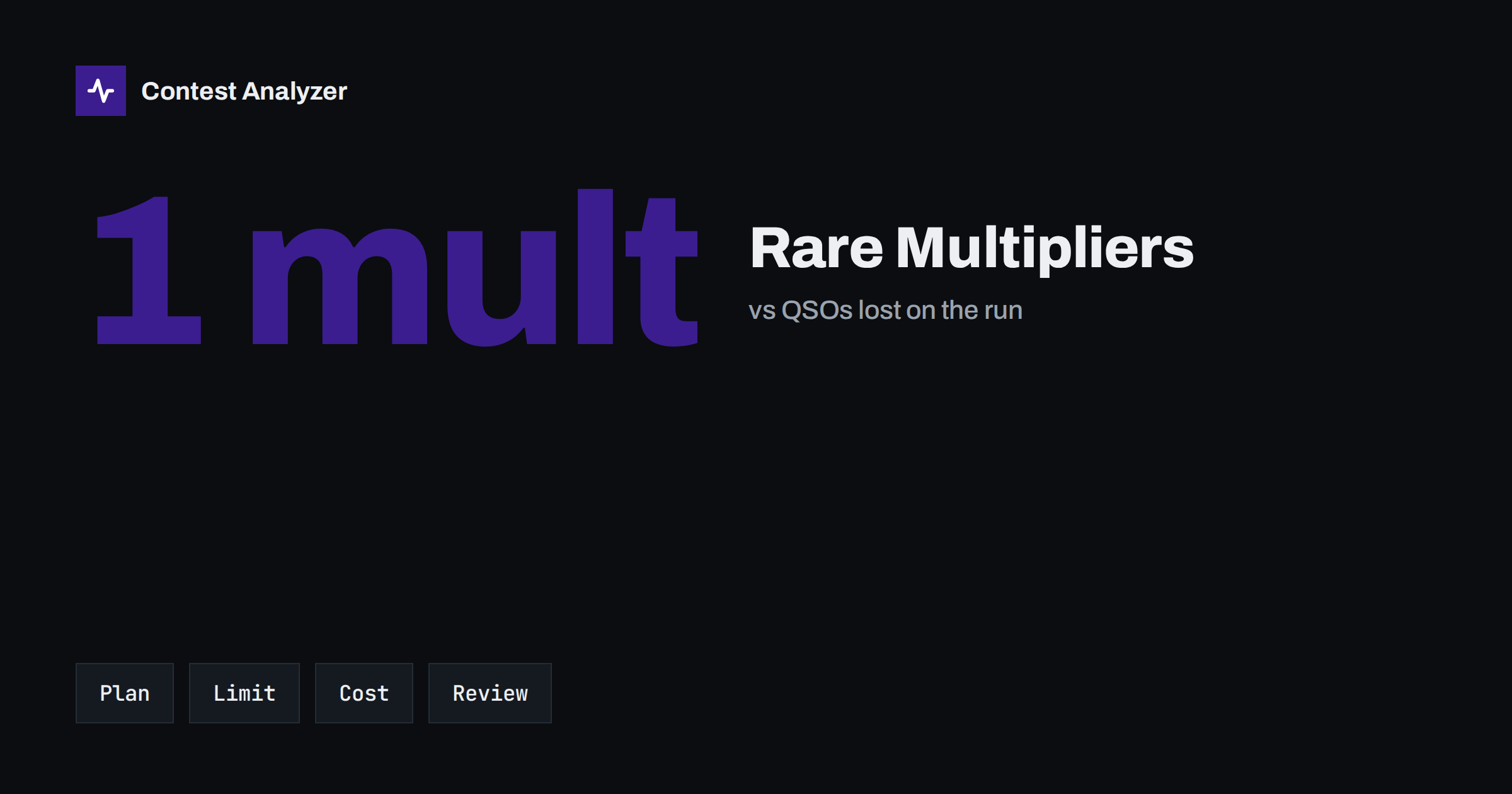
Short answer: A rare multiplier is a country, zone or prefix that few stations offer, and finding it can be worth more than a good hour of running. The cost is the rate that you lose while you wait, so plan the search: know when and where the multiplier is likely to be available, give yourself a time limit and compare the cost with the value. Your own logs from earlier years show what is realistic better than any general advice.
What makes a multiplier rare
A multiplier is rare when only a small number of stations are active in it during the contest. This can be a country with few amateurs, a remote island that is active only during an expedition, or a zone whose stations are on air only at certain hours. It can also depend on you. A multiplier that is common for a station in North America can be rare from Europe, and the other way round. A multiplier may also be rare on a certain band, even if it is easy on another one, because propagation to that place is available only in a short window.
The value of a rare multiplier is the same as the value of any other multiplier of the same type. The difference is the cost of finding it. In a contest where the final score is the number of points multiplied by the number of multipliers, one more multiplier increases the whole score by a small percentage, and this percentage is larger when the number of multipliers is still small. In the second half of the contest, the percentage is smaller, but the number of easy ones is also smaller.
Know when and where it can open
Preparation starts before the contest. For each rare multiplier that you want, find out which band and which time of day give you a chance. The main factors are the distance, the time of sunrise and sunset along the path, and the solar conditions of the year. The article on openings to each continent hour by hour shows how to read your own earlier logs for this purpose, and the article on solar flux and contest results explains how conditions change from year to year.
Make a short list: multiplier, band, expected time window and what you did last year. Keep the list on the table. During the contest, you do not have to remember anything. When the clock reaches the window, you look at the list and decide.
Set a time budget for each search
The danger of searching is that it has no end. Each minute that you wait for a station feels like an investment, and the more you wait, the harder it is to stop. The remedy is a budget. Decide before you start how many minutes you will spend, for example ten, and write down the start time. When the time is over, return to the run unless something clear has changed, such as a signal that you can now hear.
Different multipliers deserve different budgets. A zone that is needed on a band where you have none may justify more time than a country that you can try again on another band. If you work with a second receiver, the budget can be longer, because the run continues while you listen. Review your notes from earlier contests to see what budget worked for each kind of multiplier.
Count the cost to your rate
A simple comparison helps. Look at your average number of QSOs per hour while running, and divide by sixty to get the number per minute. If your rate is 120 QSOs per hour, each minute away from the run costs about two QSOs. Ten minutes cost about twenty QSOs. Then compare this with the value of the multiplier in points. In many contests this value can be calculated approximately from your current numbers. Do not rely on exact figures, but get an order of magnitude.
Remember that the cost is not only the lost QSOs. When you leave a frequency, you may lose it to another station, and finding a new one takes time. The article on contest rates explains how to read your rate, and the article on multiplier strategy in CQ WW shows how to think about the value of a multiplier.
Use patience in the right place
Patience is useful when the opening is known and the signal is coming. It is wasted when the band is empty. A good test is to listen for other stations from the same region. If there are none, then the opening has not started, and you can go back to the run and look again in a few minutes. If there are several, the opening is there, and the rare station may appear. In such a case a short wait on a frequency near the others is often the best investment.
Use the tools that you have. A cluster, if your category allows it, may show that the station is active. Check the rules of your category on assistance, as the article on assisted and unassisted categories explains. If you operate in an unassisted category, rely on your ears and on your list.
When to leave the search
- When your time budget is over.
- When the rate on the run frequency was strong before you left, and the loss is growing.
- When the signal that you wanted has disappeared and no similar ones are appearing.
- When the next scheduled opening for another multiplier is near.
- When you notice that you are tired and make mistakes in the calls that you copy.
Leaving is not a failure. It is part of the plan. A multiplier that you do not get this year may be on your list for the next one.
Expeditions, special stations and announced activity
Some rare multipliers are made by a small number of stations that go to the place on purpose. A team may operate from a remote island for the contest weekend, or a local operator may set up a station for a single event. These stations are often announced in advance, with their call, their plan and the bands they intend to use. Such information is useful, but it is never a promise. Weather, travel and equipment can change the plan, and the signal that you wait for may not appear at the time you expect.
Treat announcements as a hint and not as a schedule. If a station is announced for a band and an hour, add it to your list, but do not stop running only because of it. Listen for it in short checks, and keep the run alive. If the station is on air, it will usually have a big pileup, and you will need patience and a strong signal. If your signal is weak, consider whether a different band or time gives you a better chance of a clean QSO.
Also be careful with unusual calls. A special station may use a call that you do not know, and a quick look at the structure helps you to log it correctly, as the article on WPX prefixes and the general rules of callsign structure explain. If you are not sure about the call or the exchange, ask for a repeat, because a rare QSO with a wrong call is a double loss: you spent the time, and you did not get the multiplier.
After the contest, write down which announced stations you actually worked and which you missed. Over several years this record shows you which kinds of activity are reliable and which are not, and it improves your planning for the next contest.
What your statistics show afterwards
After the contest, look at the new multipliers by hour and by band. Mark the hours when you made a search, and see what you got for the time. Look at the hours before and after a search to see how much the rate fell. If you found the multiplier, check how long it took. If you did not, note the time and the band, so that next year you can try a different one. Contest Analyzer shows QSOs by hour and band, countries, continents, CQ and ITU zones and WPX prefixes, and it lets you compare with your own logs from earlier years. It checks every callsign and every zone against official license databases and several independent reference sources and shows only the few QSOs worth a second look, so a rare multiplier in your log is also verified. The contests page lists the supported contests.
Related reading
The bottom line
A rare multiplier is worth the search only if the cost in rate is smaller than the gain in score. Prepare a list of windows, set a time budget, leave when it ends and learn from your own logs for the next year.
FAQ
How do I decide if a rare multiplier is worth it?
Compare the QSOs you lose per minute with the value of the multiplier, and set a time limit before you start.
Should I search at the start of the contest?
Usually the run gives more early on, and multipliers become more valuable later, but it depends on the contest.
Is a rare multiplier the same on every band?
No. Many contests count multipliers per band, and the same place can be easy on one band and hard on another.
Can I use the cluster to find rare multipliers?
Only if your category allows assistance. Read the current rules.
Where can I find the best time for each place?
In your own logs from previous years, by looking at the first and last QSOs per region on each band.