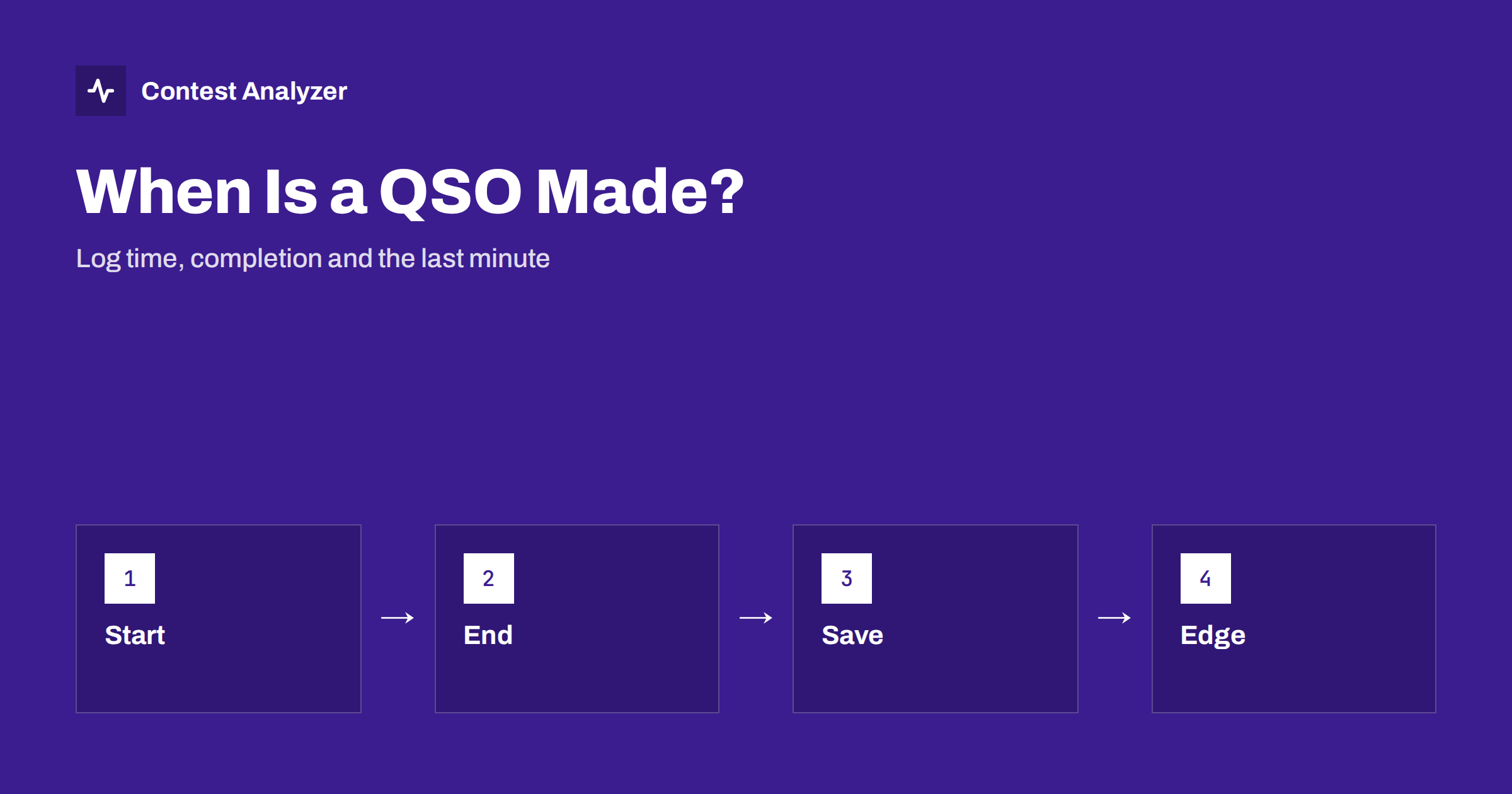
Short answer: A QSO is complete when both stations have exchanged the required information and each has confirmed the other’s call and exchange. The time that goes into the log is a matter of habit and software, and most loggers write the moment when you save the entry, which is close to the end. This is fine in the middle of the contest, but at the start and at the end the minute matters. Know your logger’s habit, keep the clock accurate and read the current rules for how time is counted.
What makes a QSO complete
A contest QSO has an exchange in each direction. You send your report and your exchange, the other station sends its own, and both of you confirm that you have the information. In a short exchange on CW or SSB, this takes a few seconds. The QSO is complete when both sides have everything that the rules require, and not when you hear the first part of the other call. If you stop before the confirmation, the other station may not log you, and your own entry is incomplete.
The rules of each contest describe what counts as a valid exchange, and some give more detail about the end of the contact. Read the current rules for your contest. In general, a QSO that ends after the end of the contest period is not valid, whatever the time written in the log says.
Which time goes into the log
There are three moments in a QSO that you could use: the start, the moment when the exchange is complete and the moment when you save the entry. Most loggers use a fourth option: the time at which the QSO is logged, which means the time of pressing the key that saves it. In a fast contest, this moment is a few seconds after the end of the exchange. In some programs the time is taken from the first character that you type in the call field. This can be a minute earlier, if you typed the call early and waited for the other station to finish.
None of these habits is wrong, but they differ, and the difference is visible when you compare your log with that of the other station. Contest sponsors know about this, and the logs of the two stations are compared with a tolerance of some minutes. The details differ between contests, so do not assume a number. Read the current rules, or the description of the checking process if the sponsor publishes one. The article on not-in-log QSOs explains how time differences can lead to a QSO that is not matched.
Why the clock matters
The time in your log is as good as the clock of your computer. If the clock is off by a minute, all of your QSOs are shifted by a minute. This is usually within the tolerance, but a larger offset, such as several minutes, can lead to unmatched QSOs and to QSOs outside the contest period. The article on UTC clock errors describes the symptoms. Synchronise the clock with a time source before the contest and check it in the middle of the contest, if you can. Use UTC and not local time, and make sure that the logger is set to the right time zone, because summer time changes in many countries can cause a shift of an hour near the contest dates.
The first minutes of the contest
At the start of a contest, stations call CQ at exactly the minute the contest begins, and QSOs are made in the first minute. Some operators start calling a few seconds before the start, but a QSO that is completed before the official start time does not count. If you log it, the time in your log is before the start, and the QSO appears outside the contest period. Wait for the start time, and keep your own clock accurate, so that you do not lose the first QSOs through a clock that is a minute ahead.
The article on the first hour of a contest describes the first minutes in detail. For the log, the rule is simple: do not start the exchange before the start, and do not let a clock that runs fast move your first QSO outside.
The last minute of the contest
At the end of the contest the problem is the opposite. A QSO that begins before the end but is completed after it may be invalid, because the time of the QSO is after the end. If your logger writes the time at the moment of saving, a QSO that finishes at the last second may be logged one minute late. The safe habit is to finish the last QSO before the end time with a margin, and to avoid starting a new exchange in the last seconds if you cannot finish it. The article on QSOs outside the contest period explains what is done with such QSOs.
It is better to lose a QSO than to have a log with a QSO outside the period, because the rules can treat it as an error. Check the time of your last few QSOs in the log after the contest, and compare them with the end time. Contest Analyzer marks QSOs outside the contest period and outside the band limits for your ITU region, with split QSOs shown as a note, and you can edit time and frequency in the report.
Slow exchanges and interruptions
Not all QSOs are quick. A long exchange with repeats, a QSO with an unclear call or a contact in a contest with a long exchange can take a minute or more. During this time the logger may hold the entry until you press the key. If you are interrupted, for example by a call from another station or by a power problem, the time of the entry can move away from the real time of the contact. If you notice such a case, make a note, and use your recording to find the real time later. Keep it simple: write the time in a text file and check it against the recording.
Time, breaks and operating-time rules
The time in the log has another use that is easy to forget: it is the base for the calculation of your breaks. In contests that limit the operating time of a category, the gaps between QSOs are used to find the off time. If a few QSOs have a wrong time, a gap that was only fifty minutes may look like sixty or more, and the other way round. A drifting clock can therefore change the picture of your operating time without any change in what you really did. The article on off time and breaks explains how operating time is counted in general terms, and the details always come from the current rules.
For this reason, it is wise to keep your own record of the planned breaks, with the UTC time at which each break started and ended. After the contest you can compare your record with the gaps that appear in the log. If they match, the clock was right. If they differ by a few minutes, you have an indication of a clock offset, and you can investigate it.
The same record is useful when you review your statistics. A report that shows breaks and off time will use the times in your log, and it is easier to read when you know what you did. It also helps you to separate real breaks from slow periods when you were still on the air but had few callers.
Practical habits
- Set the computer clock to UTC and synchronise it before the contest.
- Learn when your logger takes the time: at the first character, at the end or at the save.
- Do not start an exchange before the start time, and do not start one that cannot end before the end time.
- Look at the time field of the last QSO of each band change and of the last QSO of the contest.
- After the contest, check the first and last QSOs against the official period.
Reading the result in a report
A report that shows your QSOs by hour and minute can reveal timing problems that you do not notice in the log. A cluster of QSOs with the same time to the minute, or QSOs that appear in the wrong order, point to problems with the clock or the saving habit. Contest Analyzer gives rates, QSOs by hour and band, breaks and off time, and checks every callsign and every zone against official license databases and several independent reference sources. You can edit the time in the report and download a corrected Cabrillo. See the contests page for the list of supported contests.
Related reading
- QSOs outside the contest period
- UTC clock errors in a contest log
- Fixing a wrong time in a contest log
The bottom line
A QSO is made when the exchange is complete, but the time in your log follows your logger’s habit and your clock. Keep the clock accurate, know when your program takes the time and be careful in the first and the last minute of the contest.
FAQ
Which time should I log, the start or the end of the QSO?
Follow your logger’s default, keep it consistent and read the current rules of the contest for any specific requirement.
Can I start a QSO before the contest starts?
The QSO must be completed inside the contest period to count, so wait for the start.
What if my clock was wrong?
If you can prove the offset, for example from a recording, you can correct the whole log by that offset.
Why does the other station show a different time?
Operators use different habits and clocks. Logs are compared with a tolerance that the sponsor sets.
Should I use UTC or local time?
UTC, as the contests require, and check the time zone setting of your computer.