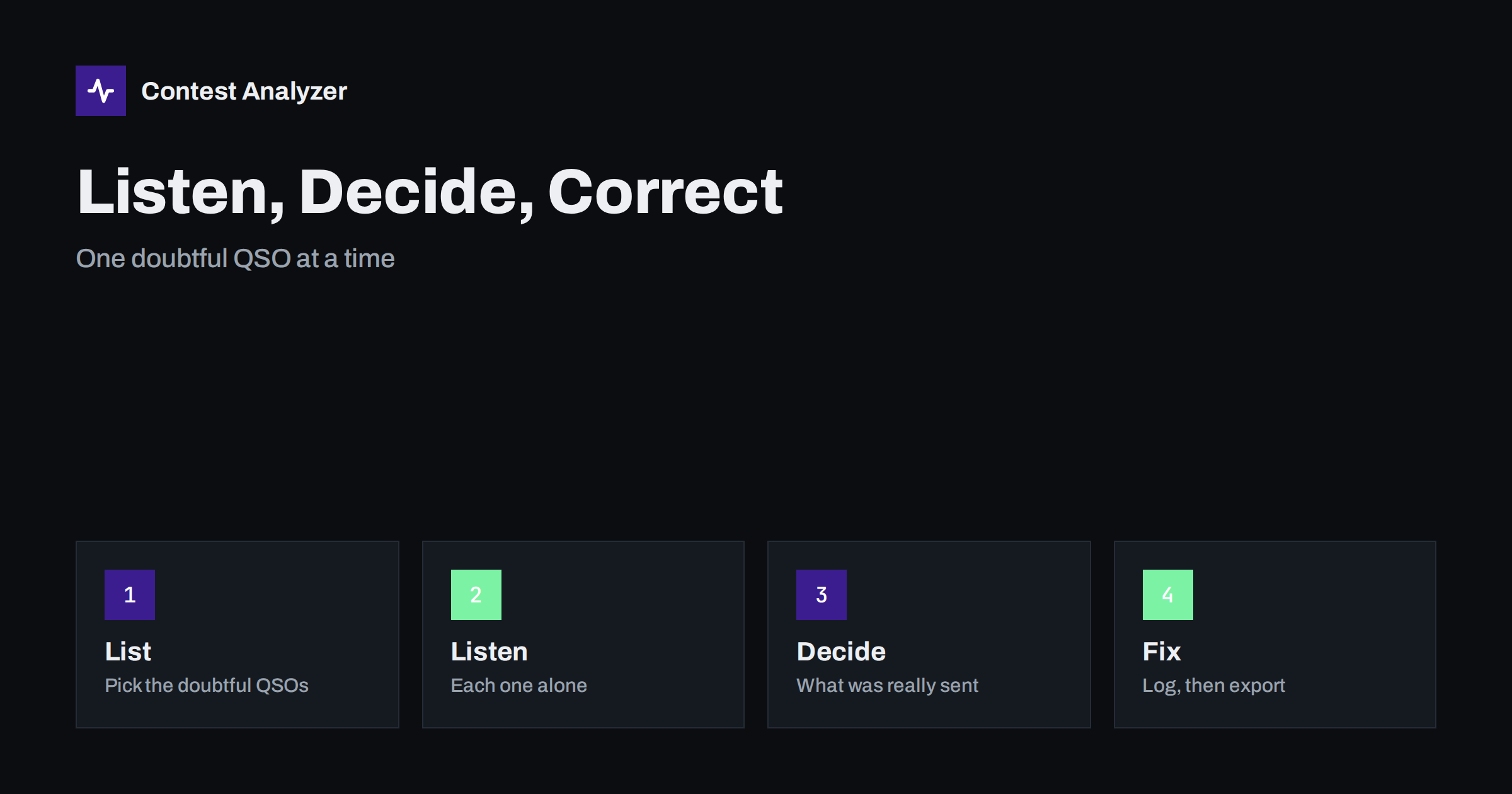
Short answer: If you recorded the contest audio, you can use it to settle doubtful QSOs after the contest. The method is simple: make a short list of QSOs that look wrong, listen to each one separately, decide what was really sent, correct the log only when you are sure, and export again. Do not try to listen to the whole contest, and do not correct a QSO on a guess.
Start with a short list, not with the recording
The biggest mistake after a contest is to open the recording and start to listen from the beginning. A 48-hour recording contains thousands of QSOs, and the large part of them are correct. Listening to all of them takes more time than the contest itself and gives little. The efficient way is to make a list of the QSOs that deserve a second listen, and to go to the recording only for these.
Good candidates for the list are the QSOs you noted during the contest as doubtful, callsigns that appear only once and look unusual, QSOs where you remember an unclear exchange or a repeat, and QSOs at the times when you were tired. Contest Analyzer helps to create this list. It checks every callsign and every zone against official license databases and several independent reference sources and shows only the few QSOs worth a second look. Instead of choosing QSOs yourself from a log of thousands, you start from that short list, and add your own notes to it.
Find the QSO by its time
With the list in hand, find each QSO in the recording using the time from the log. If your logger links the audio to the QSO, one click plays it. If you recorded in hourly files, go to the right file and to the right minute. Start playing about half a minute before the logged time, because the time in the log is usually the moment when the QSO was entered, which is after the call was heard. If the clock was not accurate, you may need to search a few minutes around the time. The article on UTC clock errors explains how to recognise a clock offset, and if all the QSOs you find are a few minutes away from where the log says, you have found the offset.
Listen to one QSO at a time
When you find the QSO, listen to it without looking at the log first. Write down what you hear: the callsign, the exchange and whatever else is needed in this contest. Only then compare it with the log. This order matters, because if you read the log first, your mind will tend to hear what it expects, and the real error stays hidden. This is the same effect that creates busted calls during the contest itself, which is explained in the article on busted callsigns.
Listen several times if necessary, with different filter settings, at reduced speed if your player can do it. Listen to the other station too: if the other operator repeated your callsign or the exchange, you can learn what they heard, and that tells you something about the QSO from their side. And listen after the QSO. Sometimes the same station calls CQ again and gives its callsign clearly, or another station calls it by name, and this settles the matter.
Decide what was really sent
There are three possible results of the listening.
- You hear clearly that the log is right. Leave the QSO as it is, and move on.
- You hear clearly that the log is wrong. The callsign or the exchange was different. Correct it in the log.
- You cannot decide. The signal is too weak, the audio unclear, or both versions sound possible.
The third case needs discipline. Do not choose the version that you prefer, and do not choose the version that gives a better result. If you cannot decide, think about what the rules and the honest course are. In many cases the choice is to leave the QSO as it was logged, because it was your best copy at that moment. In others, it is better to remove a QSO that you cannot confirm. Read the current rules of the contest, and decide with them in mind.
Cases that often turn up
- A similar callsign. You logged one callsign but the station sent another that differs by a letter or a digit. The letters and digits that are often confused are discussed in the article on SSB letters and the article on CW characters.
- The exchange was copied wrongly. The zone or other item was different from what you logged.
- The QSO is in the log twice, with different times. You may have worked the station twice, or logged one QSO as two. Listening tells you which.
- The station was another station. The call that you answered was not the one that replied. This can happen in a pile-up when two stations call at the same time.
- The recording does not contain the QSO. The recording was stopped, or the time is far from what you expected. This is not a failure of the method, just a case in which you cannot check.
When there is no recording
Not every station records the audio, and not every QSO can be found in a recording. In that case, the same method still helps in a smaller form. Use your notes, your memory of the band at that time and the pattern of the log to judge each doubtful QSO, and be honest about what you cannot know. For next time, think about the setup of a recording, since even a simple continuous recording of the receiver audio gives you a good chance of settling the questions after the contest.
Make the corrections in the log, once
Do not change the Cabrillo file by hand for each QSO, unless you must. Correct the QSO in the logger or in the report where the corrections are made, and then export a new file. In Contest Analyzer you can edit calls or zones in the report and download a corrected Cabrillo, which keeps the work in one place. Keep a note of each correction: the QSO, the old value, the new value and the reason. A list of ten corrections with reasons is a good record, and it is also the best material for learning in the next contest.
Keep the original log file and the corrected one, as described in the post-contest review routine. The corrected file is the one you send; the original is the proof of what happened if there is a question later.
Do not overcorrect
There is also a risk in the other direction. After listening to some QSOs, an operator can start to doubt many correct QSOs. The goal is not to produce a perfect log by changing everything, but to repair the real errors. If you correct only the QSOs that you can hear clearly, the log gets better. If you correct the ones that you only suspect, you may replace a correct call with a wrong one. Keep your threshold high: change a QSO only when you are sure.
Also be aware of time. Set a limit, for example one hour or twenty QSOs, and stop at the limit. If more QSOs are doubtful, take the most serious first, such as those that carry a new multiplier or that look most likely to be wrong. The article on QSO points in CQ WW and the one on multiplier strategy help to see which QSOs matter most for the score.
What you learn from the corrections
After the work, look at your list of corrections. Which bands, which hours and which modes do they come from? Are they at the time when you were tired? Are they in pile-ups? A pattern shows where to improve. If the errors are in the night hours, think about the break plan; the article on night-hour logging errors explains why this is common. If they are in fast CW, think about the speed. The report from Contest Analyzer shows the statistics by hour and band, with rates, countries, continents, CQ and ITU zones, WPX prefixes, distance, beam heading, breaks and off time and callsign length, and allows comparison with your own logs from earlier years, so you can check whether the errors are fewer than before. It works with Cabrillo from N1MM Logger+, DXLog and Win-Test and supports 22 contests, as shown on the contests page.
Related reading
- Recording audio in a contest to check doubtful QSOs
- Your post-contest review routine
- Busted callsigns in contest logs
The bottom line
A recording is most useful when it is used with a short list. Pick the doubtful QSOs, listen to each one alone, correct only what you can hear clearly and keep both the original and the corrected files. The result is a cleaner log and a list of lessons for the next contest.
FAQ
Should I listen to the whole recording?
No. Make a list of doubtful QSOs and listen only to those. This takes much less time and gives most of the benefit.
What if I cannot decide what was sent?
Do not guess. Check the current rules of the contest and decide honestly whether to leave or to remove the QSO.
Where do I find a QSO in a long recording?
Use the time from the log. Start about half a minute earlier, and allow for a clock offset if the QSO is not there.
Do I correct the Cabrillo file by hand?
Prefer to correct in the logger or in the report and export again, and keep a note of each change.
How many QSOs should I check?
Set a limit of time or of QSOs. Start with the ones that are most likely wrong or that carry multipliers.