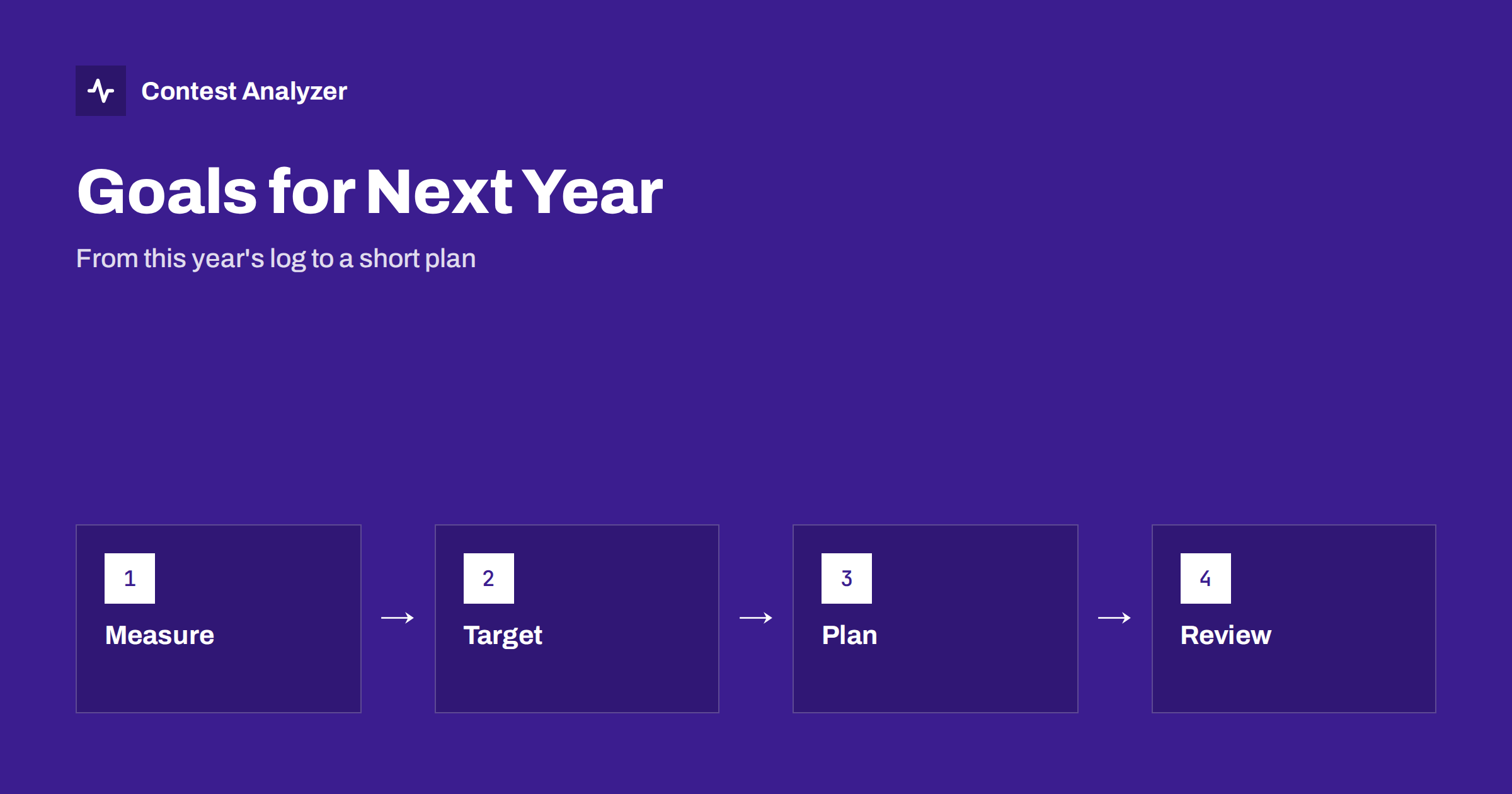
Short answer: The best time to set goals for the next contest is right after the log is finished, when you still know what happened. Choose three to five numbers from your statistics, for example the rate in the best hours, the number of multipliers, the share of corrected calls and the length of breaks. Set a modest, specific target for each, connect each to an action that you can do between contests and write everything down, so that next year’s log can answer whether it worked.
Why set goals from the log and not from feelings
After a contest you have impressions: it was a good one, it was a bad one, the bands were poor, I was tired. Impressions are real, but they are not precise. A log gives you numbers for the same questions. How many QSOs did you make in the best hour? How many multipliers appeared in the second day? How many calls did you correct afterwards? How long were your breaks and when? These numbers do not replace your feeling, but they set it in context.
A goal that comes from the log is also easier to believe. If you say “I want a better result”, you will not know whether you reached it. If you say “I want to raise my rate on the second morning by a few QSOs per hour”, you can check it. The article on setting goals from statistics introduces the idea, and this article describes the steps after the contest in more detail.
Step 1: finish the review of the log
Goals made from an unreviewed log carry the errors of the log with them. Before you look ahead, complete the review: listen to doubtful QSOs, fix what you can prove, remove what you cannot and export a corrected Cabrillo. The routine is described in the article on the post-contest review. Only then are the numbers close to what the sponsor will see.
During the review you also learn something about your own mistakes. Write them down in simple groups: partial calls, wrong zones, time problems, equipment. The count in each group is a starting point for a goal. If most of your corrections were partial calls, a goal about copying habits will give more than a goal about the antenna.
Step 2: choose the numbers that matter
Not every number is a good goal. Choose numbers that you can influence and that are close to the score. For most contesters the following are a good set to choose from:
- The rate in your best hours, which shows what your station can do at its peak.
- The rate in your weakest hours, which shows where fatigue, planning or conditions cost you most.
- The number of multipliers and how many came in the second half of the contest.
- The share of corrected QSOs, which is a direct measure of accuracy.
- The off time and the length of breaks, and whether they were placed well.
- The share of QSOs by band, especially bands that you used little.
Pick three to five. More numbers will not be followed, and fewer will not give you a full picture. The article on comparing contest results year to year describes how to read the numbers when you have more than one year.
Step 3: set a target that is modest and specific
A target is a number and a date. For example: “In the best two hours, make more QSOs than this year” is too vague, but “reach the rate of this year’s best hour in at least three different hours” is specific. A target should be a little above your present level, but not too far. Large jumps are rare in contesting, and a goal that is too far makes you give up. A series of small improvements over several years gives a better result than one plan that is too big.
Also set targets for accuracy. “Fewer corrected QSOs than this year” is a good goal, and so is “no partial calls in the exported file”. These do not depend on propagation, and they are fully in your hands. The articles on busted callsigns and the UBN report show why accuracy is worth the effort.
Step 4: connect each goal to an action
A goal without an action is only a wish. For each target, write what you will do between this contest and the next. If the goal is a better rate on the second morning, the action could be to test an antenna on a low band, or to plan a rest block earlier. If the goal is fewer corrected calls, the action could be training with recordings and a change in the way you ask for repeats. If the goal is more multipliers, the action could be to prepare a list of the rare ones with their expected windows.
Write the action as a task with a date. “Test the antenna in the spring” is better than “improve the antenna”. The article on keeping a station notebook is a good place to record both the task and the result, so that you can later see which changes made a difference.
Step 5: plan the year around the contests
Between the big contests there are smaller ones, which are good for testing. A short contest of a few hours is a good occasion to practise a new logging habit or a new strategy, without the pressure of the main event. Use them as rehearsals for the numbers you chose. Also use the calendar of your country and your club for other events: antenna work parties, equipment sales and sunspot forecasts. The article on the November contest calendar shows one way to look at the schedule.
Plan the time. If the hours that you can spend are limited, choose one or two goals for the year, and leave the others for later. Contest preparation is a hobby, and it should stay enjoyable.
Step 6: write it down and compare next year
Put the goals, the numbers from this year and the actions in a single page and keep it with your log. Next year, after the new contest, take the page and compare. Which goals did you reach? Which did you miss, and why? Did the actions have an effect? The comparison is the reward of the whole process, because it turns experience into knowledge. The article on comparing the same contest year to year describes how to separate your own progress from changes in conditions.
Do not be disappointed if conditions make a comparison difficult. A year with poor propagation can hide the effect of a good improvement. Use the shares and the accuracy numbers, which are less sensitive to conditions than the absolute totals.
Common traps when setting goals
The first trap is to set a goal that depends on things outside your control, such as the solar cycle or the activity of other stations. You cannot raise a score by wishing for better propagation. Choose measures that you can influence. The second trap is to set too many goals, which dilutes the effort and makes it impossible to see what worked. The third is to change the method of counting between years, for example by measuring the rate in different ways, so that the comparison is no longer fair.
Another trap is to treat a bad result as a failure of the whole plan. A single contest is a small sample, and one weak weekend does not cancel a good habit. Look at the trend over three or more contests. Finally, avoid goals that encourage risky behaviour, such as pushing the rate by logging calls that you did not copy fully. Accuracy is part of the result, and a goal that damages it is a bad goal.
How Contest Analyzer supports the process
A report that already contains the numbers saves most of the work in step 2. Contest Analyzer gives full statistics: rates, QSOs by hour and band, countries, continents, CQ and ITU zones, WPX prefixes, distance, beam heading, breaks and off time, and callsign length and structure. It also supports year-on-year comparison with your own logs. It checks every callsign and every zone against official license databases and several independent reference sources and shows only the few QSOs worth a second look, so the accuracy numbers are easier to find. You can edit calls, zones, time and frequency, mark QSOs as checked in your own audio recording, duplicate a QSO line and download a corrected Cabrillo. It works with Cabrillo from N1MM Logger+, DXLog and Win-Test and supports 22 contests, which the contests page lists. Plans start from the pricing page.
Related reading
- Setting realistic goals from statistics
- Comparing the same contest year to year
- A post-contest review routine
The bottom line
Use the finished log to choose a few numbers, set modest targets, attach an action to each and write the plan down. Next year’s log will then show whether the work between contests paid off.
FAQ
How many goals should I set?
Three to five, mixing performance numbers such as rate with accuracy numbers such as corrected QSOs.
Should goals be about the final score?
Usually no, because the score depends on conditions. Use rates, shares and accuracy that you can influence.
When is the best time to set them?
Right after the review of the log, while the contest is still fresh.
What if conditions make comparison unfair?
Use shares and accuracy measures, and note the conditions of each year in your records.
Where should I keep the plan?
With your log, in a notebook or a file that you will read before the next contest.