Short answer: A good post-contest report tells other operators what you used, what the bands did and how the contest went in numbers, and it helps you to compare this year with the next one. Keep it factual: the station, the conditions, your claimed result with the main statistics, what worked and what did not. Add a few clear photos if you can. Write it within a few days, while the memory is fresh, and keep a copy for yourself.
Why write a report at all
A report has three readers. The first is you, a year later. Memory is poor at details such as which antenna you used on which band, how long you slept or what the propagation was like on Saturday evening. A short written record saves you from guessing. The second is the contest community. Many operators read the reports of others to learn about stations, antennas and strategies, and to see how conditions changed. The third reader is the contest sponsor, who often publishes a result list with comments and may use your text in a summary.
The article on a post-contest review routine describes the work that you do on the log itself, and the article on posting a claimed score and soapbox explains the usual practice of publishing a claimed result. This article focuses on how to make the text itself useful.
Start with the facts of the station
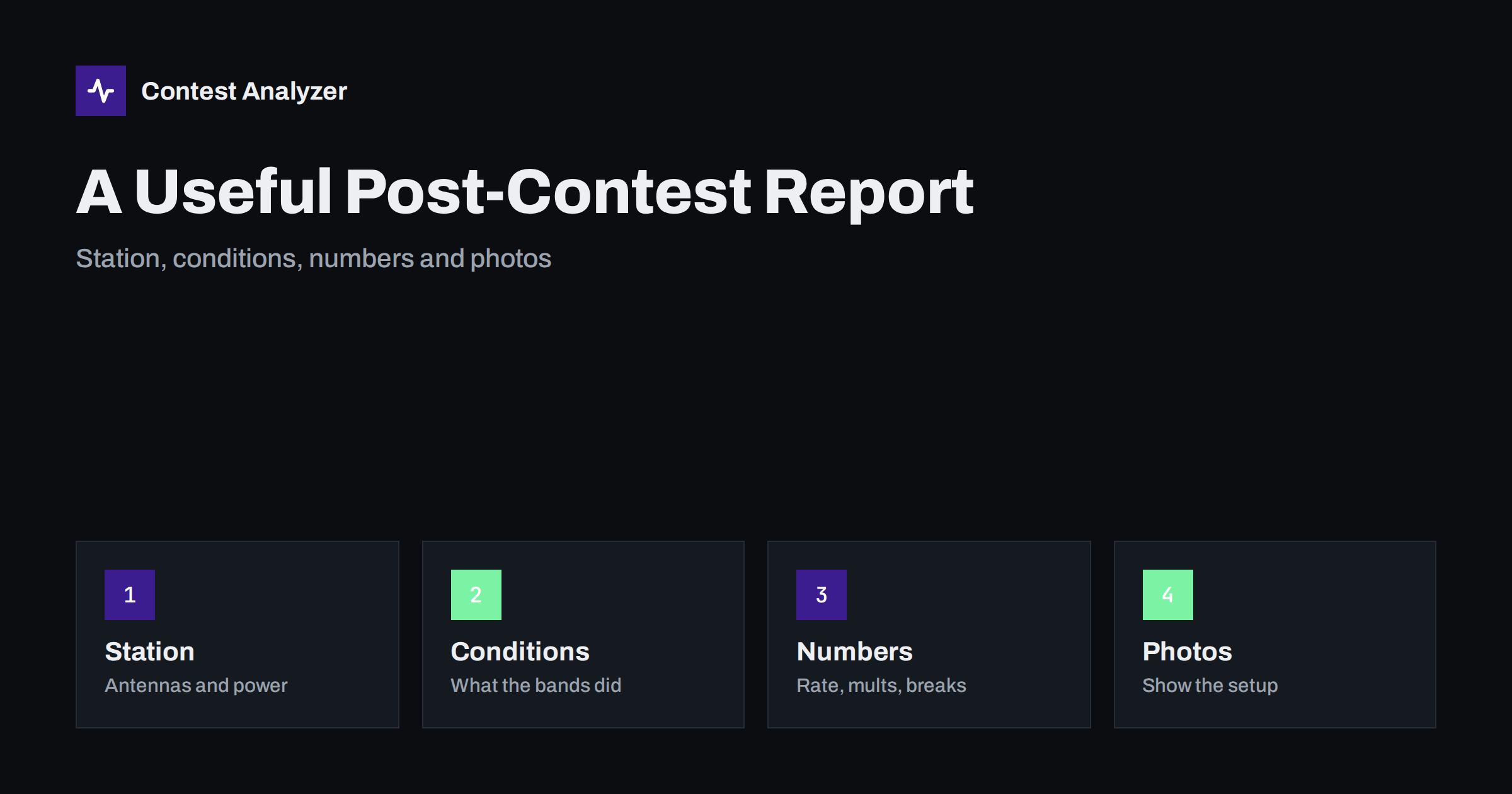
Open with a short block of facts: your callsign, the category, the location in general terms, the power level and the antennas. If you changed something since last year, say what. A new antenna, a new amplifier, a different operating position or a different logger are all worth a line. Readers want to know what a result was achieved with, and you will want the same information when you compare years. The article on keeping a station notebook explains how to collect this in one place during the year.
Be careful with the location. A general description such as the country or the region is usually enough. Do not publish your exact address or details that you do not wish to share. The same applies to photos, which can show a house number, a car plate or a view from a window.
Describe the conditions
Next, write a few lines about the propagation and the noise. Which bands were open to which continents and when? Was there a geomagnetic disturbance? Was the weather at your site a problem, for example with thunderstorms on the low bands? This information is useful to others, who can compare it with their own experience, and to you, because it helps to explain the numbers. The article on solar flux and contest results explains how to compare years fairly.
Keep the language plain. “Twenty metres was open to Asia early on Sunday for about two hours” is better than “the bands were good”. Do not invent numbers that you did not measure. If you do not remember, say so, or leave it out.
Add your numbers
A few numbers give the text a firm base: the number of QSOs, the multipliers, the claimed score and the operating time. If you have the statistics, add the best hour, the share of QSOs by band and the number of breaks. The numbers should be consistent with your log. If you post a claimed score that you later correct, note the change in the text or in a short second post, so that readers do not compare different versions.
The statistics are also a good source of material for the story. A report that says “the first night was weak on 40 m, and the rate recovered after sunrise” is more interesting than one with a list of figures. The article on hour-by-hour analysis shows how to find such moments in your data.
What worked and what did not
Readers value honesty. Say what worked, for example a strategy for the first hours or a change to your antenna, and what did not, such as a long search for a multiplier that never appeared or an equipment problem. A short list of lessons for next year is the most useful part of the report for you, and often for others. Avoid blaming other stations or the organisers. If you have a complaint, send it to the sponsor in a different way.
Do not describe how any checking of logs is done internally, either by the sponsor or by tools. Stay with what you saw and did. If you used a tool to review your log, you can say that you did, and what you learned about your own mistakes.
Photos that help
- The antennas. A clear picture of the main antennas and the mast says more than a paragraph.
- The operating position. A tidy desk with the radios, the screens and the headphones shows the setup.
- Screens with statistics. A screenshot of your rate chart or band chart is more interesting than a table.
- People. Photos with other operators are nice, but ask for permission before you publish them.
Use a moderate file size so that the page loads quickly, and add a short caption to each image. Write a text description for readers who cannot see the image. Avoid pictures that show a screen with a callsign list or personal data that you do not want to publish.
A simple outline you can copy
If you do not know where to start, use the same outline every time. It keeps the report short, and it makes the reports of different years easy to compare.
- One-line summary: the contest, the category and the claimed result.
- Station: radio, power, antennas, any change from last year.
- Plan: what you intended to do, for example which bands at which hours and how much rest.
- What happened: the conditions, the best hours, the surprises.
- Numbers: QSOs, multipliers, breaks and the main statistics.
- Problems: equipment, noise, mistakes that you found in the log.
- Lessons: three things to repeat and three things to change.
- Thanks: to the operators, the helpers and the stations you worked.
Each item can be one or two sentences. The point is not to write a long text, but to cover the same ground every year. After a few contests you will have a series of reports that tell the story of your station in a way that no single log can.
When you read old reports, you will notice how many details you would have forgotten. The date of the last antenna repair, the reason for a weak band or the name of a helper are all in the text. This is the most practical value of the habit: it turns each contest into knowledge for the next one.
Length, tone and timing
A report of three to six paragraphs is enough. Write it within a few days after the contest, when you still remember details, and before you start the log work if you want to catch your first impressions. Use the first person, short sentences and normal words. Write in the language that your audience reads, and check the spelling of callsigns and names, which are easy to get wrong.
If the contest has a place for soapbox comments, use it for a short version, and put the long version on your own page or in a club newsletter. Keep a copy of both, with the date, in your contest folder. If you publish in several places, keep the facts identical, so that a reader who finds both versions does not see different numbers. Check the figures once more against your log before you post, and correct any difference at once, because a corrected number that appears later is always less visible than the first one. Contest Analyzer helps with the numbers: it gives rates, QSOs by hour and band, countries, continents, CQ and ITU zones, WPX prefixes, distance, beam heading, breaks and off time, and year-on-year comparison with your own logs. See the contests page for the supported contests.
Think also about the readers who will find the report through a search a year or two later. They will not know the context of the weekend. Give the date, the full name of the contest and the mode in the first lines, so that the text can stand alone. Use the same spelling for the names of bands and categories as the sponsor uses, because that is the way people search.
Finally, be fair to yourself. A contest in which you made fewer QSOs than last year may still have been a good one, if the conditions were poor or if you tried a new method. Say so, with the numbers that support it. A fair report is more convincing than a modest one, and it makes the comparison with the next year more useful.
Related reading
The bottom line
A useful report is short, factual and honest: the station, the conditions, your numbers, what worked and what did not, with a few clear photos. Write it soon after the contest and keep a copy for your own comparison next year.
FAQ
How long should a post-contest report be?
Three to six paragraphs are enough for most readers.
Should I publish my exact location?
No, a general location is usually enough. Do not publish details you want to keep private.
Can I post a claimed score before I check the log?
You can, but say that it is claimed and note any later change.
Which photos are the most useful?
The antennas, the operating position and a screenshot of your statistics.
Do I need permission to show other people?
Yes, ask before you publish photos where other people can be recognised.