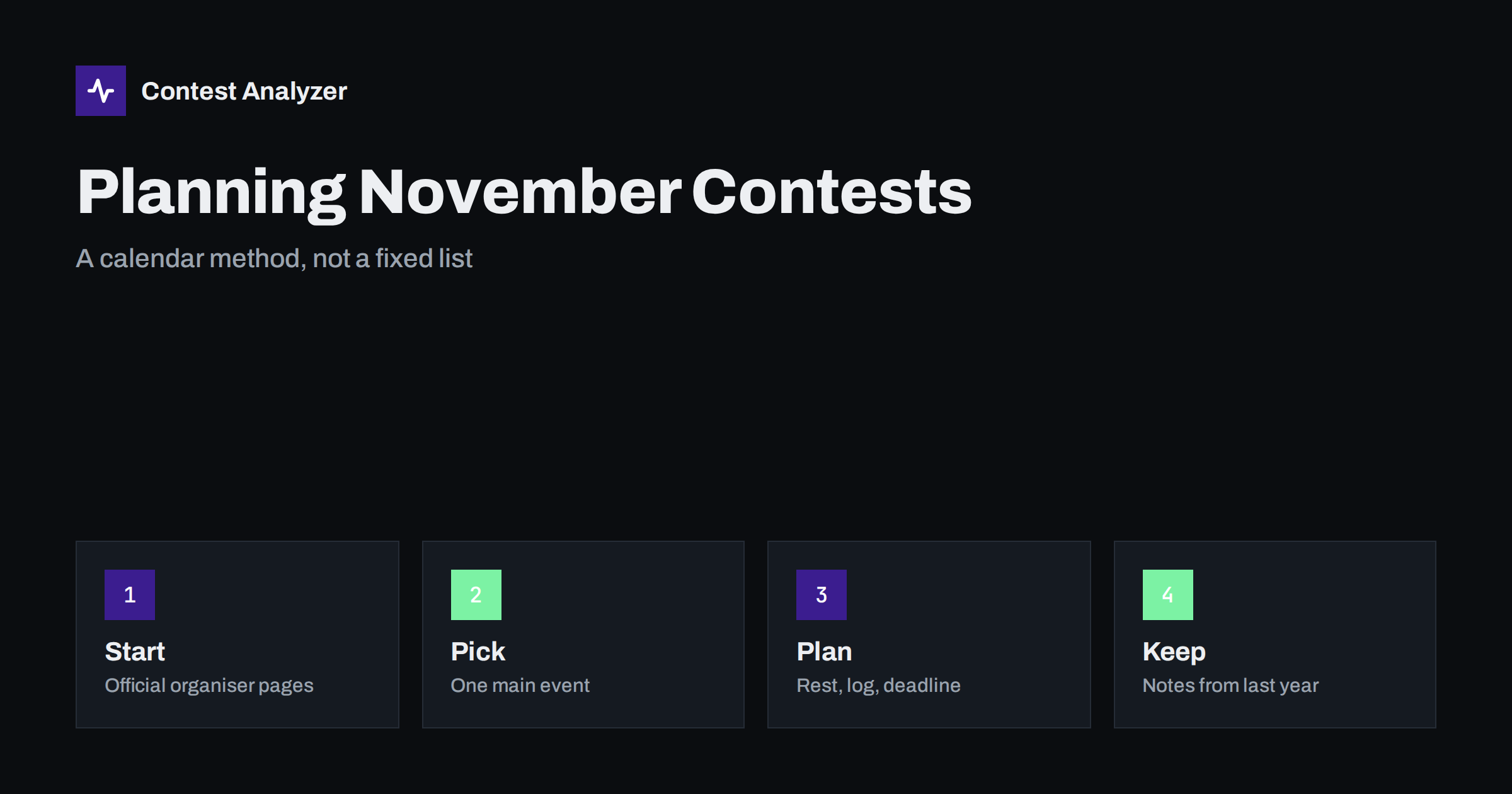
Short answer: November is one of the busiest months of the HF contest season, with the large CQ WW DX CW weekend traditionally near the end of the month and a number of other contests earlier. Dates, rules and even the list of events change, so this article does not give a fixed list: it gives a method. Start from the official pages of the organisers, pick one main contest, plan rest, logging and the log deadline for each weekend and keep notes from last year. Always check the dates yourself before you decide.
Why November is busy
In the northern hemisphere, autumn brings longer nights and better conditions on the low bands, and the contest calendar reflects this. Many operators regard November as the start of the main part of the winter season, with several well-known events, some regional and some worldwide, on successive weekends. For a contester, this is a good time to be active, but it also means that choices have to be made, because there are more weekends of activity than you can use.
Some events are large international contests with thousands of participants. Others are national or regional contests with a more relaxed pace. Some are limited to one mode, and some include several. A single month may offer both a first contest for a beginner and a challenge for an experienced operator. The point of a calendar is to help you to decide which of them to enter.
Where to get the dates
The only reliable source of dates and rules is the organiser of each contest. A contest may be held on a set weekend of the month in one year and on another in the next, and a rule that was valid last year may have changed. For this reason, a list in an article, a book or a forum post is a starting point, and nothing more.
- The official page of the contest. The most important source. Check the dates, the times in UTC, the modes and the rules.
- A contest calendar maintained by a society or a volunteer site. Useful for an overview, but verify against the official page.
- Your national society. Many societies publish a list of the events that their members commonly enter.
- Your own notes from last year. They tell you which contests you entered, what you thought of them and how much time they needed.
For the CQ contests, the rules pages such as the CQ WW rules are the places to look, and for the other contests, use the page of the organiser. The article on contest schedules and UTC planning shows how to convert the times in the rules to your local time and to avoid mistakes with the clock.
The main events in general terms
A November calendar usually has a few types of events. There is a very large, worldwide contest, and the CQ WW DX CW weekend has traditionally been held in the last part of the month, for which see the CQ WW DX CW checklist. There are national and regional events, in which the activity is stronger from one part of the world. There are also contests for specific modes, such as RTTY or digital modes, and some that are linked to a particular cycle or tradition. Which of them are held in a given year, and on which dates, you must find out from the organisers.
It is better not to make a plan on the basis of a remembered list. A contest may have been moved to another month, merged with another event or paused. When you build your calendar, write the date and the source next to each event, so that you can see where the information came from and check it again closer to the date.
Choose one main event
With several contests in one month, a good approach is to choose one main event and treat the others as optional. The main event is the one you prepare for: you check the station, you set up the logger and you plan the rest. The other events can be entered casually, as practice or for fun, without the pressure of a serious attempt. This approach is realistic for most people, who have work, family and other commitments, and it gives the best chance of a good result in the contest that matters to you.
When choosing, consider your station and your interests. If your antennas for the low bands are good, a contest with a lot of activity on the low bands may suit you. If you like a particular mode, choose that. If you are new, a contest with a simple exchange, such as the one described in the article on your first HF contest, is a gentle start.
Plan the weekend, not only the contest
A contest weekend has several parts, and each needs time.
- Preparation. Check the station, the logger, the clock and the backups some days before. See backups during the contest.
- Operating. Plan the hours when you will operate and those when you will rest. See off time and breaks and operator fatigue and breaks.
- Review. Reserve an evening after the contest to export and check the log. See the post-contest review routine.
- Submission. Know the deadline and plan to submit well before it. See log deadlines. For CQ WW the current rule is 48 hours after the end of the contest, and for the others check the rules.
If two contests fall on consecutive weekends, remember that the review and the upload of the first may overlap with the preparation of the second. It is wise to finish the first log before you begin the second contest.
Time zones and the clock
One of the commonest planning mistakes is to mix up time zones. Contest times are given in UTC, and the clocks in many countries change at the end of the summer, often in the autumn weeks, so that the difference between your local time and UTC changes. If you note a start time in local time in September and the clock change comes before the contest, you may arrive an hour early or an hour late. Write the contest times in UTC in your calendar, convert them to your local time on the day and check your logger clock at the start. The article on UTC clock errors in a contest log shows what can happen when the clock is wrong.
The same applies to the end of the contest and to the time of the log deadline. A deadline is usually given in UTC as well, and a few hours of confusion can mean that a log is late. When you are in doubt, count the hours in UTC and not in local time.
Balancing contests with the rest of life
A calendar with many contests looks exciting, but it must fit into real life. A 48-hour contest takes a weekend, and the preparation and the review take several evenings. A realistic plan for most hobbyists is to enter one or two major contests in a month and to use the others for short sessions. A few hours in a contest can still be useful: you gain some QSOs and multipliers, you practise your operating and you add a data point to your own statistics. The log of a part-time entry is also worth reviewing, and the figures will tell you something about the hours in which you operated.
If you operate with friends or as a club, agree on the plan early. Decide who will run the logger, who will do the review and who will submit the log. A shared calendar, with the dates and the tasks, avoids misunderstandings, especially for multi-operator entries, where the header of the log and the category must be agreed by everybody. See multi-operator categories and band-change limits for the usual points that groups need to settle.
Use last year’s numbers
Your own statistics are the best calendar tool. If you entered a contest last year, you have a log, a result and perhaps notes about what went well and what did not. Use them to decide whether to enter again, which category to choose and what to change. A review of the log from last year can be done now. Contest Analyzer checks every callsign and every zone against official license databases and several independent reference sources and shows only the few QSOs worth a second look. It gives full statistics, with rates, QSOs by hour and band, countries, continents, CQ and ITU zones, WPX prefixes, distance, beam heading, breaks and off time and callsign length and structure, and it lets you compare with your own logs from earlier years. You can edit calls or zones in the report and download a corrected Cabrillo. It works with Cabrillo from N1MM Logger+, DXLog and Win-Test and supports 22 contests, which you can see on the contests page. Serial numbers are not checked and dupes are not errors.
The article on setting realistic goals from last year’s statistics shows how to turn these figures into targets for the new season.
Keep a personal calendar
A simple personal calendar helps to keep the information in one place. For each contest, write the name, the date and time in UTC and in your local time, the mode, the category you plan to enter, the log deadline and the address of the rules. Add a line with the lessons from last year. Set a reminder a week before each event to check the rules again, because that is when changes are often announced. A calendar of this kind takes an hour to build and saves a lot of confusion during the season.
Related reading
The bottom line
November offers more contests than anyone can enter, so planning is a part of the pleasure. Get the dates from the organisers, choose one main event, plan the rest, the log and the deadline for each weekend and use last year’s numbers to decide what to do. Then check the dates again a week before.
FAQ
Which contests are held in November?
That changes from year to year. The CQ WW DX CW weekend has traditionally been late in the month, but always check the organisers’ pages.
Where should I check dates?
On the official page of each contest. Other calendars are useful but should be verified.
Can I enter several contests in one month?
Yes, but choose one main event and treat the rest as optional, so that you can prepare and rest properly.
When is the log due?
Each contest sets its own deadline. For CQ WW the current rule is 48 hours after the end of the contest.
How can I use my earlier logs for planning?
Review them and compare the statistics to see what worked, and write down what you want to change.