Short answer: In search and pounce, the best QSO often starts with a few seconds of listening. Listen to the station you want to call for at least one complete exchange, copy its callsign and the exchange it gives, check your dupe window, then call once and clearly at the moment when it finishes a QSO. This habit reduces dupes, busted calls and wasted calls, and it gives you the exchange before you have to ask for it.
Why calling early costs more than it gains
When you tune across a busy band, the urge to call is strong. A new multiplier is on the frequency, other stations are in the queue, and every second seems to count. Calling blindly, without having heard the call or the exchange, feels fast. But it often costs more: you may call a station that is a dupe, you may call before it has finished the previous QSO and be ignored, or you may call with a guess at the callsign and make a busted QSO.
Listening is not slow. A QSO normally takes a few seconds, and in those seconds you hear the callsign twice, usually once in each direction of the exchange, and you hear the exchange of the other station. With that information, your own QSO can be much shorter: you know the call, you know what to send back and you can check the dupe window in advance. The overall result is faster.
Listen to a full exchange
The best habit is to listen to one complete QSO on the frequency before you call. You hear the station you want to work calling CQ or answering, you hear the exchange that it sends and you hear the reply. You get the callsign, at least partly, twice, and you get a sense of how it sends: speed, accent, quality of the signal. If it is a rare multiplier, this short observation can make the difference between a good QSO and a failed one.
If your logger lets you enter the call while you listen, do it. Typing the call at this moment lets the logger show you the dupe status and the multiplier status before you call. The article on call history files explained describes a related feature, which fills the exchange from earlier QSOs. Take care that the data match what you hear.
Check the dupe window
Before you call, look at the dupe indicator. A dupe is a waste of your time and the other station’s, and in a high-rate contest it is easy to avoid. Most loggers show the status as soon as you type the call. Make this a reflex: type, look, then call. The article on dupes in contest logs explains why dupes arise and how they are treated, and cross-band dupes explained clarifies the cases of the same station on a different band.
Notice that a quick look is also a check of the multiplier status. If a station is not a dupe but is not a multiplier either, you may decide to leave it for later if you are looking for multipliers. You make the decision with information, not by chance.
Call at the right moment
The best moment to call is when the station has just finished a QSO and is about to listen. Calling in the middle of the exchange disturbs the QSO and gets no answer. Calling after a long pause may be too late, because others have already called. Listen for the end of the QSO: a final “73” or a short “TU” on CW, or the closing words on SSB. Then call once, clearly, with your callsign sent at a speed and quality that match the other station.
Send your callsign once or twice, then listen. Do not send it five times in a row; if there is no answer, wait and listen. If the other station replies with a partial call, repeat your call. If it replies with a different call, you are not the one it chose, and you can wait for the next gap. The article on CW pileup technique offers ideas for situations in which many stations call at once.
Use the band map and the waterfall
A band map or a waterfall display shows stations on the band, and some programs let you click on a station to tune the radio. That is a handy tool, but handle it with care. A callsign on the band map comes from a spot or from your own entry, and it is not always right for the signal you are tuned to. Always confirm by ear that the call you hear matches the one on the screen. If you do not, you risk calling a station that is not the one you intended, or logging a call that nobody has sent.
The band map is also a way to see which stations are worked and which are not, so that you can plan your search. The article on using a second radio for search and pounce shows how a second receiver can prepare your next QSO while you finish the current one, and a good plan reduces the pressure to call in haste.
Take the exchange from the air, not from memory
When you answer, copy the exchange that the other station sends. Do not fill it from memory or from a database, unless the contest rules and the nature of the exchange allow it. Zones, states and numbers may differ from your expectation. The article on zone errors in multi-zone countries shows how often the usual value is wrong. A short pause to copy the actual value is a good investment.
If you hear the exchange sent to another station before you call, you may already have it. Even so, check it once you reach the QSO. Some stations change their exchange, for example a serial number rises with each QSO, and a number that you heard a minute ago is already out of date.
When listening has to be quick
There are times when you cannot listen for a whole exchange: a station is about to leave, a band is closing or the contest is in its last minutes. In those moments, shorten the habit but do not drop it. Hear the callsign at least once, type it, check the dupe window and call. If you did not catch the call, wait for the next time it is repeated rather than guess. A few seconds of patience is still better than a wrong call.
The opposite situation is also important: a station that sends at a very high speed or in a very crowded spot may need more listening, not less. If you cannot copy the call after two attempts, move on. Time is the cost of a long attempt, and the next station is only a few kilohertz away. Accept that some QSOs are not worth the effort, as the article on partial callsign copies argues.
Common mistakes in search and pounce
A few errors appear in many logs. The first is calling on top of a QSO in progress. It disturbs two stations and rarely brings a reply. The second is calling a station that you have already worked on another band without checking whether it counts again. The third is calling with a guessed call from the band map, without checking by ear. The fourth is sending your call over and over without listening for the reply. The fifth is starting to log before the exchange is complete, so that a missing field is filled with a default value. Each of these is easy to avoid with the habits above.
There is also a mistake of attitude: to treat search and pounce as the lesser art. A skilled operator can gather many multipliers and QSOs by reading the band, choosing the right moment and calling cleanly. It takes as much skill as running, and the same attention to accuracy.
Practise and measure
Like any habit, listening before calling needs practice. In your next contest, try to follow the rule for an hour and compare the results with an hour in which you call as fast as you can. Look at the number of QSOs, the number of dupes and the number of repeats. Many operators find that the careful hour is not slower, and that the log is cleaner.
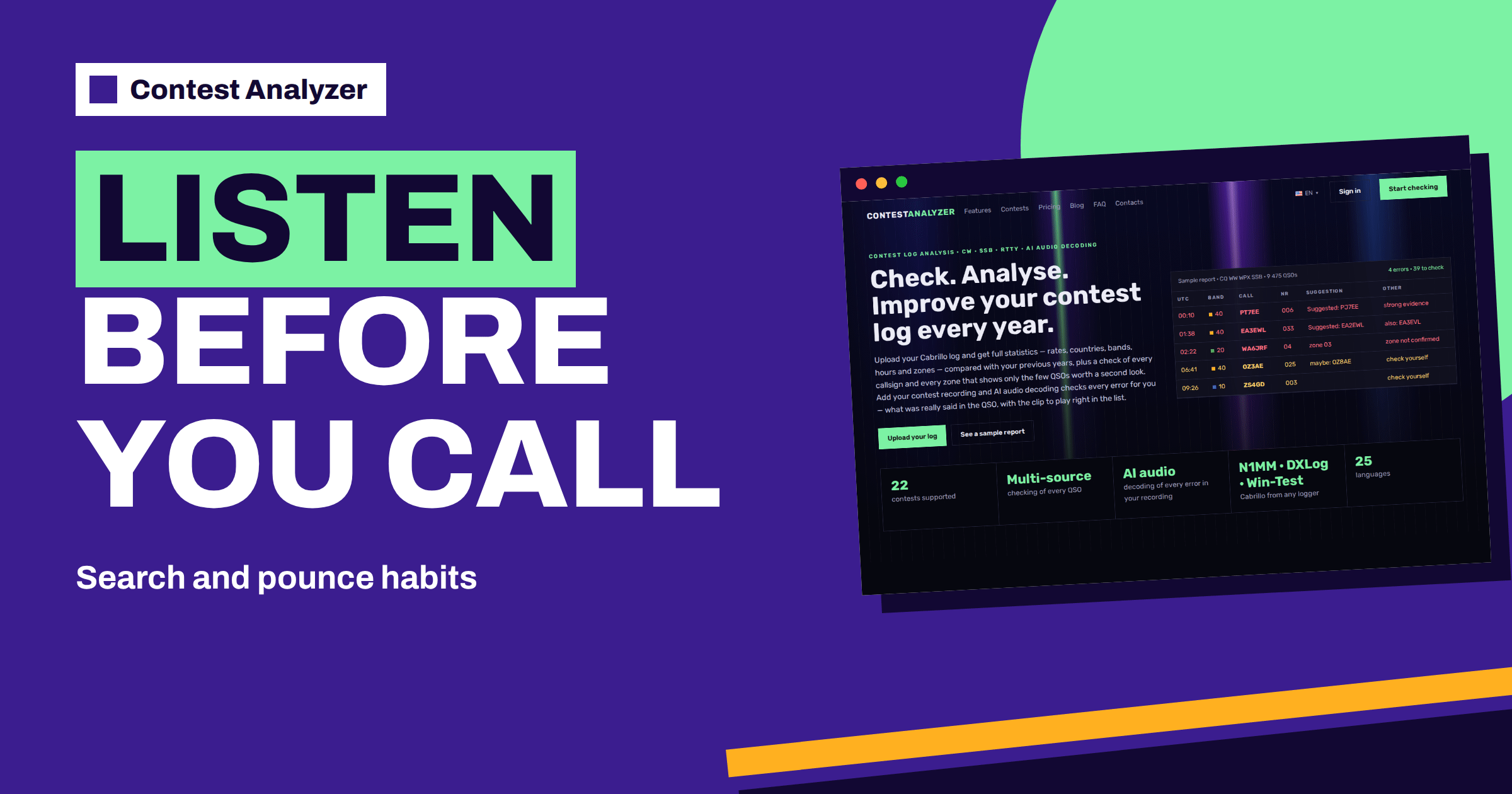
After the contest, you can see the effect in the log. Contest Analyzer checks every callsign and every zone against official license databases and several independent reference sources and shows only the few QSOs worth a second look. It also reports rates, QSOs by hour and band and breaks and off time, so you can compare search-and-pounce periods with run periods and see where errors cluster. Dupes are listed separately and are not counted as errors, and you can use the list to see how well your dupe check worked. See the contests page for supported contests.
Related reading
- Run vs Search and Pounce: Measuring Both
- DX Cluster Etiquette in Contests
- The Risk of Logging Partial Callsigns
The bottom line
Listening before you call is a small discipline with a large effect: listen to one exchange, check the dupe window, call once at the right moment and copy the exchange from the air. The result is fewer dupes, fewer busted calls and a log that needs less repair after the contest.
FAQ
Does listening first slow my rate?
Often it does not. Shorter QSOs, fewer repeats and fewer dupes compensate for the seconds spent listening.
What if a rare station is about to leave?
Judge the risk. Listen for at least the callsign, and call as soon as you are sure. A busted rare QSO gives nothing.
Can I trust the band map?
Use it as a guide and confirm the call by ear before you call or log.
How many times should I send my call?
Once or twice, then listen. Repeating it many times blocks the frequency and gains little.