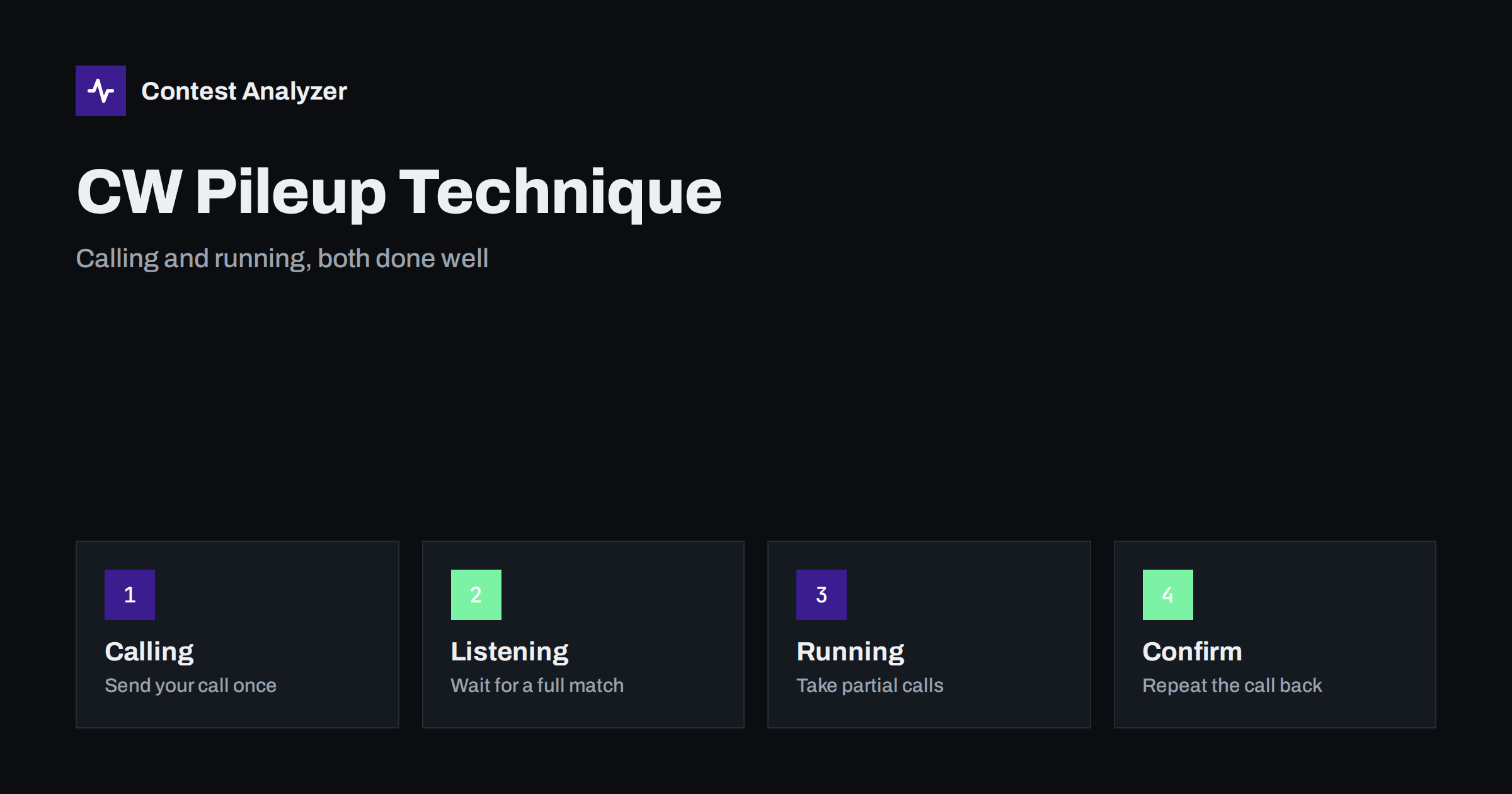
Short answer: In a CW pileup, the caller wins by sending his call once or twice at the right moment and then listening, while the station on the frequency wins by taking one call at a time and confirming it clearly. Both sides lose time and accuracy when they are in a hurry. A short confirmation of the callsign is the cheapest protection against a busted call and a not-in-log QSO.
What a pileup is in a contest
In a contest, a pileup appears when many stations want the same QSO at the same moment. It may be a station that is strong and in demand, a rare multiplier on a quiet band or a station that has just opened on a new band and has a queue. In such a case the frequency is crowded with callers, the signals overlap and the operator on the frequency can copy only part of what he hears. The method of working a pileup is a combination of listening skills, patience and a clear way of sending.
The rules of conduct are not complicated, but they are easy to forget when the rate is high. The principle is that both sides help each other. The caller makes it easy to be picked, and the station on the frequency makes it easy to be sure that the QSO is complete. The article on planning for rare multipliers describes when a pileup is worth your time and when it is better to move on.
As a caller: find the right moment
A caller who sends his call all the time never hears the answer. The better method is to listen first and learn the pattern of the station on the frequency. How fast does he answer? Does he take the strongest call, the first call or a call with a certain prefix? Does he work in a certain order, for example by call area? A few minutes of listening give the answer and also show you whether he is working split, which changes where you must transmit. The article on working split in contests shows how to log the frequency in such a case.
When you decide to call, send your callsign once, clearly and at the speed of the station on the frequency, then stop and listen. Send it again only if you hear that the operator is calling a partial call that can fit yours, or if nobody has been picked for a while. Calling over a QSO in progress is a mistake that hurts both of you, because the operator on the frequency has to ask again.
As a caller: timing and frequency
The best moments to call are the ends of QSOs, when the operator has just sent a confirmation and is listening for the next call. If you wait for the end of the previous QSO and start your call a moment after his transmission ends, the chance of a clean answer is higher than when you send in a random moment. When the frequency is very crowded, a small shift in frequency can help, if the operator tends to answer callers who are slightly off the frequency. Some operators ask for this by saying so. Do not move without a reason, because a shift may also make you invisible to the filter that the operator uses.
If you hear that the operator copies a partial call that you think is yours, answer with your full call once and wait. If he sends a different call, do not repeat yours at once. The conflict between callers with similar calls is one of the main sources of dupes and not-in-log QSOs, and a clear pause usually solves it.
As the station on the frequency: take one call at a time
The operator who runs a frequency has the harder task. He hears many calls at once and has to pick one. The most efficient method is to pick any part of a call that he is sure about and send it back, with a question mark if needed. Then the stations whose call fits that part can answer, and the others stay silent. This is the technique that is often called working with partial calls, and it brings order into the frequency. The article on logging partial calls in a pileup shows how this is done in the logger.
It helps to be consistent. If you always pick the strongest, callers learn that and stop sending when a stronger station is calling. If you always answer in the same rhythm, callers learn when to send. Many operators in a long pileup also use a short fixed phrase between QSOs to mark the moment that callers should start again.
Confirm the call, always
The most important step after the pick is the confirmation. Send the full call of the station that you have copied, followed by your exchange. The other station then knows that you have his call correctly, and if you have it wrong he can correct it at once. This step takes about a second and removes one of the biggest causes of busted calls and not-in-log QSOs. The article on busted callsigns explains the cost of an error.
When the station answers your exchange, wait for his confirmation before you log it. If the exchange needs a repeat, say so clearly. An incomplete QSO should not be logged, and a QSO that you are not sure about is better logged only after you have settled it. In a contest where dupes are allowed, a second QSO with the same station is cheaper than a wrong log line. The article on dupes in contest logs explains why.
The rules and the spirit of a pileup
Contest rules do not usually describe the technique of a pileup, but they do affect it. The rules set limits on assistance, on the operating time, on the power and on the way in which a contact is valid. A QSO is complete only when both sides have received the callsign and the exchange, and the way in which you log it must correspond. Check the current rules of the contest for the exact definition. For the CQ WW rules, the contest sponsor’s pages are the official reference, for example the CQ WW rules page.
Good manners matter, too. Do not call on top of a QSO. Do not keep sending after the operator has chosen another station. Do not ask for a repeat of the exchange if you heard it. These habits make the pileup work for everybody, and they reduce the number of errors in all logs.
After the pileup: check the log
A pileup is a place where errors are made, so look at those QSOs again after the contest. Pay attention to calls that appear only once, calls that are similar to others in the same period and exchanges that were corrected during the QSO. Contest Analyzer checks every callsign and every zone against official license databases and several independent reference sources and shows only the few QSOs worth a second look. You can edit calls, zones, time and frequency, mark QSOs checked in your own audio recording, duplicate a QSO line and download a corrected Cabrillo. It works with Cabrillo from N1MM Logger+, DXLog and Win-Test, and the contests page shows the supported contests.
The rate chart is also a guide. A long flat run at a high rate, followed by a drop in the same hour, shows a pileup that gave points and then ended. Look at what happened during and after it, and ask if you would do the same next time.
Pileups on the low bands and with weak signals
On the low bands and in poor conditions, a pileup is a different challenge. Signals fade, the noise level is high and the operator on the frequency often has to ask for repeats more than once. As a caller, you will gain more by being patient than by raising your power of voice; there is no such thing in CW, but there is the equivalent in calling too often. A call sent at the wrong moment into a fade is wasted, and the same call a few seconds later may be heard clearly. Listen to the fading pattern for a minute and send when the signal of the station on the frequency is at its best, because your own signal at the other end is then probably also better.
As the operator on the frequency in such conditions, slow down a little, repeat the call that you picked and be ready to send it more than once. A calm and regular rhythm helps callers to understand that you are still working and that their turn will come.
Practise before the contest
Pileup technique can be practised outside contests. Work a rare DX station in a quiet period, or listen to a pileup without calling and notice how the operator picks the stations. Copy the rhythm and the choice of partial calls. The article on your first CW contest contains a few exercises that fit this purpose. A few hours of listening can improve your technique more than a few hours of calling without a plan.
Related reading
The bottom line
A pileup works when callers are patient and the operator on the frequency is clear. Send your call once and listen, take one call at a time, confirm it back and check the doubtful QSOs afterwards.
FAQ
How often should I send my call in a pileup?
Once or twice, then listen. Continuous calling prevents you from hearing the answer.
What if the operator answers with a partial call?
If it fits your call, answer with your full call once and wait. If it does not fit, stay silent.
Why is a confirmation of the call important?
It gives the other station a chance to correct an error and prevents busted calls and not-in-log QSOs.
Should I call off the frequency?
Only if the operator works split or asks for it. Otherwise stay on the frequency and be clear.
Can I log a QSO that I am unsure about?
It is better to settle it first. A repeat costs seconds, a wrong line can cost the QSO.