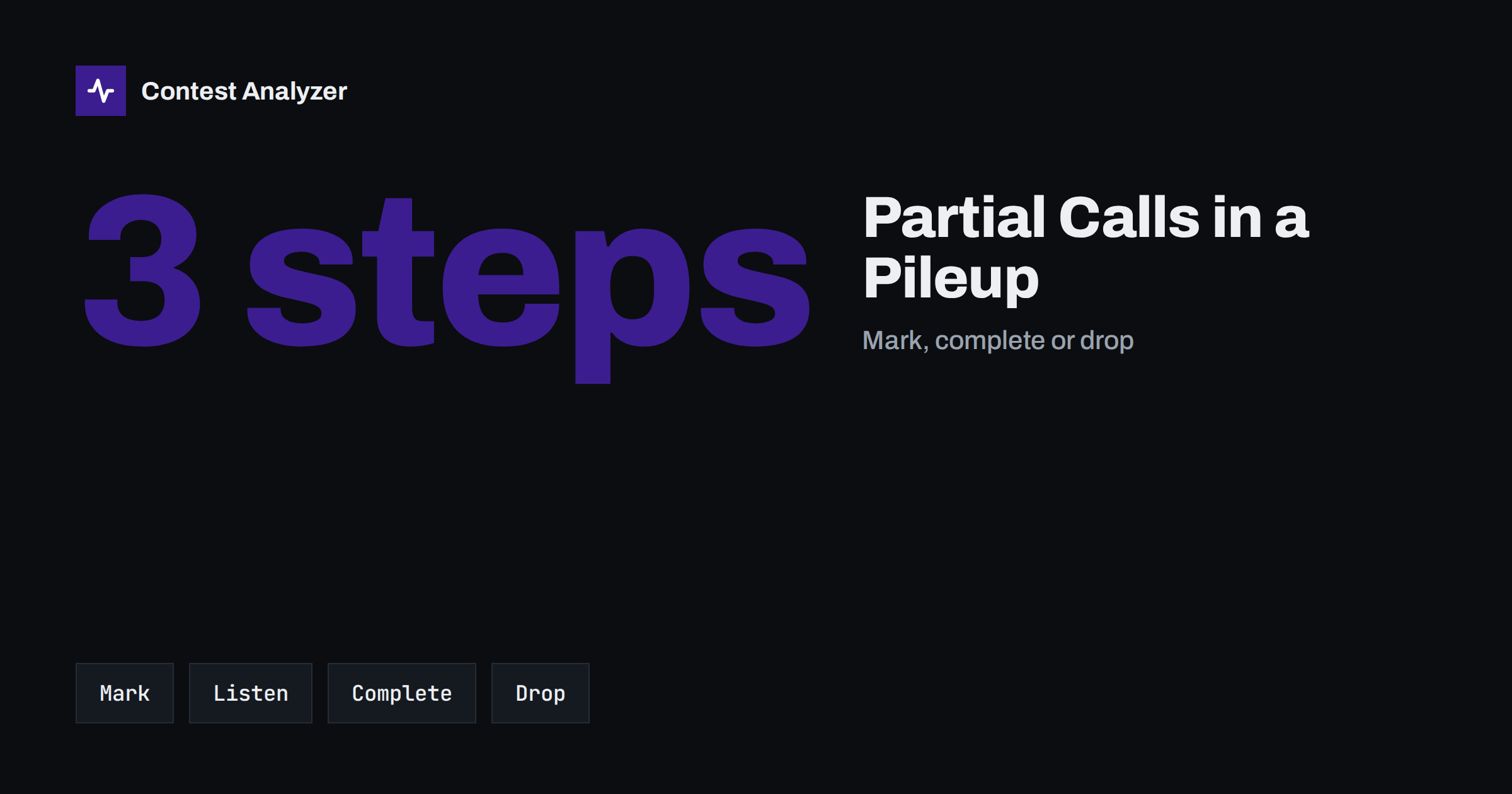
Short answer: In a big pileup it is normal to catch only the first part of a call, such as K2 or K3, and to move on. That is acceptable as a working note, but it must not stay in the log that you send. After the contest, complete each partial call only if you can prove the full call, for example from your own audio recording. If you cannot prove it, remove the QSO. A half-call in the file is an error whatever you meant by it.
Why partial calls happen
When a rare station calls CQ and hundreds of stations answer at once, the signal that you hear is a mixture of callsigns. You may catch the prefix and the digit of one caller, and the suffix is lost. The caller who is selected sends the call again, or the DX station replies with a partial, and you must decide in a moment whether to wait for the full call or to call again. In a run, with a steady stream of callers, the same situation arises on a smaller scale. You hear “K2” and the rest is covered by a louder station.
Operators solve this in different ways. Some ask for the full call every time. Some log what they have and fill in the rest later. Both are legitimate, but the second one needs a clear system, because the log is only as good as the memory that you have at the end of the contest.
Why K2 and K3 are special cases
The examples of K2 and K3 are common because the United States has so many stations, and many of them have calls that start with the same letter and digit. The beginning of the call gives you very little information. It is a single prefix letter and a digit, followed by one to three letters that you have not heard. There are thousands of possible calls behind “K2”. The same is true for calls that start with W, N or A in the United States, and for any large country where the number of licences is high.
This is the reason why a partial call is so risky. You cannot infer the suffix from the context, and a guess has a very small chance of being right. If you complete “K2” with the call of a station that you worked earlier, you will probably produce a busted call or a duplicate of an earlier QSO. The article on busted callsigns shows what such an error costs.
How to mark a partial call during the contest
The mark should be quick and should not enter the exported file by accident. Most loggers offer one of these options:
- A question mark in the callsign field. It is fast, but it stays in the log until you remove it, and it is dangerous at export time.
- A note or comment field. You enter the call as heard in the callsign field and write “check” in the note. The note is not exported.
- A time mark in your paper or electronic notes. You write the time of the QSO and the part of the call you heard. This is slow, but it is independent of the software.
- A function key that starts the audio mark. If you record the whole contest, you can add a marker to the recording at that moment.
Whatever method you choose, it should take a second. Under pressure, only a method that takes one keystroke will be used.
How to complete the call afterwards
After the contest, go through your marked QSOs one by one. The best source is your own audio recording, as the article on using audio to fix log errors describes. Listen to the QSO at the logged time, find the moment when the other station gave the full call and write it down. If the recording does not contain the complete call, you do not have a proof, and you should not complete it.
What is not a proof? The following sources are not enough on their own:
- A call that looks similar in a list of stations that you have seen in the contest.
- A call that you worked the day before and that has the same beginning.
- A call that a friend or a club member remembers.
- A call that the logger suggests when you type the first letters.
These are leads. They tell you where to listen in the recording, but only the recording itself can confirm the answer.
When to drop the QSO
If you cannot complete the call with certainty, remove the QSO from the log that you send. You lose one QSO and, if the station was a new multiplier, perhaps that multiplier as well. This feels like a loss, but it is smaller than the loss of leaving a wrong call. In many contests a wrong call removes the QSO and may also remove a second QSO as a penalty, according to the current rules. The article on the UBN report describes how such penalties appear.
It is also worth asking why so many QSOs are partial. If you have dozens of them, the cause may be a habit of not asking for a repeat, a noisy audio chain or a setting of the receiver filters that does not match the conditions. Look at your notes and decide what to change in the next contest.
Asking for the repeat in the right way
The cost of a repeat depends on the situation. In a run on CW, sending the partial call with a question mark takes a second or two, and the right station usually answers. On SSB, giving what you have and asking for the call again takes longer, but a calm operator can manage this in a pileup with a short phrase. When you are searching and pouncing, you can simply wait until the station gives its call again, because the next QSO in the pileup usually offers a new chance.
A common mistake is to send the partial call and then log the station that answers without checking that it is the same one. If you send “K2?” and a station with the call K2ABC answers, you can log it. If you send it and a station with a completely different call answers, you have a different QSO. Keep each QSO separate in your head and in the log.
A worked example of the routine
Suppose that on Saturday evening you log eleven QSOs with a marker because the calls were incomplete. On Sunday during a slow hour you do not touch them, because the rate is more important. After the contest you sort the list by the marker and open the recording at the first time. In seven cases you hear the other station give the full call twice, and you correct the entry. In two cases you hear only the first part, and the rest is lost in noise, so you remove the QSOs. In the last two cases the recording is missing because of a short interruption of the program, and you also remove them. The result is nine QSOs fixed or removed on a calm evening, and none of them reaches the checker as an error.
The routine has three parts: a marker, a list and a decision for each item. The only time pressure is during the contest, and then it costs one keystroke. All the thinking happens later, when you have the recording and the time.
You can improve the routine each year. Count how many QSOs you marked, how many you could complete and how many you dropped, and write the numbers in your station notebook. If the share of dropped QSOs is high, work on your copying habits. If the share of completed QSOs is high, your method works and you can keep it.
What a checker finds in your file
Half-calls are among the easiest errors for a checker to find, because they cannot match any station. They are also among the easiest for you to fix, if you look for them. Contest Analyzer checks every callsign and every zone against official license databases and several independent reference sources and shows only the few QSOs worth a second look. In the report you can edit the call, mark the QSO as checked in your own audio recording and download a corrected Cabrillo. The corrected file is only as good as your evidence, so use the editing function only for what you can prove. You can see the supported contests on the contests page.
Related reading
The bottom line
A partial call is a note to yourself, not a QSO. Mark it in a way that stays out of the exported file, complete it only with proof from your recording and drop the QSO when the proof is missing.
FAQ
Is it acceptable to log only K2 and fix it later?
Yes as a working note, but the call must be completed or the QSO removed before you submit the log.
Can I guess the suffix from my earlier QSOs?
No. A guess is not proof and often produces a busted call.
What is the best proof for a doubtful call?
Your own audio recording of the QSO, where you can hear the other station give its full call.
Does a partial call cost more than a dropped QSO?
Usually yes, because a wrong call can remove the QSO and may add a penalty under the current rules.
How many partial calls are normal?
It depends on the contest and the conditions, but a large number suggests that you should ask for repeats more often.