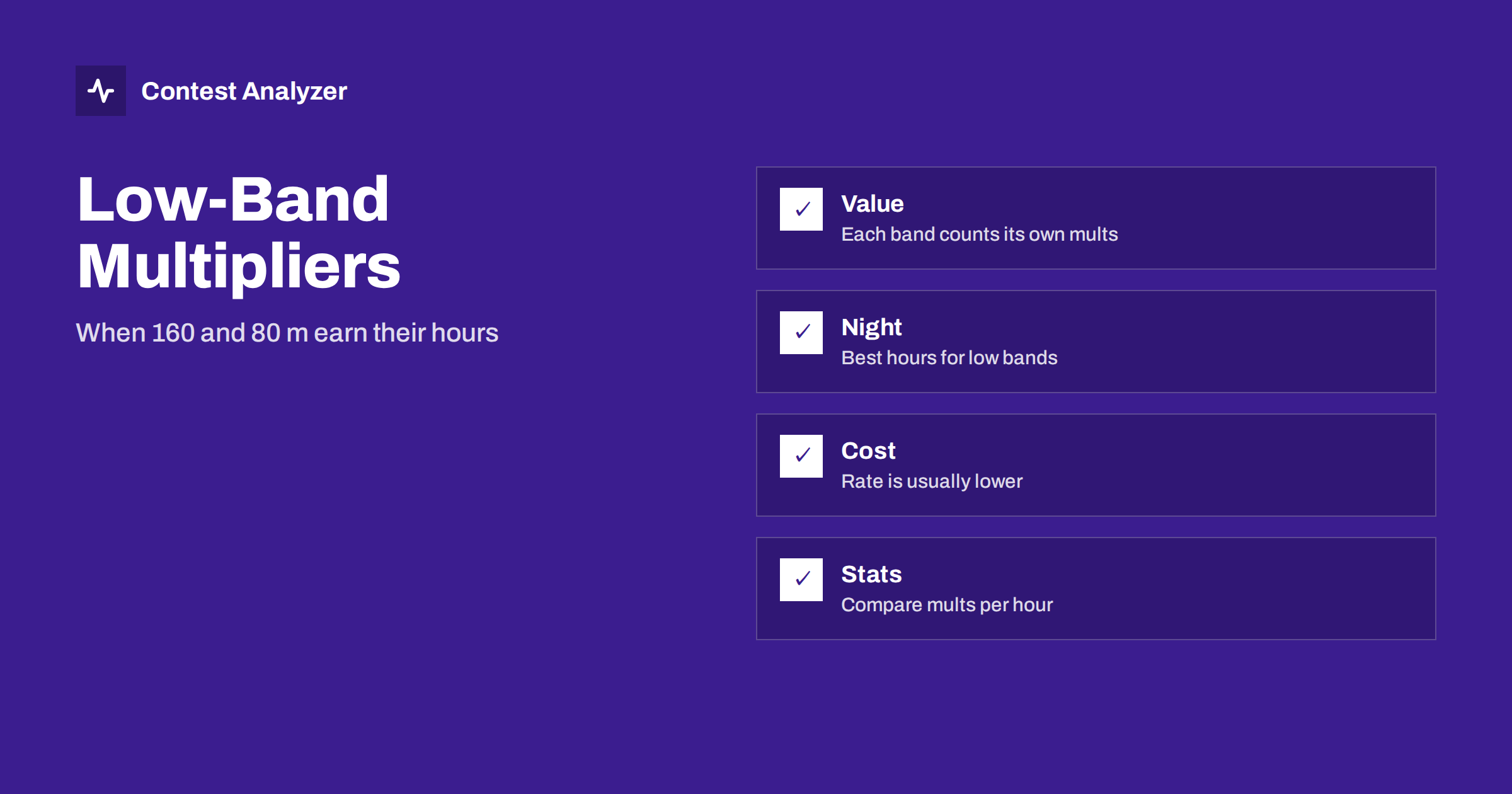
Short answer: In CQ WW, zones and countries count as multipliers on each band separately, so a new zone or country on 160 or 80 m adds the same as one on 20 m. The rate on the low bands is usually lower, but the multipliers there are often easy to reach at the right hours. Your statistics show whether the hours you gave to the low bands paid back in multipliers per hour.
Why low bands matter for the score
The CQ WW score is the number of QSO points multiplied by the sum of zones and countries worked on each band. Because the multipliers are counted per band, a station that is active on five or six bands has a larger pool of possible multipliers than a station on one or two. The low bands add to that pool, and a country that you worked on 20 m counts again if you work it on 80 m.
The low bands are different from the high bands in the way they work. They are open mainly in the dark hours at your location and at the other end, they need good antennas and a quiet receiving site and they often have a lower rate. The article on low bands at night describes the general strategy. Here we look at how to judge it with numbers.
A simple way to value the hours
To decide if the low bands are worth your time, compare two numbers for each hour: the number of QSOs and the number of new multipliers. A high-rate hour on 20 m may give 100 QSOs and 3 new multipliers, because most of the countries and zones are already in the log. An hour on 80 m may give 40 QSOs and 8 new multipliers, because the band is fresh. If each multiplier is worth more than the points of a QSO, the 80 m hour is the better one. The exact balance depends on your total score, which is why the comparison should be made with the real numbers of your contest.
The article on new multipliers per hour shows how to read the curve. At the beginning of a band the curve rises quickly, and later it flattens. The point at which the curve flattens is the point at which it is better to move to another band.
When the low bands are most productive
The first productive period is the night at your location, especially the hours around the local sunrise and sunset, when the path to the other side of the world is open. These are the times when long-distance multipliers appear on 160 and 80 m. A second period is the time when the high bands start to close for a region. If you observe that the 20 m rate drops at night, you can move to a lower band without losing the whole rate.
Conditions are not the same each year. The article on solar flux and K index explains how the state of the ionosphere affects the results. A quiet geomagnetic situation is good for the low bands, and a disturbed one reduces the signals. If you compare years, take the conditions into account.
The cost of working the low bands
Time on the low bands has costs. The rate is usually lower, because the stations are weaker and the calls are harder to copy. The noise level is higher and the number of busted calls tends to grow. The article on why logging errors cluster at night describes this problem. Fatigue adds to it, because the low-band hours often come when the operator has already been awake for a long time.
There are also practical limits: antennas, ground systems, receiving antennas and the level of local noise. Many stations cannot work the low bands at the same level as the high bands, and for them the best plan may be a short, well-chosen period of low-band operation instead of a long one. Your statistics will show if this is true for you.
Reading the band picture in your log
After the contest, open the table of QSOs and multipliers by band and hour. For each low band, mark the hours when the number of new multipliers was high and the hours when it was low. A few questions help to read it:
- When did the first multipliers appear on 160 and 80 m, and when did the flow stop?
- How many QSOs did you work on 160 and 80 m for each new multiplier?
- Did the low-band hours replace high-band hours with a better rate?
- Did you start the low-band session too late or end it too early?
- How many of the multipliers worked on a low band were also worked on a high band?
The article on reading a band-by-hour picture shows how to put these numbers into one grid. Contest Analyzer gives QSOs by hour and band, countries, continents, CQ and ITU zones, rates, breaks and off time, so that you see the relation between rate and multipliers in one place. It also checks every callsign and every zone against official license databases and several independent reference sources and shows only the few QSOs worth a second look. It works with Cabrillo from N1MM Logger+, DXLog and Win-Test.
Where multipliers come from
For the low bands, the multipliers are mainly the zones and countries that are far away or rare. The typical case is an Asian or Pacific zone from a European location, or a North American zone from the Pacific. If you know the zones that are missing in your log, you can plan the time to look for them. The article on planning for rare multipliers gives general advice about patience and the moment to leave a band.
The list of countries also matters. Country lists, such as the DXCC list, are updated from time to time, and a logger with an old country file may count a country wrongly. Update the country file before the contest, and check the current rules for the list used in CQ WW.
Plan, then adjust
A good plan for the low bands has three parts. First, decide the hours in which you will try them, and a minimum number of multipliers per hour for staying there. Second, decide which signs will bring you back to the high bands, for example a rate that falls below a certain level. Third, prepare the practical side: antennas tested, filters ready, a light snack and a place to rest. Then use the real result of the contest to correct the plan for next year.
The article on multiplier strategy in CQ WW shows the same idea for the whole contest. The low bands are one part of the picture, and the numbers will tell you how large a part they should be for your station.
Antennas and receiving conditions on the low bands
The value of the low bands also depends on what you can hear. A transmitting antenna that is only average can still bring good results if the receiver is quiet and the receiving antenna is directional. Many experienced low-band operators say that you cannot work what you cannot hear, and that the biggest improvements often come from reducing noise and not from adding power. A separate receiving antenna, a small loop or a long wire that is placed away from the noise sources can make the difference between a band that is only noise and a band with many readable stations.
Look at your own results from this angle. If your low-band QSOs are mostly strong stations close to you and rarely a distant one, your receiving situation may be the limit, and a small change in the receiving set-up can raise the number of multipliers. The antenna comparison in judging an antenna change with your contest statistics shows how to use the numbers to test such a change.
Running and calling on the low bands
On the low bands, many stations run on the same part of the band and calls are crowded into small segments, so it can be difficult to find a clear frequency to run. For that reason, searching and pouncing is more common there than on the high bands, and the multipliers often come from calling stations that are already running. This changes the way you should read the rate: a low rate on 160 m is typical, and a low rate is not by itself a sign that the choice was wrong. The measure is the number of new multipliers, not the rate.
When you do run on a low band, expect that callers will come in waves. A good run on 80 m at the right hour can be very productive, particularly when it brings stations from other continents that have just opened. Use your statistics to see how long these runs lasted in the previous years, and plan the hours so that you are there when they start.
Related reading
The bottom line
Multipliers count per band, so the low bands can pay back well when they are open and fresh. Judge them by new multipliers per hour, use the night hours and adjust the plan with your own statistics.
FAQ
Do zones and countries count again on each band?
In CQ WW, multipliers are counted per band. Check the current official rules for the exact scoring.
Is it better to stay on 20 m with a high rate?
Not always. When the number of new multipliers per hour falls, a lower rate on a fresh band can give more.
Which hours are best for 160 and 80 m?
Mostly the night hours at your location and the hours around sunrise and sunset. Conditions change from year to year.
How can I measure the value of a low-band hour?
Compare QSOs and new multipliers per hour for each band in your statistics.
Should every station work the low bands?
It depends on antennas and noise at your site. A short, planned period may be better than a long one.