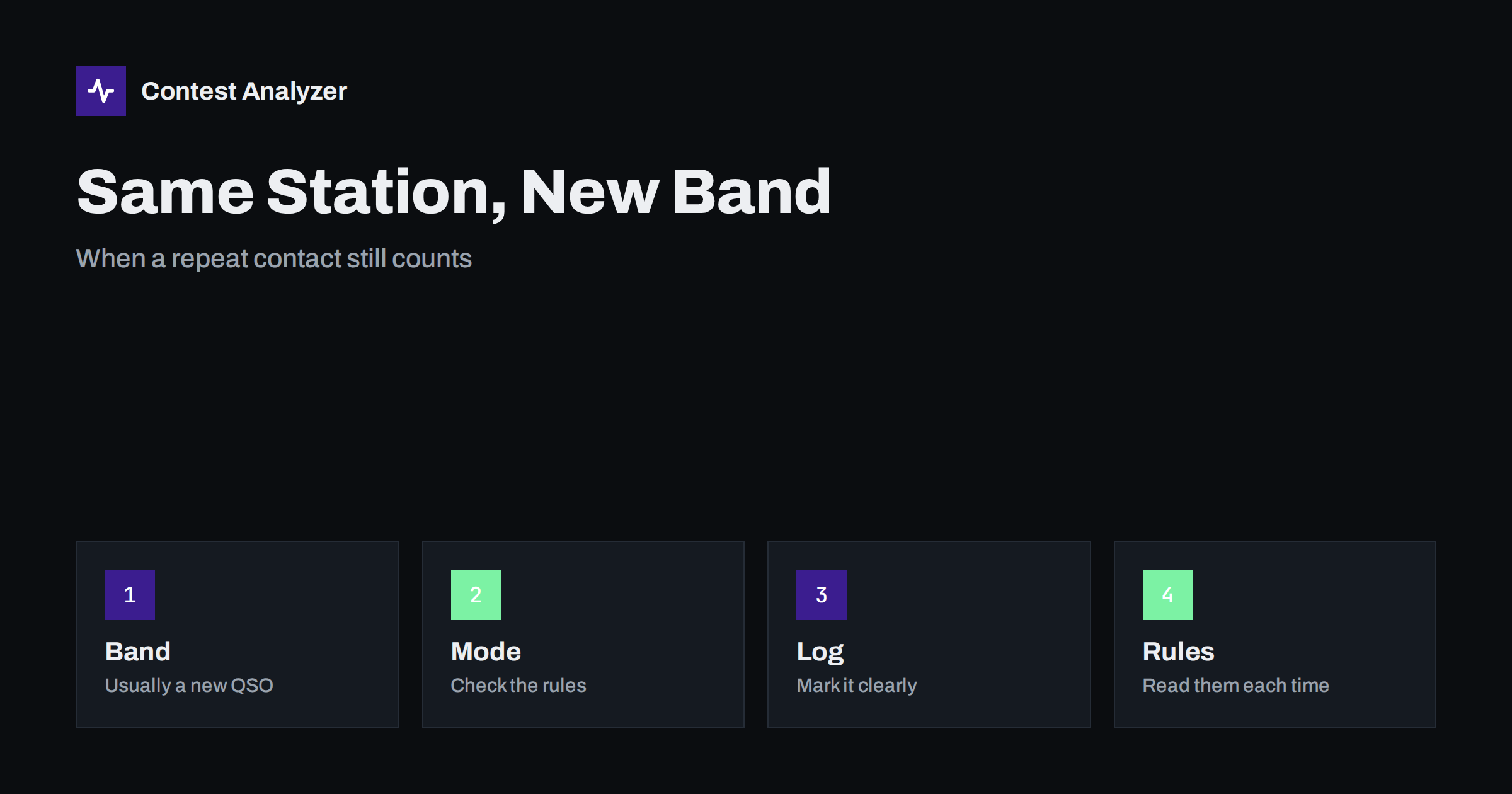
Short answer: In most big HF contests, working the same station again on a different band is a new, valid QSO, while working it again on the same band is a dupe. But the details depend on the contest: some events treat different modes as separate, some count a contact only once for the whole event, and some change the rule from year to year. Read the current rules, make the logger follow them and log every legitimate repeat contact without hesitation.
The basic principle
Most HF contests are built so that a station can be worked once per band. The reason is that the score is based on QSOs and on multipliers that are counted per band. A station that is heard on 40 m and later on 20 m is, for scoring purposes, two opportunities. This is the rule in several of the large contests, but not all of them, and a station that applies it in one event by habit can be wrong in another.
The word dupe means a repeated contact with the same station on the same band, and, where the rules say so, in the same mode. A dupe scores nothing, but it is not a serious fault. Our article on dupes in contest logs explains why working a dupe can be better than a long argument, and worked-before checks explains why dupes are not errors.
Band: the usual rule
When a contest counts QSOs per band, the logger keeps a separate worked-before list for each band. If you call CQ on 15 m and a station that you worked on 20 m answers, the logger will not mark a dupe, and you should take the QSO. This is also the reason many operators spend time moving through the bands: every band change brings a new set of possible contacts and a chance for multipliers, as the article on band changes and rate discusses.
The same station can be useful for multipliers as well. A rare country or zone worked on a second band counts again if the multiplier is counted per band. For this reason, many operators ask the station to move to another band, a practice that has rules of its own, described in QSY requests for multipliers.
Mode: where rules differ
In a contest with CW, SSB and RTTY sections that run at the same time, the mode may count. Some events allow the same station to be worked once on each mode on the same band; others treat the contest as one mode only, and a contact in the wrong mode is outside the rules. The usual large contests are separate by mode: there is a CW weekend and an SSB weekend, and you operate in one mode only, so the question hardly arises. In mixed-mode contests, read the rule on modes with care.
If your logger has a setting for dupe checking by band and mode, check it before the contest. A setting made for another event can mark a legitimate contact as a dupe or fail to warn you about a real one. The article on logger settings to check before a big contest has a list that includes this point.
Once per contest: the exception
Some contests count a station only once for the entire contest, whatever the band. In those events, a second contact on another band does not add to the QSO count, though it may still count for a multiplier, depending on the rules. Others use time limits, for example allowing a repeat contact only after a certain time. The rules are not the same everywhere, and they change. Never assume that what you know from one contest applies to the next.
When you read the rules, look for a short paragraph that deals with duplicate contacts. It is often near the scoring section. Write the key points in your notebook: per band or per contest, per mode or not, and what happens to a duplicate in the log. The article on category overlays shows how a whole set of such rules can be brought into one page of notes.
Logging the repeat QSO correctly
A legitimate repeat on another band must be logged as a full QSO, with the right band, frequency and exchange. If you change the band on your radio but the logger still shows the old one, the QSO will be logged on the wrong band and will look like a dupe in the log. Always check the band field at the moment of logging. The articles on wrong band after antenna or band switching and on wrong frequency in the log describe how this happens.
In the exchange, send the full information again. Some serial-number contests give a new number for each QSO, even if the station is the same. In zone-based contests, the zone stays the same. Be consistent with what you send, since an inconsistency between two QSOs with the same station can make a log checker look closer.
What if the logger shows a dupe by mistake?
Sometimes the logger marks a dupe that is not one. A typical cause is a mistake in the callsign field, such as a call typed with a leftover portable indicator, or a band setting that did not change. Look at the details before you refuse the QSO. If the contact is valid, log it. If you are not sure, working the contact costs little, because a dupe does not usually give a penalty, and a refused valid contact costs the other station a QSO.
The reverse case is a real dupe that the logger did not catch, perhaps because the first QSO was logged with a different form of the callsign. This will be a dupe in the final log and will be removed from the score. It is a minor loss, but it may also show a problem in the logging habits that you should look at.
How dupes appear after the contest
When you check the log later, dupes are listed separately from errors. They should not be deleted unless the rules tell you to, because the organiser’s software will handle them. Contest Analyzer follows this view: dupes are not errors. It checks every callsign and every zone against official license databases and several independent reference sources and shows only the few QSOs worth a second look, and it lets you edit calls, zones, time and frequency in the report. See the FAQ for the short answer on dupes. Serial numbers are not checked.
Count the number of repeat contacts in your log by band. If many of your QSOs are repeats on a second or third band, that is a sign of a good use of the bands. If you have many dupes on the same band, check whether you are forgetting to look at the worked-before indicator or whether a bad clock or a missing macro is involved.
Three short examples
First, imagine a contest that counts QSOs per band. You work a station on 40 m at 21:10 UTC and again on 20 m at 09:40 the next morning. Both are valid, both score, and the second one may add a multiplier on the new band. In the log they appear as two lines with two different bands, and a good logger will not complain about either.
Second, imagine a contest that counts a station once per contest. You work the same station on 15 m and later on 10 m. The second QSO is a duplicate for the QSO count, but if the rules count multipliers per band, the station may still be a multiplier on the new band. Here the right action depends on the exact wording, which is why a note taken from the rules is more reliable than memory.
Third, imagine a station that calls you three times on the same band within ten minutes because it did not hear your reply. This is a dupe the second and third time. A short acknowledgement, a polite word and a return to CQ is the usual way to handle it. Some operators log such repeat attempts in a separate note, which helps if the other station later claims that the first QSO was incomplete. Whatever you do, keep your tone friendly, since the other operator may not know the rule.
These examples are simple, but they show the habit that matters: know the rule, let the logger apply it, and judge each unusual case calmly.
Related reading
- A Dupe or a Busted Call? How to Tell Them Apart Afterwards
- Band Strategy by Hour: Plan Your Next Contest
- Chasing Multipliers Early or Late: What Your Logs Show
The bottom line
A contact on a new band is usually a new QSO, a contact on the same band is a dupe, and the details depend on the contest. Read the rule on duplicates for each event, set the logger to match it, log every valid repeat and treat dupes calmly: they are not errors.
FAQ
Is a second contact on another band always valid?
Not always. It is in many big contests, but some events count a station once per contest. Check the current rules.
Does mode matter for dupes?
In some mixed-mode events, yes. In single-mode contests the question does not arise.
Should I refuse a station that is a dupe?
That is your choice. Working it costs little time and avoids a missed valid contact if the logger is wrong.
Can a repeat contact give a new multiplier?
If multipliers are counted per band, yes. The rules say how they are counted.