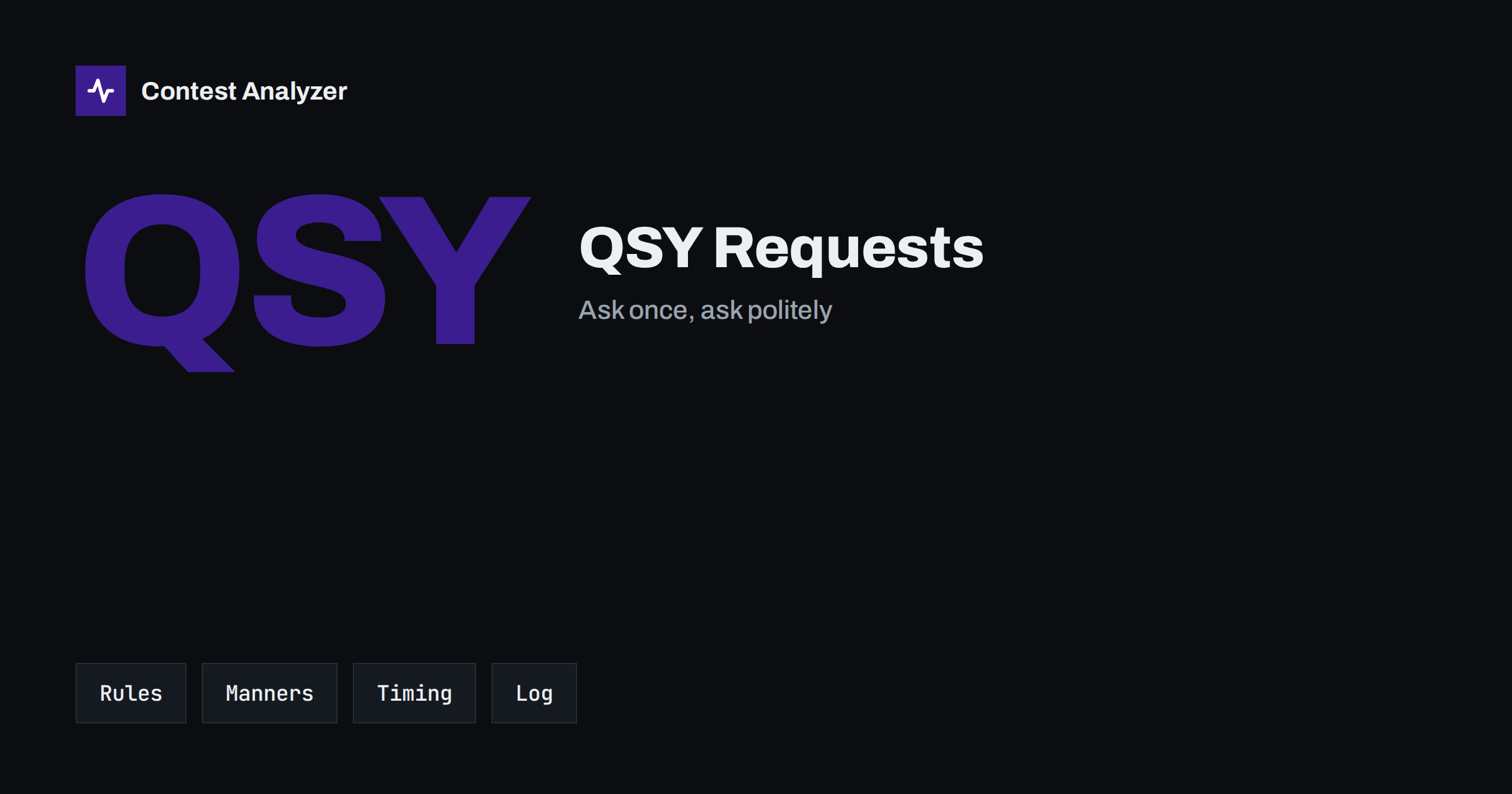
Short answer: A QSY request asks a station to move to another band so that you can work it there as a new multiplier. Many contests allow it, but the rules differ, so check the current official rules for your contest before you ask. Ask once, ask politely and at a moment when the other station is not in the middle of a pile-up. Make sure that the QSO is logged on the band where it really took place, with the right time and the right exchange.
What a QSY request is
When you work a station on one band and the contest counts multipliers per band, you may want to work the same station again on another band. The station is the same, but the multiplier is new: a country, a zone or a prefix that you do not yet have on that band. Instead of looking for it on the other band, you ask the station to move to a frequency that you propose, and you work it again after the move.
In practice, the request is short. After the exchange on the first band, you add a brief question: could the station go to another band, and which one? If the answer is yes, you agree on a frequency, move and call. If the answer is no, you thank the station and continue. The whole exchange takes a few seconds, and it can produce a multiplier that would otherwise cost you minutes of searching.
What the rules may say
Do not assume that a QSY request is always allowed. Some contests accept it without conditions, some allow it with limits, and some may restrict the use of schedules in certain categories. In particular, assisted and unassisted categories, and multi-operator categories with a limit on band changes, can have special rules. The articles on assisted versus unassisted categories and multi-operator band-change rules explain the general principle: the category you enter decides what you may do.
Read the current rules of your contest and look for words such as “schedules”, “arranged contacts”, “pre-arranged” and “QSY”. If you cannot find a clear answer, ask the organisers before the contest. It is better to ask once than to learn after the results that your QSOs were counted differently. The statement here is general, and the official text of your contest is the only authority.
Etiquette on the air
Good manners matter more than usual with a QSY request. The station that you ask is working a pile-up, and every second that it spends on your question is a second not used for the next caller. So make the request short, and accept a refusal without comment. Never ask the same station twice, and never make a request during the middle of a busy run that you are not part of.
The best time to ask is when the station answers you and the pile-up is small. A friendly short request, with the band that you need, is usually welcome, especially from a station that has a good signal on that band. If the station is a rare one, do not ask: it has many callers, and your request would be unfair to them. A rare station usually has many requests and cannot answer them all, and a polite caller waits for the normal time on the band.
Choosing which band to ask for
Before you ask, know what you need. Your logger shows which multipliers you still need on each band. Choose the band where the station is a new multiplier and where you can expect a good signal in both directions. Asking for a band where the path is closed wastes the time of both stations. If you operate two radios, you can listen on the other band while you finish the first QSO, and check that the station is audible there.
Think about the situation of the other station as well. It may not have an antenna for the band that you want, or it may be set up for one band only. A request that is easy for a station with a multi-band beam may be impossible for a station with a single wire. If the answer is no, do not insist. The articles on planning for rare multipliers and on multiplier strategy in CQ WW help you to decide which multipliers are worth the effort.
Logging the QSY QSO
The QSO after the move is a normal QSO. It has its own time, its own band and its own exchange, and it must be logged separately from the first one. A common mistake is to change the band in the logger after the move but to leave the frequency of the first QSO, or the other way round. Check that the logger shows the frequency of the new band when you log it. The articles on frequency field errors in the logger and on rate versus band changes explain what can go wrong.
The exchange should be given again. Do not copy it from the first QSO unless the rules say that it stays the same, such as a zone. A serial number, for example, will be different, since you have made more QSOs between the two. Log the number that was actually exchanged on the new band.
What the statistics show
After the contest, you can see how QSY requests affected your result. Look at the multipliers per band and at the time between the first QSO and the second one with the same station. A short gap between two QSOs with the same call on different bands is the mark of a QSY request. Count them, and compare the number of multipliers gained this way with the time that it took. If you made many requests with few successes, you may be asking the wrong stations or at the wrong time.
Contest Analyzer gives full statistics, including rates, QSOs by hour and band, countries, continents, CQ and ITU zones and WPX prefixes, and year-on-year comparison with your own logs, so you can see how the multiplier count by band changed from one year to the next. It checks every callsign and every zone against official license databases and several independent reference sources and shows only the few QSOs worth a second look. You can edit calls, zones, time and frequency in the report, mark QSOs checked in your own audio recording, and download a corrected Cabrillo. It also marks QSOs outside the contest period and outside the band limits for your ITU region, with split QSOs shown as a note. It works with Cabrillo from N1MM Logger+, DXLog and Win-Test. See the contests page for supported contests.
When not to ask
There are moments when a request is not a good idea. If the band is crowded and the station is struggling to hear the callers, leave it alone. If the contest rules are not clear, do not risk the QSOs that depend on them. If you are operating in a category with a strict limit on band changes, check whether the move counts against the limit. And if you are a small station with a weak signal on the other band, the effort may not give a result.
Do not ask for a QSY in exchange for a favour that you cannot give. A request should be a simple question, and the answer should be easy for the other station. That is what keeps the habit friendly and useful for everybody.
Practical example of a request
Imagine that you work a station on 20 metres and the logger shows that this country is still a new multiplier on 15 metres. You complete the QSO on 20 metres and log it. Before you go back to CQ, you look at the other band: is it open towards that station? If you can hear it on 15 metres, or if the bandmap shows spots, a request makes sense. You add a short question and a suggested frequency, and you wait for the answer. If the answer is yes, you tune the radio, check that the frequency is free, and call.
On the new band you may find that the station is not there yet, or that the frequency is occupied. Do not wait for long. Return to the old band if the other station does not appear within a short time, and mark the multiplier as still needed. A request is a convenience, and when it does not work after a minute or two, it has stopped being a gain. Also remember that the QSO on the first band stays valid whatever happens next, so you have lost nothing but a little time.
When you keep notes, mark the stations that agreed to move. In the next contest, a station that was friendly once may be friendly again, and your notes about its signal on each band help you to choose the band without guessing.
Related reading
The bottom line
Check the current rules, ask once and politely, choose a band where you need the multiplier and log the second QSO as a normal one on its own band.
FAQ
Are QSY requests allowed in every contest?
Not necessarily. Read the current rules of your contest and your category.
Can I ask a rare station to move?
It is better not to. Rare stations have many callers and little time.
Do I give the same exchange again?
Give the exchange as the rules require. A serial number changes, a zone usually does not.
What if the station says no?
Thank it and move on. Do not ask again.
How do I see QSY results in my log?
Look for the same call on two bands with a short gap, and count the new multipliers.