Short answer: A worked-before check tells you, as you type a callsign, that you have already logged this station on this band. A dupe in the log is not an error: duplicate QSOs usually count zero points and cost no penalty, though the details depend on the contest rules. The best practice is to log a doubtful QSO rather than lose a real one, and to keep the worked-before check turned on so that you decide with the facts in front of you.
What the worked-before check does
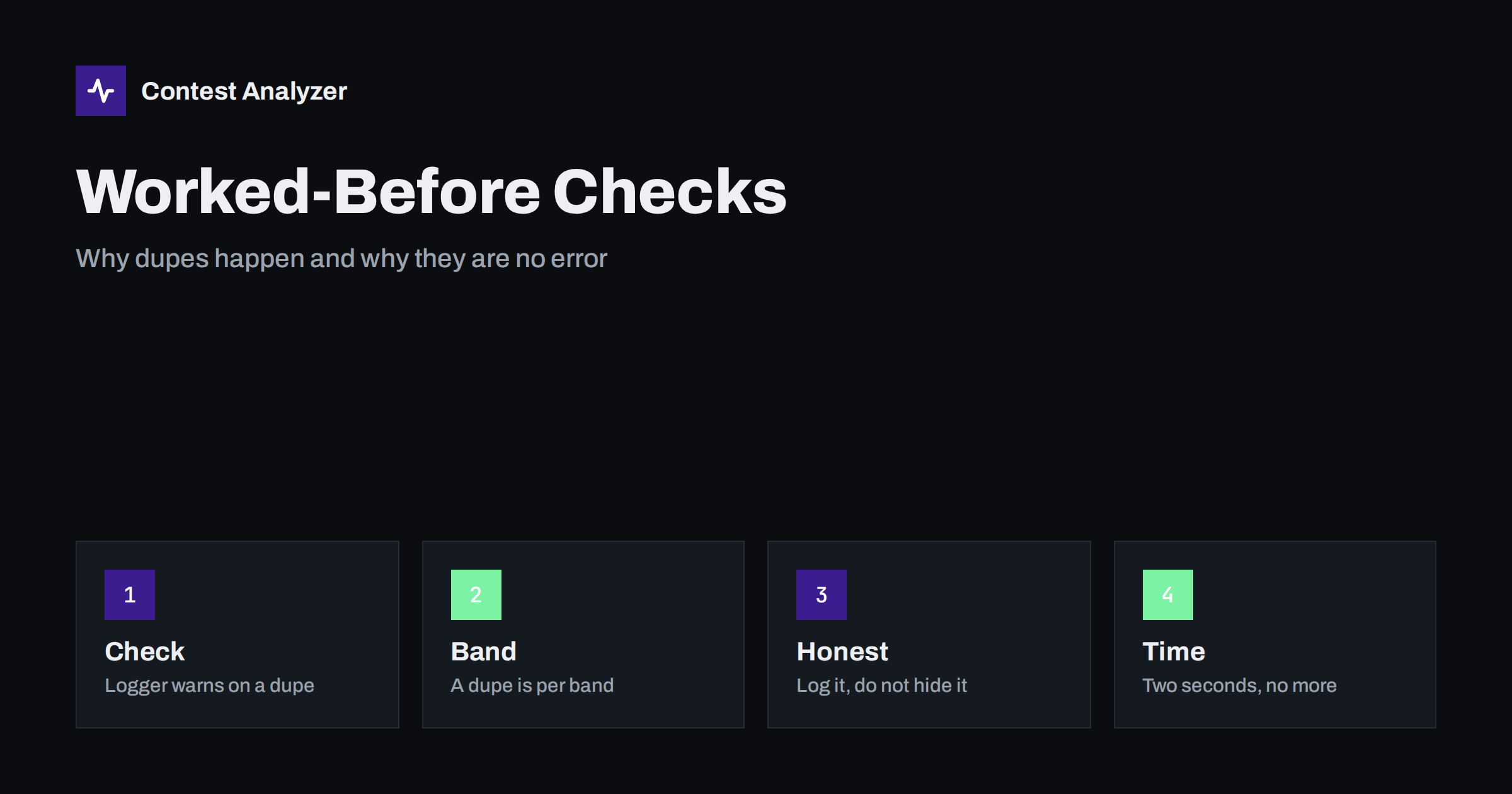
Every serious contest logger compares the callsign that you type with the list of QSOs already in the log. If the same station has been worked on the same band, and in the same mode where mode matters, the program shows a warning. Some programs also mark the callsign in a list of previous contacts, show the time of the earlier QSO and keep the dupe in the log with a zero-point mark. The check works from the keyboard and from the bandmap, so that stations already worked are shown in a different colour.
The exact way a dupe is counted depends on the contest and on the logger settings. In a typical band contest the same callsign can be worked once on each band. In others a station can be worked once on each band and mode, and some contests have a separate rule for the whole contest. Always check the current rules and set the logger to the correct contest type, as described in setting up N1MM Logger+ for CQ WW.
Why dupes happen at all
With a good logger, why do dupes still appear? The first reason is that the check works on the call that you typed, and the call may be wrong or partial. If you type a short part of the call and the logger shows the match with an earlier station, you may be wrong, and the real caller is a different station. The second reason is a change of band without the right band in the logger: if the frequency data is wrong, the logger believes that you are on another band. The third reason is human: a caller who works you again because he does not remember, or because he did not hear his own confirmation.
Some dupes are made on purpose. An operator who hears a call that sounds like a dupe but is not sure, can work it again in order not to lose a real QSO. This is a sound decision, because a QSO that is a dupe costs a few seconds, and a QSO that was refused wrongly can cost a point and a multiplier. The article on dupes in contest logs describes the reasoning in detail.
Dupes in the log are not errors
A dupe in the log is a QSO that was made and recorded honestly. It is not a busted call or a wrong exchange, and it is not an attempt to cheat. In most contests the rules say that dupes are not penalised, they simply do not count again. That is why it is better to leave them in the log than to remove them by hand: removing a QSO from the file that you did make may later create a not-in-log difference with the other station. Keep the line, mark it as a dupe, and let the scoring ignore it.
The statements here are general, and each contest decides its own rules. Read the current rules of your contest, especially if you plan to use a special category. In some contests there are penalties for too many dupes, or special treatment of dupes in multi-operator entries. If you are not sure, ask the organisers.
When to refuse and when to work it again
Honest operation means that you have two good options when the logger shows a dupe. If you are sure that the station is a dupe, say so and move on, or work him again if the rate is slow and the repeat takes only a few seconds. If you are not sure, work him and log the QSO. Many contesters prefer the second option, because arguments about a dupe on the air cost more time than the QSO. When you run and the rate is high, a dupe that calls again can be answered quickly with a short exchange and then ignored by the scoring.
When you search and pounce, the situation is different. Use the check before you call. If the station is already in the log, there is no reason to call him again, unless you think that the first QSO was wrong. The article on run versus search and pounce shows how the two modes treat dupes in the numbers.
Dupes with changes in the call
A special case is a station that changes his callsign during the contest, for example a portable station with a different suffix or a special event call that is used with a different prefix. For the logger, these are different calls, and the check does not mark them as dupes. For the contest rules they may be the same station or not. Be careful: a station that uses two calls in the same contest may be counted differently by the organisers. The article on /P, /M, /MM and /AM in contests describes how to log these suffixes.
The other case is a call that you have logged wrongly. If an earlier QSO was recorded with a busted call, a later QSO with the correct call will not be marked as a dupe. After the contest, the two lines can look like two different stations. A report that checks every call may show them, and you can correct the earlier one.
Dupes in multi-operator and SO2R stations
With several computers or two radios, the check works only if the logs are shared. In a multi-operator station, each computer must see the QSOs of the others in time, or the same station may be worked twice on the same band by different operators. A network between the computers solves the problem, and a short break in the connection creates dupes. The article on merging logs from several computers shows what to check after the contest, and the article on SO2R basics describes the same problem for two radios at one position.
If a dupe appears because the network was down, it is a normal side effect and not an error. Keep the line in the log, and if the rules ask for a list of dupes, provide it. A station that works hard and honestly will have some of them.
Dupe sheets and bandmaps
Before logging programs existed, operators kept a dupe sheet on paper: a table of prefixes and bands with the calls already worked. Today the same job is done by the logger, but the idea is the same. A bandmap that shows the stations already worked in a different colour is a modern dupe sheet, and it saves a lot of time in search and pounce. Some programs also show the multipliers that are still needed on that band, which combines the worked-before check with the strategy.
Keep the data safe. A dupe check is only as good as the log behind it, and a log that is lost or restored from an old backup loses the dupe information. Copy the log regularly, as described in protecting your log during the contest, and restore it carefully after a problem.
Reading dupes after the contest
After the contest, count the dupes by band and by hour. A cluster of dupes in one hour may show a problem with the network, with the frequency data of the logger or with a run in which the same stations called many times. A very high number may mean that the worked-before check was turned off or that the contest type was set wrongly. Contest Analyzer treats dupes as what they are: not errors. It gives full statistics, such as rates, QSOs by hour and band, countries, continents, CQ and ITU zones, breaks and off time, and you can duplicate a QSO line in the report when you need it. It checks every callsign and every zone against official license databases and several independent reference sources and shows only the few QSOs worth a second look. It works with Cabrillo from N1MM Logger+, DXLog and Win-Test, and you can see the supported contests on the contests page.
One more habit is worth mentioning: do not turn the warning off because it annoys you. Some operators disable the check in order to log faster, and then they find a large number of dupes after the contest and no idea where they came from. The warning is the cheapest quality control that you have, and it costs no time when the QSO is new.
Related reading
- Not-in-log QSOs: causes and prevention
- Call history files in contest loggers
- Your post-contest review routine
The bottom line
Use the worked-before check to decide, not to argue. Keep it switched on, log a doubtful QSO honestly, and remember that a dupe is not an error. Check the current rules of your contest for the exact treatment.
FAQ
Is a dupe a mistake?
No. It is a QSO that was made and recorded. In most contests it simply counts for nothing, but check the rules.
Should I delete dupes from my log?
Usually not. Keep them in the file, marked by the logger, unless the rules ask otherwise.
Can the logger be wrong about a dupe?
Yes, if the call or the band was entered wrongly. Look at the call and the band before you decide.
What if I am not sure that a station is a dupe?
Work him again. A few seconds cost less than losing a real QSO.
Why do dupes appear in multi-op logs?
Because computers did not share the log in time. Check the network and clocks before the next contest.