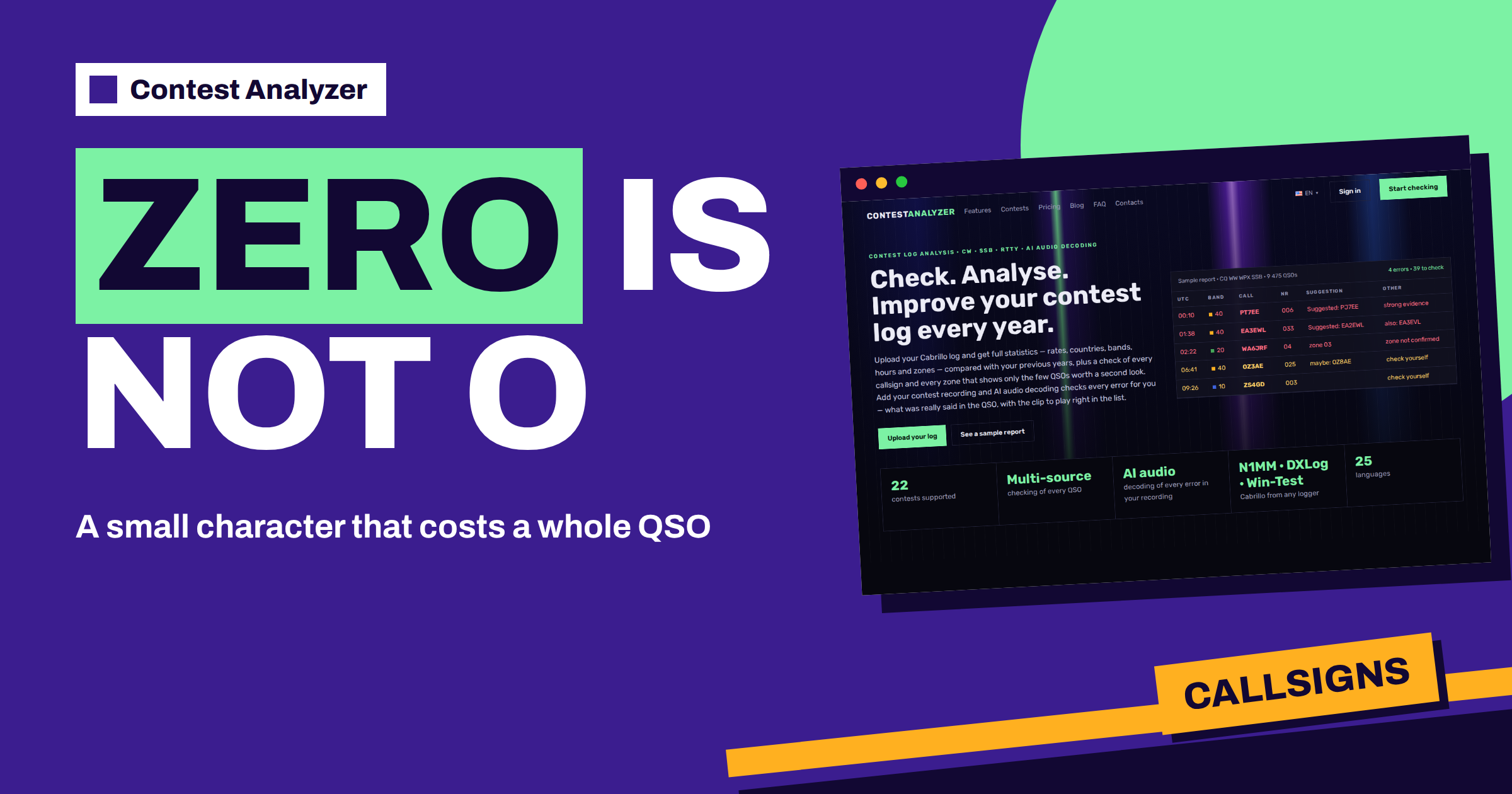
Short answer: The digit zero and the letter O are easy to mix, and the mix-up creates a busted callsign even when the rest of the call is perfect. The problem appears in logger fonts, on a bad keyboard, in RTTY decoding, in SSB phonetics and in handwritten notes. Make the zero visibly different in your logger, learn which callsign areas use a zero, use clear phonetics on voice and check the zeros and Os in your log after the contest. It is a small habit that removes a whole class of errors.
Why these two characters are confused
The digit 0 and the letter O have almost the same shape. In many fonts they differ only in width, and on a small or poorly lit screen the difference disappears. On paper, handwriting makes them nearly identical. In sound the two are separate, but not always clear: on SSB the word zero and the word oscar are different, but under noise and an accent the difference may be lost. On CW, zero is a long series of dashes, while the letter O is three dashes, and a fast sender with a loose rhythm may run them together.
Callsigns make the problem worse because they are short, and each character matters. A callsign with one wrong character is a different callsign. If you log OH0 instead of OHO, or the other way round, the QSO is wrong even if you heard everything else correctly. The article about busted callsigns gives the general picture, and this is one of the simplest causes.
Where zeros appear in callsigns
The digit zero is a normal part of many callsigns. In the United States the call area digit 0 is used in the Midwest, so calls such as K0 or W0 followed by a suffix are common. In Japan the JA0 prefix is in use, and in Russia the UA0 area covers the far east of the country. Several European prefixes also use a zero, including a prefix for the Åland Islands. Suffixes can contain the digit as well in some countries, though less often.
The letter O appears in many other prefixes and suffixes, from Denmark to Austria and Finland. This means that a correct callsign may contain either character, so you cannot rule one out by logic alone. You must hear it, see it or confirm it. The article on callsign structure: prefix, digit and suffix shows how to read the parts of a callsign, which helps you decide which character is likely in a given position.
Make the zero visible in your logger
The first defence is technical. Choose a font in your logger that distinguishes the zero and the letter O clearly, with a slash or a dot inside the zero, or a narrower shape. Many contest loggers already use such a font, but a change of screen resolution or a different theme can undo it. Check the callsign field and the log window in a test log, and try both characters.
- Increase the size of the callsign field so that you read the characters without effort.
- Use a monitor that you can read at the distance you sit, with brightness that does not tire your eyes in the night hours.
- If you use a second window, such as a bandmap or a cluster window, check the font there as well.
- Do not mix fonts in your notes, and write the zero with a slash on paper.
It is a small change that takes a few minutes before the contest and reduces the chance of an error in all the hours that follow.
Voice: say zero, say oscar
On SSB, use the standard phonetics. Say zero for the digit, and oscar for the letter, every time you say a callsign that contains either. Do not say oh for the digit, because oh sounds like the letter in many languages, and some operators use it by habit. If the other station asks for confirmation, repeat the character in its phonetic form, and be ready to confirm it twice. The article on SSB phonetics and confirming callsigns quickly shows how to keep it short, and the one about confused letters on SSB lists other pairs to watch.
In a pileup, a station that sends a callsign with a zero is easier to copy if it says the call slowly once, with the digit in full. If you are the one calling, take that into account: give your callsign clearly at the speed of the frequency. The same applies when you answer a station and confirm its callsign: say the zero clearly.
CW and RTTY
In CW, the zero is a distinctive sequence, but cut numbers make the situation more complicated in the exchange. In some contests, operators send a letter in place of a digit to save time, with the letter T standing for zero in the exchange. In a callsign, though, cut numbers are not normally used, and a zero is a zero. Mixing the two conventions is a typical source of errors: a zero in the callsign copied as a T, or a T in the exchange copied as a zero. The article on cut numbers in the CW exchange explains the rules in general, and the one on confused characters on CW lists the pairs to watch.
In RTTY, the decoder may show a zero as an O or the reverse when the signal is weak. The same character shifts that cause a wrong letter can also turn a digit into a letter, because the RTTY code uses the same pattern for letters and figures with a shift that can be missed. If you operate RTTY, check each callsign that contains a zero or an O against what you know of the station. The article about RTTY decoding errors describes the usual causes.
Check the log afterwards
After the contest, search your log for callsigns that contain a zero or the letter O and read them once. It is a short list, and the pattern is easy to see. Pay special attention to prefixes where either character is possible, and to calls that appear only once in the log. A callsign with a zero that appears only once and looks unusual is a candidate for an error. The article about unique calls explains why singles deserve a second look.
A log checker helps because it verifies every callsign against official license databases and several independent reference sources, and it suggests the most likely correct callsign when one looks wrong. A zero that should be an O, or the other way round, is exactly the kind of difference that a check can reveal. You still decide, and a recording is the best evidence.
Other look-alike pairs
The zero and the letter O are the best-known pair, but they are not alone. The digit 1 and the letters I and L look alike in some fonts. The digit 5 and the letter S, the digit 8 and the letter B, and the digit 2 and the letter Z also cause trouble when the screen is small or the writing is quick. The same habits help with all of them: a clear font, clear phonetics and a look at the log afterwards. If your logger offers a font with distinct shapes for these characters, use it for the whole log and not only for the callsign field.
It is useful to know which pairs are likely in the part of the callsign you are reading. In the digit position of a callsign a letter is impossible, and in the suffix a digit is rare in most countries, so a pair that includes a digit and a letter can often be resolved by the position. Where the position does not decide, you are back to listening. Over time, a contester builds a feeling for which characters are possible in which place, and this feeling is a good argument for practising with real callsign lists between contests.
One more practical tip concerns the callsigns that you type from memory or from the bandmap. A spot on a cluster may carry the same mix-up that you are trying to avoid, because the person who spotted the call could have typed it wrongly. Treat the spot as a hint, and confirm the callsign by listening before you log it. The article about DX cluster etiquette says more about the way spots are best used.
Handwriting and notes
If you keep a paper backup, notes of multipliers or a list of stations to call, write zeros with a slash and letters without. The same applies to any list that you type into the logger later, because a character that was unclear on paper becomes a firm error on the screen. When you transfer a paper log, read the callsign aloud as you enter it. The article on the paper backup log gives other suggestions for the transfer.
Related reading
The bottom line
Zero and O are a tiny difference with a large cost. Use a clear font, say zero and oscar, know where each character is likely, and read the zeros and Os in your log after the contest. A log check can point to the doubtful ones. Details of what is checked are in the FAQ.
FAQ
Which is correct, zero or O, in a callsign?
Both occur. The correct character depends on the callsign, so confirm it by sound, by sight or by a reliable source.
Should I say oh for the digit?
No. Say zero for the digit and oscar for the letter, so that the two cannot be confused.
Does a slashed zero help?
Yes. A font with a slashed or dotted zero makes the digit visible at once, in the logger and in your notes.
Can a log checker find a zero that should be an O?
It can flag a callsign that looks wrong and suggest the most likely correct one. You then confirm it.
Are cut numbers used in callsigns?
Not normally. They belong to the exchange in some CW contests, so do not apply them to the callsign.