Short answer: The Contest Analyzer contests page lists the Stew Perry Topband Distance Challenge as a CW contest from 26 December 2026, 15:00 UTC, to 27 December, 14:59 UTC, with a log deadline of 14 days. A long deadline invites delay, and the holiday season makes delay likely. Prepare the callsign verification and the export test in advance, upload soon after the end, review the short list in one or two sittings and keep the corrected file ready well before the deadline you confirm in the official rules.
What the contests page says
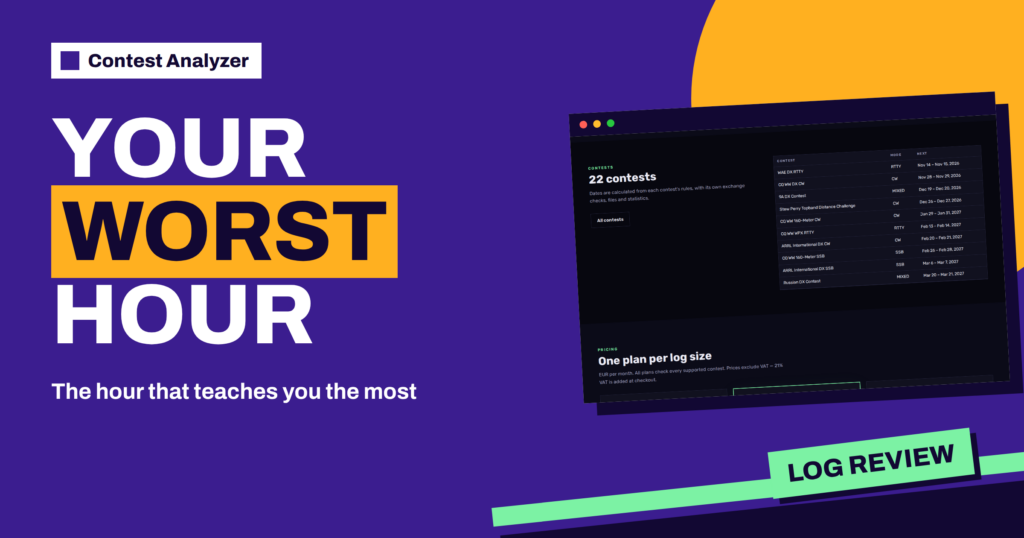
The page is a calendar of 22 supported contests with the dates calculated from each contest’s rules. For the Stew Perry Topband Distance Challenge it lists the mode as CW, the start as 26 December 2026 at 15:00 UTC, the end as 27 December at 14:59 UTC and the log deadline as 14 days. The next contests in the same list are CQ WW 160-Meter CW at the end of January 2027 and CQ WW WPX RTTY in February, so this event closes the year of contests on the list.
The key facts are the period and the deadline. Everything else, including the exact exchange, the categories and the way the score is calculated, belongs to the official rules, which you should read before the contest. We have a general guide in the article on the Stew Perry Topband Challenge, and the notes on the CQ 160-Meter Contest describe what is special about contesting on the lowest band.
A topband contest has its own habits
Operating on 160 metres is different from the higher bands. Signals are weaker, noise is a bigger problem, the best conditions are at night and a good QSO can take longer than on 20 metres. All of this has an effect on the log. Weak signals produce partial callsigns, and partial callsigns produce errors. If you have read about logging what you really copied on weak signals, you know the principle: log only what you heard, and ask for a repeat when needed.
The same applies to the way you work during the long night hours. A quiet band makes it tempting to relax, but fatigue is a real factor, and errors rise in the small hours. The article on low-band night strategy suggests how to plan the night, and the winter 160-metre season gives the wider picture of what to expect.
Before the contest
Three small tasks in the week before the contest save time later. First, make sure that your callsign is verified in your Contest Analyzer account. The FAQ says that a log can be checked only for a callsign in your account that is verified, so accounts are not shared. Second, test the Cabrillo export from your logger with a short dummy log, and open the file to see that the header is right. Third, decide how you will back up the log during the contest, because a power or computer failure on a winter night is a realistic risk.
You can read about the account side in the article about the verified callsign, and about backups in log backup during a contest. If you operate from a different location from your usual one, note that in your records, because the location and the category may be part of the header.
A timeline for the 14 days
A deadline of 14 days gives a comfortable margin, but the days between Christmas and the new year tend to pass quickly. A plan with fixed steps keeps the work from slipping. Confirm the exact deadline in the official rules and count backwards from there.
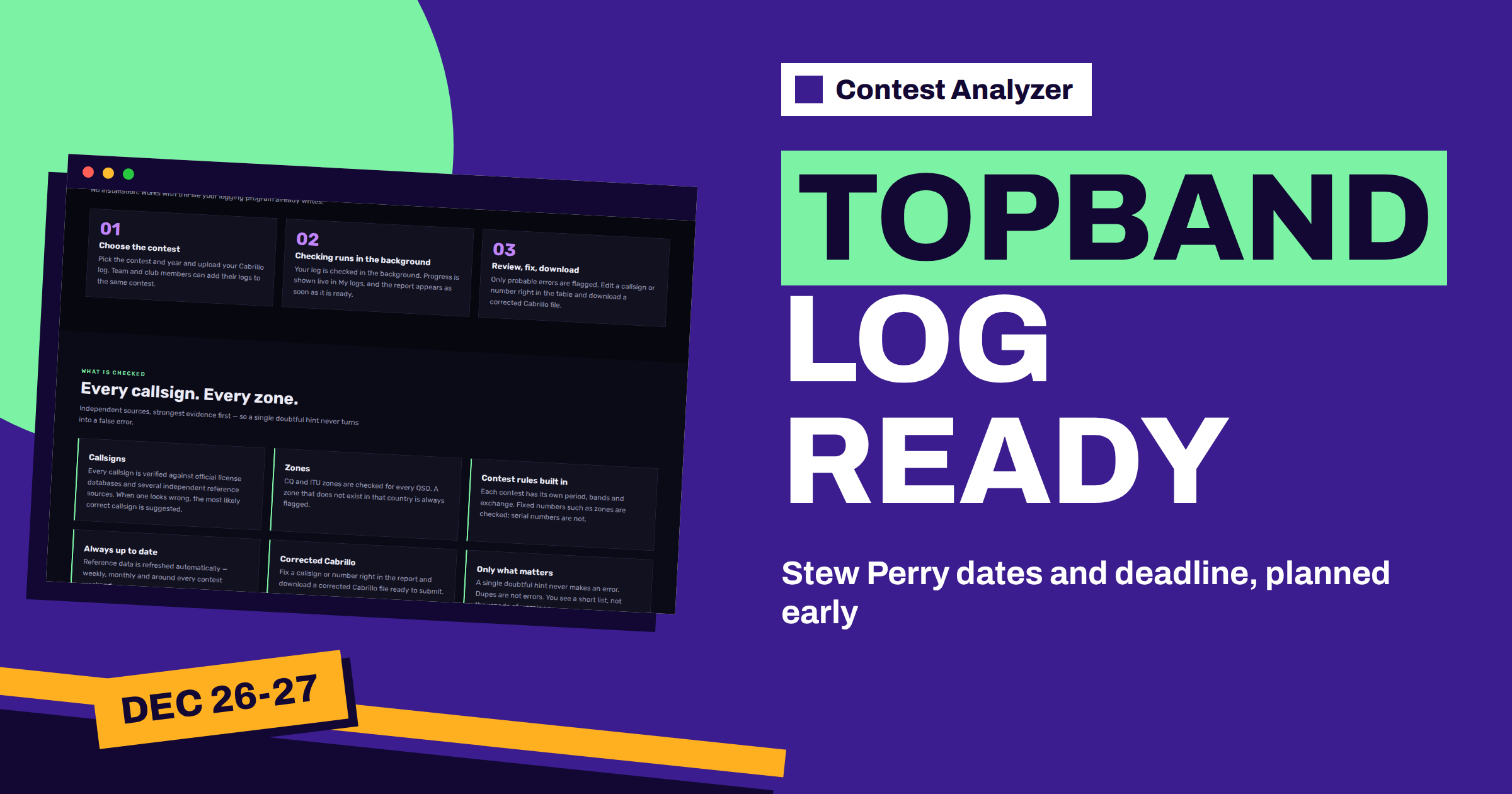
- The end of the contest, 27 December after 14:59 UTC. Stop the logger, copy the log file to a second place and export the Cabrillo file.
- Within two days. Choose the contest and the year in the app, upload the log and let the background check run. Progress is shown live in My logs.
- Within the first week. Review the report in one or two sittings. Work through the short list, edit what you are sure of and leave the rest.
- Before the second week begins. Download the corrected Cabrillo file, compare it with the original and read the header.
- Well before the deadline. Submit according to the current rules, keep a copy and note the confirmation.
If you operate in a team or a club, the service lets members add their logs to the same contest, which is described in the article on club and team logs.
What the report can and cannot do for a CW topband log
The report checks every callsign against official license databases and several independent reference sources, and suggests the most likely correct callsign when one looks wrong. On a weak-signal band, that is precisely where a second look is most useful, because the number of partial copies is higher than on a busy higher band. The report also checks the fixed parts of the exchange where the contest has them. It does not check changing serial numbers, which the FAQ states plainly.
In a CW contest the usual confusion between similar characters applies as everywhere, and a recording of your operation, if you made one, is the best evidence. The article on CW copying accuracy explains the character pairs that give trouble, and the one on AI audio decoding describes the audio feature that the home page mentions for the plans that list it.
Operating notes for a long winter night
A contest that starts in the afternoon UTC and ends the next afternoon covers one full night, and on 160 metres the night is the main event. Prepare the station for the cold and the dark: check the antenna and the ground system in daylight, make sure the receive antennas work and that the noise level in the shack is acceptable. A few small checks before the start, such as the RF test described in the article on RF in the shack, can prevent trouble at three in the morning.
During the night, do not let the low rate persuade you to stop paying attention. Weak signals are exactly where a wrong character slips in. Ask for repeats, write down what you copied and not what you expect, and keep a note of the doubtful ones. A short note beside a QSO is worth more than a long memory the next day. Food, drink and a regular break also belong to the plan, and the article on food, drink and focus in a 48-hour contest gives ideas that work equally well for a 24-hour event.
Practical questions about the file
A few practical details are worth checking before you export. Make sure the contest line in the header names the Stew Perry Topband event as your logger writes it, and that the category and the callsign are as you intend. Look at the date and time of the first and the last QSO: they should fall inside the period on the contests page, between 26 December at 15:00 UTC and 27 December at 14:59 UTC. If your log passes midnight UTC, which this contest does, check the date at the change; the article about the midnight UTC rollover shows the usual traps.
If anything looks wrong, correct the cause in the logger, export again and upload the new file. There is no reason to hurry with a 14-day deadline, and a careful second export is better than a patched file.
Using the statistics
A topband log is short compared with the large weekend contests, but the statistics still tell you something. The hourly table shows when the band was alive, and the distribution by distance and by continent shows where your signal reached. Compare with the previous year if you took part, and note the changes in conditions. The article on solar flux and propagation helps you to think about what is a difference in conditions and what is a difference in operating.
If this is your first Stew Perry, the log becomes your baseline. Keep the report and the notes, and next December the comparison is ready. The comparison across years is one of the main points of a service that keeps your history, as described in account and history.
Holiday-season reminders
The contest falls in the days after Christmas, when travel, guests and family plans can break the usual routine. Decide early how much time you can give to the contest and to the review afterwards, and put both in your calendar. If you will be away on the day the deadline is near, finish the review earlier. A log that is submitted two days before the deadline is better than one that is submitted two hours after it.
Related reading
The bottom line
The Stew Perry Topband Distance Challenge gives you a day of weak-signal CW and 14 days to submit. Verify your callsign, test the export, upload early, review in calm sittings and submit with a margin. Take the dates from the contests page and the details from the official rules, and use the FAQ for what the check covers.
FAQ
When is the Stew Perry Topband Distance Challenge this year, according to the contests page?
The page lists 26 December 2026, 15:00 UTC, to 27 December, 14:59 UTC. Confirm in the official rules.
What is the log deadline?
The page shows 14 days. Check the organiser’s current rules for the exact moment and method.
Which mode is it?
The contests page lists it as CW.
Do I need to verify my callsign before uploading?
Yes. A log can be checked only for a verified callsign in your account.
Can I upload early and review later?
Yes. The check runs in the background, and the report appears when it is ready.