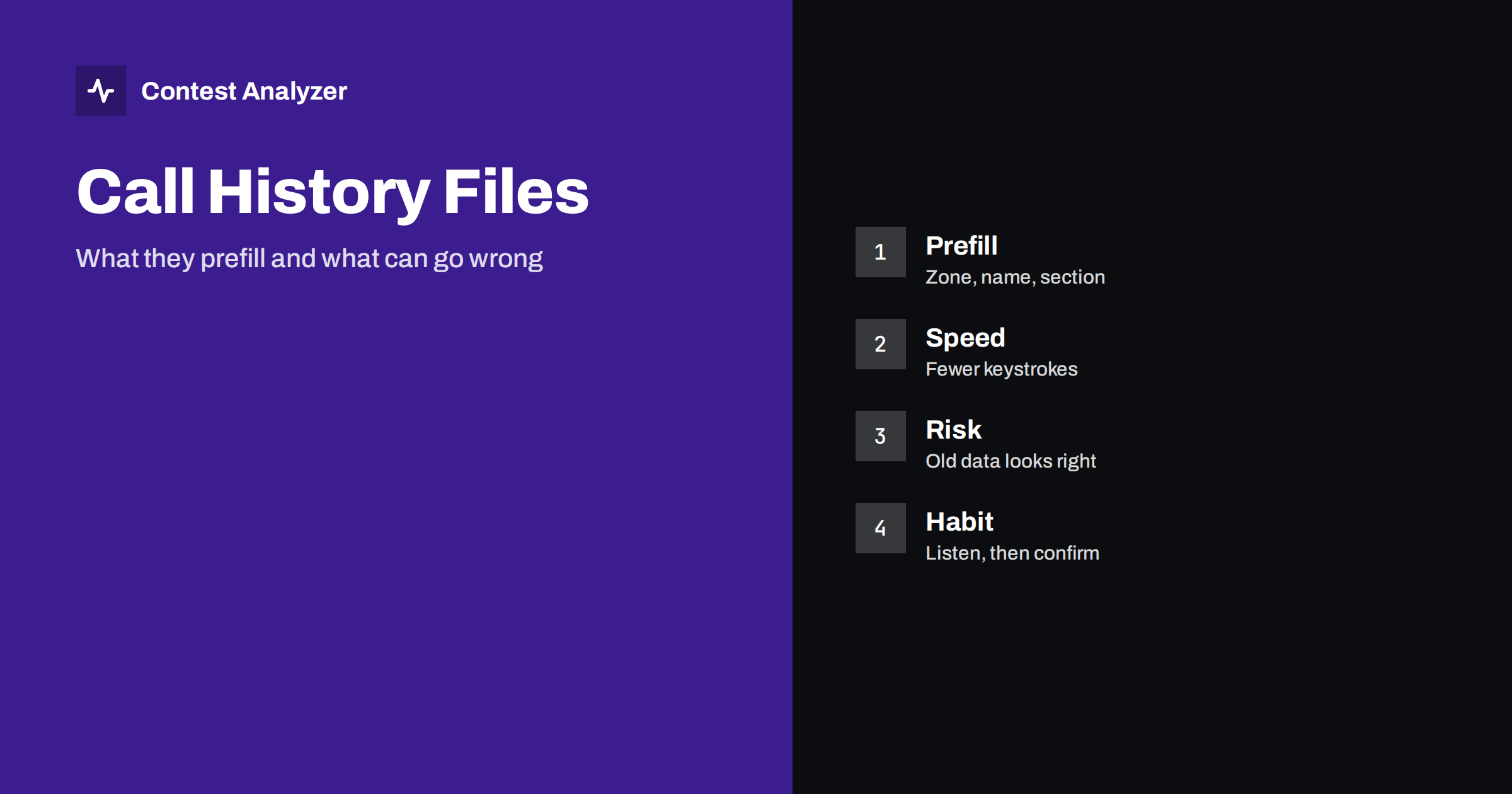
Short answer: A call history file is a list of callsigns with the exchange data that each station sent in the past, which your logging program uses to prefill fields as soon as you type a call. It saves keystrokes and can improve your rate, but the data is only as good as its source and its age. The safe habit is to treat the prefilled value as a suggestion that you confirm by ear, not as the truth.
What a call history file is
In general terms, a call history file is a plain text or database file that your logger reads at the start of a contest. Each line connects a callsign with one or more items: a zone, a section, a name, a province, a serial or any other element that the contest exchange contains. When you type a callsign in the entry window, the program looks it up and fills the exchange fields for you. If the station gives you the same exchange it gave last time, you only press a key to confirm.
The idea is old and simple. Many stations send the same fixed information every year, and writing it again and again is wasted time. Fixed items such as a CQ zone, an ITU zone or a section rarely change for a given station, so the history is often right. Loggers such as N1MM Logger+, DXLog and Win-Test have their own ways of loading and using such files, and the exact menu names differ, so consult your logger’s documentation for the steps.
Where the data comes from
Call history files are built from earlier logs and exchanges: yours, those of friends and clubs, or collections that are shared by the contesting community. Some are specific to a contest, because the exchange differs. The history for a zone contest is not useful for a contest that uses names or states, and a file made for a different contest can fill the wrong field with a plausible but wrong value.
The quality of the source varies. A file built from your own verified logs is usually better than an anonymous collection of unknown age. In both cases, the data reflects what was sent at a given time, not what a station will send this weekend. A station may have moved, changed its zone setting, changed its category, or had its call used by another operator. That is why any prefilled value should be treated as a hypothesis.
How call history helps
The benefits are real. The first is speed: fewer keystrokes per QSO, which matters in a pileup or during a high-rate run. The second is attention: when the exchange is mostly filled, you can spend more of your concentration on the callsign, which is the part where errors have the highest cost. The third is consistency: the same station is logged the same way each time, which makes later analysis cleaner.
In search-and-pounce operation, a prefilled value is also a useful hint about what you should hear. If the history says that a station is in a certain zone and you hear a different one, that difference is a signal to listen again. Used like this, the file is a second opinion rather than a replacement for your ears.
The hidden risks
The main risk is silent trust. When a field is filled, the eye reads it as correct and the mind moves on. If the value is old, you log it without noticing. In a long contest, many QSOs may carry a quietly wrong zone or section. A wrong zone is a mistake that can reduce the count of valid multipliers and may even be treated as an error when the log is checked. Our article on why stations change zones explains why the zone a station sends is not always the zone listed in a table.
A second risk concerns callsigns. If you type a partial call and your logger completes it from history, you may accept a callsign that you did not actually hear. A station that was active last year may not be active now, and a similar callsign may have been transmitted instead. Partial callsigns and auto-completion are a known source of busted calls; see partial callsign copies for the habits that reduce this danger.
A third risk is mixing contests. If you use a file from a different contest or a different year without checking it, the fields may not match the exchange, and the logger may place the right data in the wrong column. A quick test before the contest, with a few known callsigns, can reveal such problems in a minute.
Rules of thumb for safe use
- Keep the file specific to the contest, and replace it when the rules or exchange change.
- Prefer data from your own verified logs, or from sources you trust, and note the date of the file.
- Listen to the exchange, then compare it to the prefilled value. If they differ, trust what you heard and correct the field.
- Never accept a callsign only because the logger offers it. The callsign must come from your ears, not from the list.
- Mark doubtful QSOs with a note, so that you can review them after the contest.
These rules take almost no time in practice, and they protect your log from the most common errors that history files can introduce.
Updating and maintaining the file
Update your file after each contest while the memory is fresh. Add the stations you worked, with the exchange you actually received, and remove entries you now know to be wrong. If you have checked your log carefully, the corrected data is the best material for next time. Some operators keep a short text file with changes: stations that moved, special event callsigns that appeared once, and stations that use a non-standard zone.
The same applies to the country file, which defines how callsigns map to countries and zones. Without a recent country file, even a perfect history will give wrong results for new prefixes. Our article on country file updates explains why you refresh it before a big event. Also test the whole chain with a handful of callsigns, including a portable one, to see that the logger behaves as you expect.
Reading the result after the contest
When the contest is over, your log shows the effect of the history file. Look for QSOs where the zone or section does not fit the callsign’s country. Look for stations that appear with two different values in the same log. These are the clues that something was filled from history and not heard. Tools that check the log help here: Contest Analyzer checks every callsign and every zone against official license databases and several independent reference sources, and shows only the few QSOs worth a second look. It does not check serial numbers.
When you edit a callsign, zone, time or frequency in the report, you can download a corrected Cabrillo file. That makes a useful loop: the report points you to doubtful items, you fix them, and then you update your own history so that next year’s file is cleaner. See the FAQ for the supported loggers and contests.
A short pre-contest test
Ten minutes before a big contest are enough to test the chain from callsign to filled field. Type five callsigns that you know well: a station from your own country, a station from a multi-zone country, a portable call with a slash, a special event call and a callsign that you have never worked. For each one, look at which fields the logger fills and compare them with what you know to be true. If any value is wrong, find out whether the problem is in the history file, in the country file or in the logger settings, and fix it before the first QSO.
Also check what happens when you overwrite a prefilled value. In some programs a manual change is kept for that QSO only, while in others it can alter the stored history. You should know which behaviour you have, because it decides whether a quick correction during the contest affects the next time you work the same station. Write the answer on your station notebook page so that you do not have to rediscover it at three in the morning.
Finally, decide who is allowed to edit the history file at a multi-operator station. If several people change it at once, the result can be inconsistent. One person should own the file, and changes should be made between contests, not during them, unless the change is a clear correction.
Related reading
- Call History Files in Contest Loggers: Use and Risks
- Why You Update the Country File Before a Big Contest
- Zone Errors with Stations from Multi-Zone Countries
The bottom line
Call history files make logging faster and more consistent, but they replace listening with memory, and memory is sometimes out of date. Use a file that fits the contest, keep it fresh, listen first, and treat every prefilled value as a suggestion. Review the log after the contest, correct what is wrong and feed the corrections back into the file.
FAQ
Does a call history file make my log more accurate?
Only if you keep it current and check it by ear. It reduces typing, but old data can introduce errors that you do not notice.
Can I use one file for all contests?
It is better to keep a separate file for each contest, because the exchange differs and a wrong field can be filled with a plausible but incorrect value.
Should I let the logger complete partial callsigns?
Be careful. A completed callsign must still be confirmed by what you heard, otherwise busted calls become more likely.
How often should I update the file?
After every contest is a good habit, and before a big event you should at least check the date and test a few known callsigns.