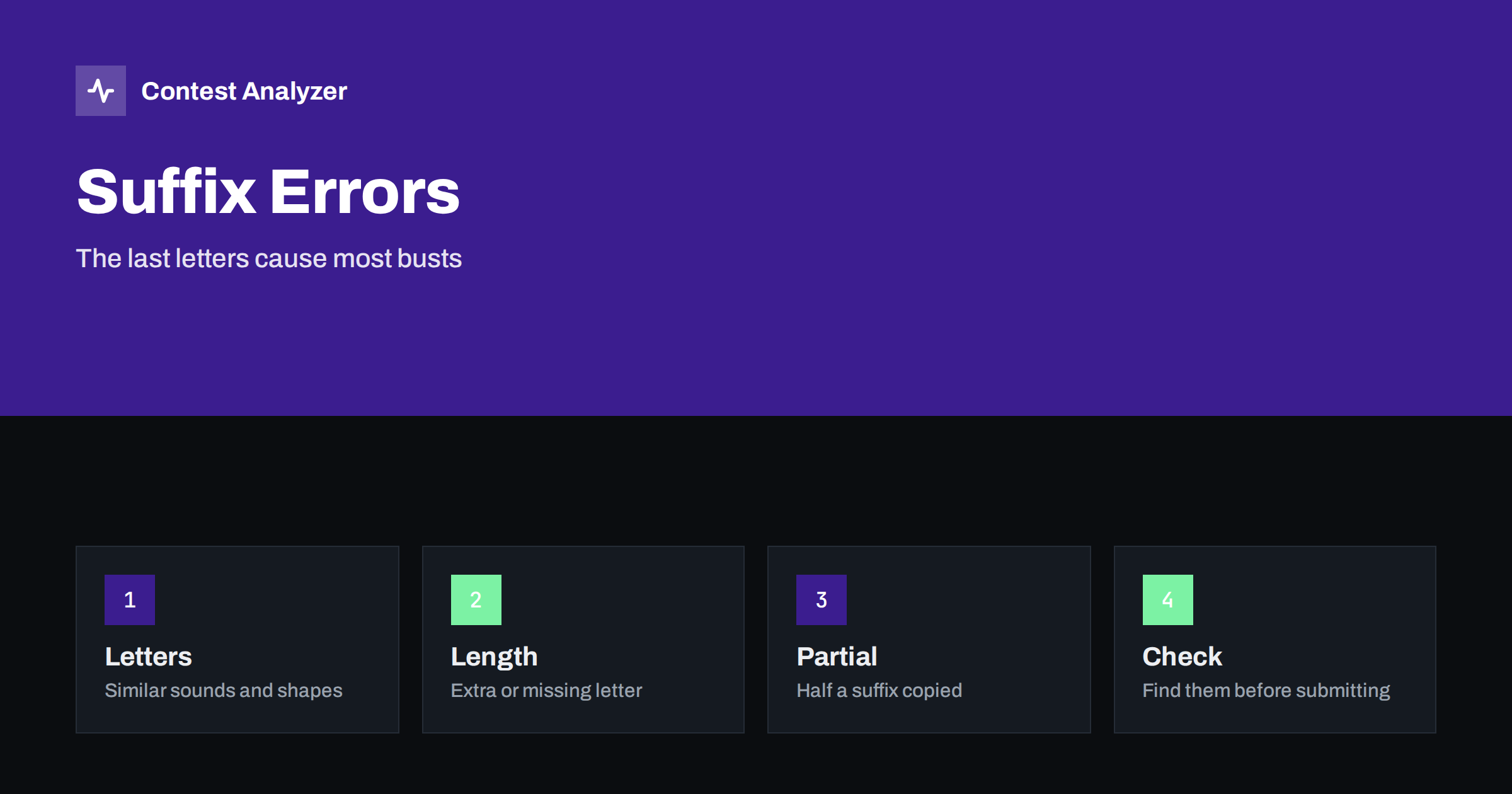
Short answer: The prefix and digit of a callsign are easy to hear and are often confirmed by the context, while the suffix of one to three letters is where most mistakes enter the log. Typical errors are a wrong letter that sounds or looks like the right one, a letter too many or too few, and a suffix copied only in part. A careful review of calls that differ by one letter from a better-known station, together with a database check, finds most of them.
Why the suffix is the weak point
A callsign has a prefix that identifies the country, a digit and a suffix that identifies the station. The prefix and digit are limited sets and are easy to recognise. The suffix is a short sequence of letters from the whole alphabet. In a weak signal or a pileup, an operator hears the prefix first, which is often repeated, and the suffix last, when the signal is weakest or another station is already calling. The most variable part comes at the moment of least attention.
The earlier articles on how a callsign is built and on busted callsigns give the background. Here we concentrate on the suffix and on the patterns that appear again and again in logs.
Wrong letters
The commonest suffix error is a wrong letter. On CW, letters that differ by one element are easily confused, for instance a pair of letters that share the same dots and dashes except for one. On SSB, letters that sound alike, such as B, D, G and P or M and N, are easily mixed, and in a noisy channel the difference disappears. On RTTY, a decoding error may replace one letter with a similar one in the code. The articles on CW characters that get confused and on letters that sound alike on SSB list the usual pairs.
A wrong letter produces a call that is valid in form and may belong to another station. This is why it is hard to see in your own log. The call looks plausible, and it is only the check against other information that reveals it. A habit of repeating the suffix with phonetics, even when the rest is clear, is the best protection.
Extra or missing letters
A suffix can also be too long or too short. An extra letter appears when the operator hears an echo, a click or the start of another call. A missing letter appears when the end of the call is cut by noise or by an overlapping station. Both errors change the call into another valid call, or into one that does not exist. A two-letter suffix and a three-letter suffix look similar to the eye, and the logger may accept both without complaint.
Special calls and portable indicators add complications. A call with a slash and a suffix can be copied as if the slash part were part of the suffix. The articles on /P, /M, /MM and /AM in contests and on logging partial calls in a pileup deal with such cases. When the suffix is not clear, ask for it again, using the shortest repeat that works.
Partial suffixes and guessing
Under pressure, operators sometimes log a call after hearing only part of the suffix, guessing the rest. The logger helps by offering matching calls from a list, and the operator accepts the suggestion. This is quick and often right, but when the guess is wrong, the error is invisible. Helpers such as Super Check Partial can lead to a wrong call being accepted because it looks familiar. See Super Check Partial while operating for help and traps.
A good rule is to accept a suggestion only if you heard enough of the call to agree with it. If you heard only the prefix and the first letter of the suffix, ask for a repeat. The article on partial callsign copies describes the risk.
Calls that differ by one letter
One practical check is to look for pairs of calls in your log that differ by one letter in the suffix. If the log contains a very active station and also a call that is one character away from it, with only one QSO, the second may be a busted copy of the first. This is not always true, since two different stations can have similar calls. Look at the band, the time and the exchange. If the exchange is the same and the time is close to the first QSO, a bust is likely.
Look also at the stations that appear only once and have suffixes that look unusual. The article on unique calls in contest logs shows how committees treat such calls. Another check is the zone or the exchange: if the zone does not fit the country of the prefix, the call may be wrong in a part you did not expect.
How checkers find suffix errors
A contest committee compares logs of different stations and finds calls that do not match, as described in the article on log checking reports. A call that appears once, with no match in the other logs, and is one letter away from an active station is a typical sign of a bust. You can do part of the same work yourself before you submit, by reading your list of single calls and looking for near duplicates.
Contest Analyzer checks every callsign and every zone against official license databases and several independent reference sources. When a call looks wrong, the most likely correct callsign is suggested, and only the few QSOs worth a second look are shown. You can edit calls, zones, time and frequency in the report and download a corrected Cabrillo. Serial numbers are not checked, and dupes are not errors.
Habits that prevent suffix errors
Several habits help. Always confirm the suffix, especially in a pileup, by sending the call back and waiting for the reply. Use phonetics on SSB for the suffix letters. On CW, slow slightly for the suffix when the signal is weak. Write down the call in the entry field before you send your reply, so that you can see it. Use the notes field to flag a doubtful suffix. After the contest, listen to the recording of the marked QSOs, as in listening to doubtful QSOs and fixing the log.
A short exercise
To see how the problem works in practice, take your last log and run a simple exercise. Export the list of callsigns, sort them alphabetically by suffix within each prefix and digit, and read through the list. Mark every pair of calls that differ by only one letter. For each pair, ask whether both stations plausibly took part in the contest. A very active station and a one-time near duplicate are suspicious. Two stations that both appear several times are probably real.
Then take the marked pairs and check them against your notes and your recording. For each, decide one of three things: the call is right, the call is wrong and the correct form is known, or the call is doubtful and should be left as it is. In a log of a thousand QSOs, an exercise of this kind usually finds a few real errors and a few false alarms. The false alarms are worth having, because they teach you which unusual calls are real.
Learning from your own pattern
Over several contests, your own suffix errors will show a pattern. You may confuse the same two letters again and again, or make more errors in a certain mode, or at a certain hour. Write the pattern down. A note such as I confuse D and B on SSB after midnight is the kind of knowledge that changes behaviour. For that letter pair, you will start using phonetics earlier and asking for repeats more readily.
Share the pattern with the other operators of a multi-operator station. Different people make different mistakes, and a team that knows its weak points can arrange the shifts so that the hardest hours are given to the operator who copes best. If you train outside contests, practise the letters that give you trouble, with a recording of your own contest as material. The article on training with your old logs suggests a way.
Finally, keep the right attitude. A suffix error is not a personal failure; it is part of the work in a noisy channel. The aim is to reduce the rate of errors steadily, and to keep the log honest. A modest improvement in each contest adds up to a clean record over the years.
Related reading
- SSB Phonetics and Confirming Callsigns Quickly
- CW Copying Accuracy in Contests: Speed, Fills, Repeats
- Similar Prefixes That Are Easy to Confuse in Contests
The bottom line
Suffix errors are the most common callsign errors because the last letters are heard at the worst moment. Confirm them, look for near duplicates and singles in your log, and use evidence from audio or a database check before changing anything.
FAQ
Why are suffixes copied wrongly more often than prefixes?
They come last, in a pileup or in noise, and they are the most variable part of the call.
Should I always ask for a repeat?
If you are not sure, yes. A short repeat costs seconds, and a busted call costs more.
Can a wrong call be a real station?
Yes. A bust often produces a valid call that belongs to another station, which is why it is hard to see.
How can I check my log?
Look at calls with one QSO, near duplicates of active stations and mismatched zones, then use audio or a database check.