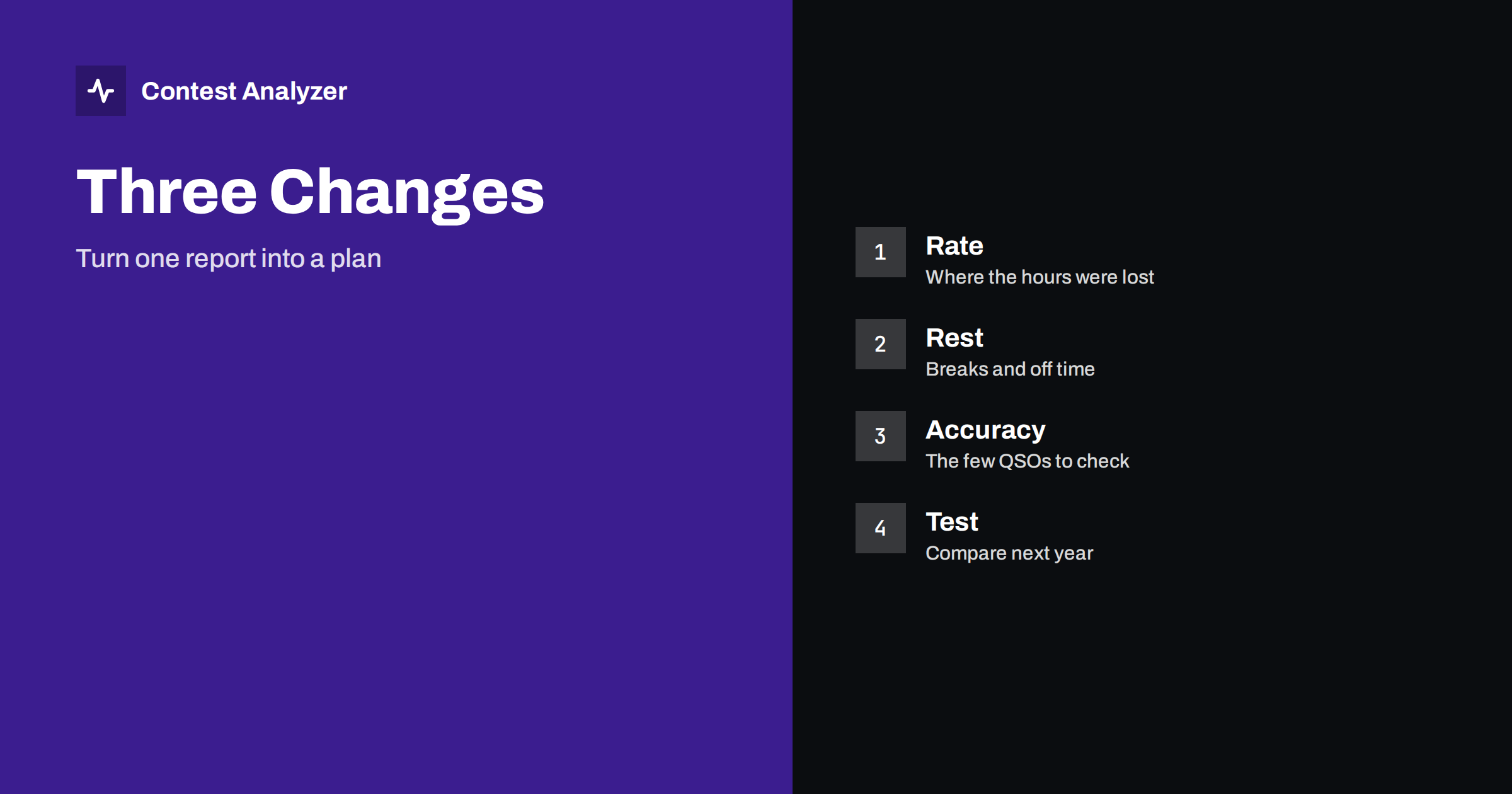
Short answer: A Contest Analyzer report is most useful when it ends in a decision. Read it with three questions: where did the rate fall, how did the breaks and rest work out, and which QSOs needed a second look. Choose one concrete change for each, write them in your notebook with the numbers behind them, and upload next year’s log of the same contest to see whether they worked.
From numbers to decisions
After a contest, it is tempting to look at the score and the totals and stop. The report offers much more: full statistics, with rates, QSOs by hour and band, countries, continents, CQ and ITU zones, WPX prefixes, distance, beam heading, breaks and off time, and callsign length and structure, plus a short list of the QSOs that deserve a second look. A long list of figures does not improve a station by itself. The improvement comes from picking a few and acting on them.
The method in this article is deliberately small: three changes, one per area. Three is a number you can remember, prepare and test. If you try ten changes at once, you will not know which of them helped. The earlier articles on turning this year’s log into goals and on setting realistic goals from last year’s statistics take the same approach in general terms.
Change one: where the rate fell
Open the rate and hourly statistics first. Look for the three weakest hours that were not planned rests. For each, ask what was happening. Was the band wrong for the time? Did you stay on a band too long? Was the antenna pointed the wrong way? Were you tired? The answers come from the hourly table and from your notes. The article on hour-by-hour analysis and band strategy by hour show how to read them.
Turn the finding into a specific change. Examples: be on 40 metres half an hour earlier in the evening; start the multiplier search on the second radio at a fixed time; move the afternoon meal to the hour with the lowest rate. Write the change as a sentence that starts with a verb and has a time or a band in it. A vague plan such as improve the evening rate is not testable.
Change two: rest and breaks
Next, look at the breaks and off time in the report. How long was your longest rest, and when did it happen? How did the rate behave before and after it? In a category with off-time rules, the rules decide what counts, so check the current text of the contest. The question here is about quality: was the rest placed where it cost the least, and was it long enough to help?
The change might be to move the main rest to a different hour, to split it into two shorter ones or to add a short pause in the afternoon of the second day, when many operators feel the dip. It might also be to rest more, if the later hours show a clear drop. The articles on off time and breaks and on operator fatigue give more background.
Change three: accuracy
The check of every callsign and every zone against official license databases and several independent reference sources produces a short list of QSOs that deserve a second look. Count them, and look at when they occurred and what they have in common. If they cluster at night, fatigue or noise is likely. If they involve similar suffixes, a habit with phonetics may be the cause. If they involve zones, the exchange or the logger setup may need attention. The report also shows callsign length and structure, which can help to see which kinds of calls give trouble.
Here, too, make the change specific: confirm the suffix on every weak signal after midnight; check the zone field of the first ten QSOs; mark doubtful calls with a note for later listening. You can edit calls, zones, time and frequency in the report, mark QSOs as checked in your own audio recording, and download a corrected Cabrillo file. Serial numbers are not checked, and dupes are not errors. The article on busted callsigns lists common causes.
Write the plan down
Put the three changes in your notebook with the date, the contest, the numbers that led to each one and the way you will measure success. For instance: the weakest three hours had 40 QSOs together; the goal is 70. The longest rest was in the hour with the highest rate on the previous day; the goal is to move it. The QSOs to check numbered 25, mostly after midnight; the goal is fewer than 15. With such targets, you can look at the next report and answer yes or no.
Include a note on conditions and on any changes you make to the station, as in a station notebook. Without the note, you may credit your change for an effect that was caused by the weather in the ionosphere.
Test the changes next year
When you take part in the same contest again, upload the log in the same way and compare it with the earlier one. The service supports year-on-year comparison with your own logs. Look first at the three numbers you chose, then at the whole picture, so that you notice side effects. An improvement in one area sometimes costs something in another, for example more rate with more errors. If that happens, adjust the plan and try again next time.
Keep the logs of the same contest in the same account, as described on the pricing page for the main and extra logs, and use the contests page to choose the right entry and year. After two or three cycles, the notebook becomes a record of your progress and a guide for the future.
What not to change
Equally useful is a short list of what you will leave alone. The report may show an area where you are already strong: a steady rate in the best bands, a good use of the multiplier hours or a low number of doubtful QSOs. Write it down. It guards against the common mistake of changing something that works because a new idea is attractive. If a part of your operation matches the best of your earlier logs, protect it. Changes should concentrate on weak points and not disturb the strong ones.
Also leave alone the things you cannot control. Conditions, the number of active stations and the weather affect the result, and no plan changes them. What you can control is your preparation, your habits and your station. The report helps to separate the two groups when you read it together with your notes.
An example plan
To make this concrete, here is a plan that an imaginary operator might write after a CW contest. The first change: be on 20 metres five minutes before the start and start the first run on a prepared frequency, because the first ten minutes were slow. The second: take the main rest between 03:00 and 06:00 UTC on the second night instead of the first, because the rate before and after the first-night rest was lower than in the hours that followed it the next night. The third: send the suffix twice on weak signals after midnight, because most of the QSOs to check were in those hours.
Each change has a reason in the numbers, a time or a band, and a target that can be checked. After the next contest, the operator looks at the first-hour rate, the placement of the rest and the number of QSOs to check after midnight. If the numbers improved, the changes stay. If not, the operator asks why, and tries another idea. This is a slow method, but it is dependable, and it builds knowledge about your own station that no general advice can replace.
The same method works for clubs and teams. Each member picks three changes, and the team picks three more for the group. Discuss them in a short meeting after the contest and write them in a shared document. When the next contest comes, the document is the starting point for preparation.
One more tip: schedule the review. Put a date in your calendar a few days after each contest for the review and the plan, because without a date the good intentions fade. A one-hour session with the report on the screen and the notebook open is enough. Do it soon after the contest while the memories are fresh, and again briefly a week before the next contest to refresh your memory of the plan.
It is also worth telling one other person about your plan. A friend or a club mate who knows your three changes can ask about them after the next contest, which is a gentle push to follow through. Many operators find that a shared plan is kept more often than a private one.
Related reading
- How to Compare Your Contest Results Year on Year
- Your Post-Contest Review Routine: What to Check
- Check Your Contest Log Before You Submit: A Checklist
The bottom line
Do not try to fix everything. Pick the weakest hours, the placement of rest and the pattern of doubtful QSOs, write three specific changes with targets and test them in the next contest by comparing reports. Small steps, checked by numbers, add up.
FAQ
Why only three changes?
Three can be remembered, prepared and tested. Many changes at once make it impossible to tell what worked.
What if the next contest has bad conditions?
Note the conditions and judge the changes with care. Compare similar situations if you can.
Do I need earlier logs?
They help. The service supports comparison with your own earlier logs, but even one report gives ideas for change.
Does the check include serial numbers?
No. Callsigns and fixed items such as zones are checked, while serial numbers are not.