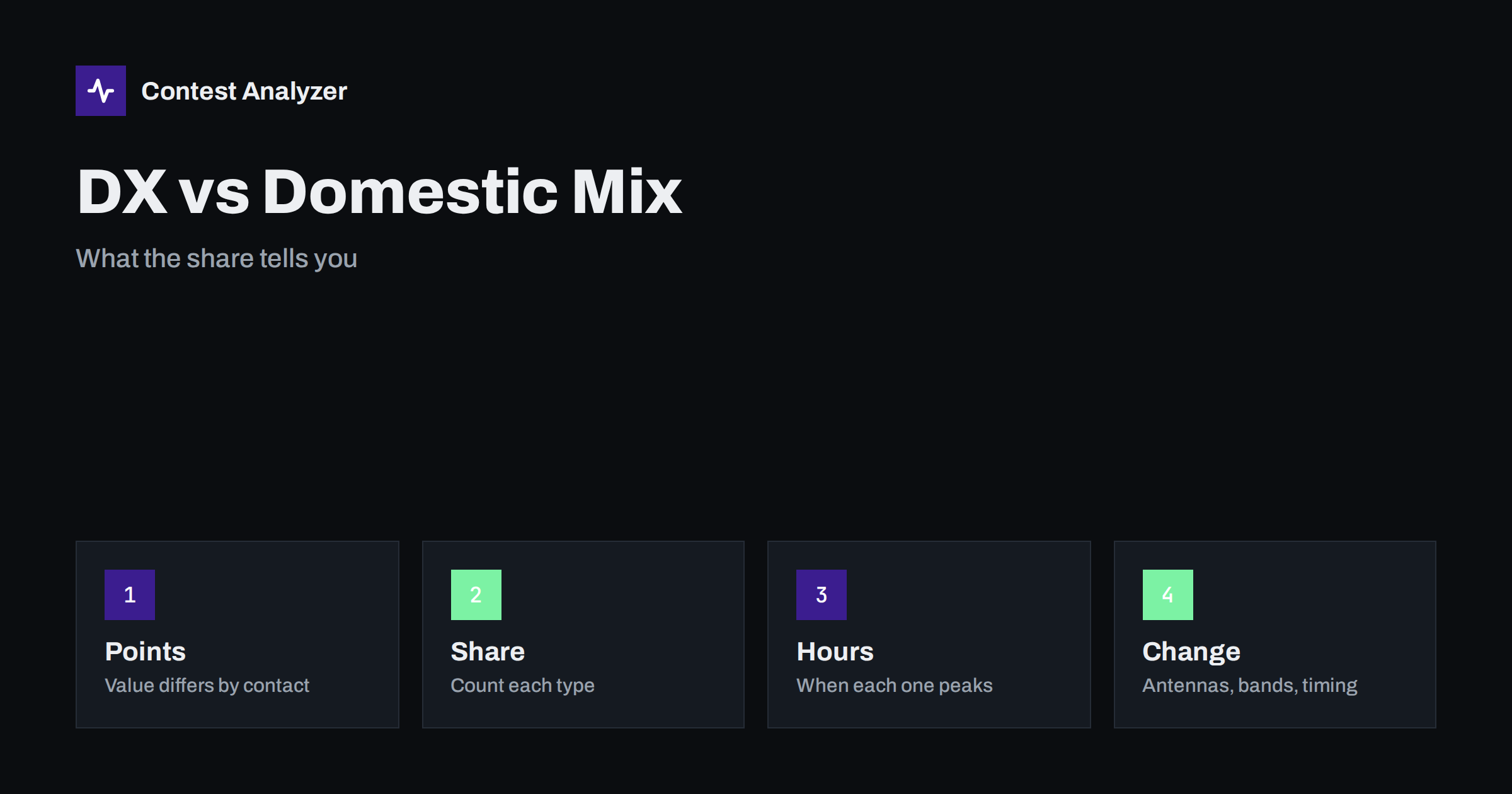
Short answer: A contest log contains domestic QSOs, with stations in your own country, and DX QSOs, with stations elsewhere. In many contests the two types are worth different amounts and bring different multipliers, so the mix between them shapes the score. Count each type by band and by hour, compare the share with the point rules and with your earlier logs, and decide whether to change the bands, the timing or the antennas. Check the current rules for the exact scoring.
What the mix means
In a typical HF contest, every QSO is worth some number of points, and the number depends on where the other station is. A QSO with a station in your own country may be worth little or nothing, a QSO with another country on your own continent a little more, and a QSO with another continent more again. The rules differ, and some contests make every QSO equal. The article on QSO points in CQ WW explains one such scheme, and the one on DX versus same-continent QSOs looks at a similar comparison from another angle. Here we use the narrower definition of domestic as the same country.
The mix also affects multipliers. Domestic stations add few multipliers, since they are in a few zones or states. DX stations add countries and zones. A log with many domestic QSOs may have a high QSO count but a low multiplier count, and the product of the two decides the final score in most contests. This is why a look at the mix can explain a result that surprises you.
How to count the types
The simplest approach is to group the QSOs by the country of the other station. Your logger or a report can do this by prefix. Group the countries into three classes: your own, the rest of your continent and other continents. Then count the QSOs in each. For a more detailed view, repeat the count for each band and for each hour. A table with these counts is the main tool for this analysis.
Take care with special cases. Stations with unusual prefixes, portable stations and those in territories can fall in a different class from what you expect, as in the article on /P, /M, /MM and /AM in contests. Do not spend too long on a few doubtful cases, but make sure that the large groups are right. A small number of misplaced stations does not change the picture.
Compare the share with the rules
With the counts ready, compare the shares with the rules. If the contest gives zero points for domestic QSOs and you made one third of your QSOs with domestic stations, you spent a lot of time on contacts that did not score. They may still have been useful, since they may have given multipliers in a state or province, but you should know it. If the contest counts every QSO equally, the share is less important, and the more interesting question is how the mix affects the multipliers.
Keep in mind that a high share of domestic QSOs is natural for some stations. A station in a country with a large number of active contesters will find many domestic callers on every band. A station in a quiet region may find that nearly all QSOs are DX. Compare yourself with your own earlier logs, not with a station in a very different place. The article on same contest, two years shows how to do it.
Read the mix by hour
The mix changes during the contest. Domestic QSOs are common in the hours when the band is short and the stations of your own country dominate. DX QSOs peak when long-distance paths open. Plotting the share by hour often shows a pattern: domestic in the first hours or in the middle of the day, DX in the evening or at night. The shape depends on the band, and the article on openings to each continent hour by hour describes the typical picture.
If the hourly table shows a high rate in hours dominated by domestic QSOs and a low rate in the DX hours, the question is whether you could have moved the effort. Perhaps a low rate in the DX hours reflects real conditions, and perhaps it reflects your own preparation: not enough time on the band, a weak antenna or a missed opening. The article on band strategy by hour helps plan this.
Antennas, power and the mix
The share of DX contacts reflects the performance of your station toward distant regions. A low take-off angle, a good gain in the right direction and clean transmit and receive performance push the mix toward DX. If you made a change at the station, the mix is one of the first numbers that will show it. The article on judging an antenna change with your contest statistics describes a careful comparison, and the one on beam heading statistics shows where your QSOs come from.
Power categories also matter. A low-power station will often find that a larger share of its QSOs are with nearby stations, because they are easier to work. This is a normal effect, not a fault. In the same way, a station that spends a lot of time searching and pouncing may have a different mix from one that runs. Compare like with like.
Decide what to change
Use the counts to choose one or two changes. If the DX share is low, consider more time on the bands and hours that favour DX, or a better antenna for those bands. If the domestic share is high and the points rules make domestic QSOs worthless, consider reducing the time spent on them, perhaps by moving away from the most crowded frequencies. If the multipliers are lacking, shift effort toward search-and-pounce for new countries and zones. Check the current rules for your contest before you decide.
Do not forget that domestic QSOs can be useful. A reliable stream of easy QSOs keeps the rate up at times when the band is poor for DX, and in some contests they count for multipliers by region. The aim is a conscious mix, not the highest DX share at any cost.
Using a report for the analysis
A report that gives countries, continents, CQ and ITU zones, distance and beam heading, as well as QSOs by hour and band, supplies most of the numbers needed here. Contest Analyzer provides these statistics for the 22 supported contests listed on the contests page and compares them with your own earlier logs. It checks every callsign and every zone against official license databases and several independent reference sources, so that a bad prefix does not distort the count. Serial numbers are not checked.
A numerical example
Suppose a log has 1,200 QSOs. Of these, 420 are domestic, 520 are with other stations on your continent and 260 are with other continents. In a contest where domestic QSOs score nothing, the first group contributes only through multipliers, and 420 contacts is a large share of the effort. If last year the figures were 300, 480 and 380, the shift is clear: more domestic, fewer intercontinental. The question becomes why. Were conditions worse for long paths? Did you spend less time on the bands that open to other continents? Was there a change in the antennas?
You look at the hourly table and find that the intercontinental QSOs this year were concentrated in two evening hours, while last year they were spread over six. Your notes say that the geomagnetic activity was high on the second day. This suggests that conditions explain much of the change, and that you should not blame the station. At the same time, you notice that on the first day, with normal conditions, the share was close to last year’s. The station is fine. The decision is to keep the plan and to prepare alternatives for poor days: for example, a stronger focus on multipliers within your own continent.
Do not chase one number
A final warning: avoid optimising the mix alone. The aim of a contest operation is a high score, and the score depends on QSOs, points and multipliers together. A change that raises the DX share but lowers the total rate may reduce the score. Test changes one at a time, and judge them by the whole result and by several seasons of data, not by one number in one weekend. Keep your notes, and be ready to be surprised: sometimes the numbers show that a habit you thought was costly, such as working many domestic stations, actually kept you going in the hours when nothing else was possible.
Related reading
- Continent Breakdown of a Contest Log Explained
- Distance Statistics: Longest QSOs and What They Tell You
- Band Ratio in Contest Statistics: What the Share Says
The bottom line
Count your domestic and DX QSOs by band and by hour, compare the shares with the points and multiplier rules and with your own earlier logs, and choose a small change. The mix is not good or bad in itself; it is good when it matches your plan.
FAQ
Are domestic QSOs worth less?
In many contests, yes, but not in all. Check the current scoring rules.
Should I avoid domestic contacts?
Not necessarily. They keep the rate up in poor hours. Know their value in the rules.
How do I count the types?
Group QSOs by the country of the other station, in three classes: your country, your continent, other continents.
Does the mix change with power?
Often, yes. Lower power typically means more nearby QSOs. Compare with your own earlier logs.