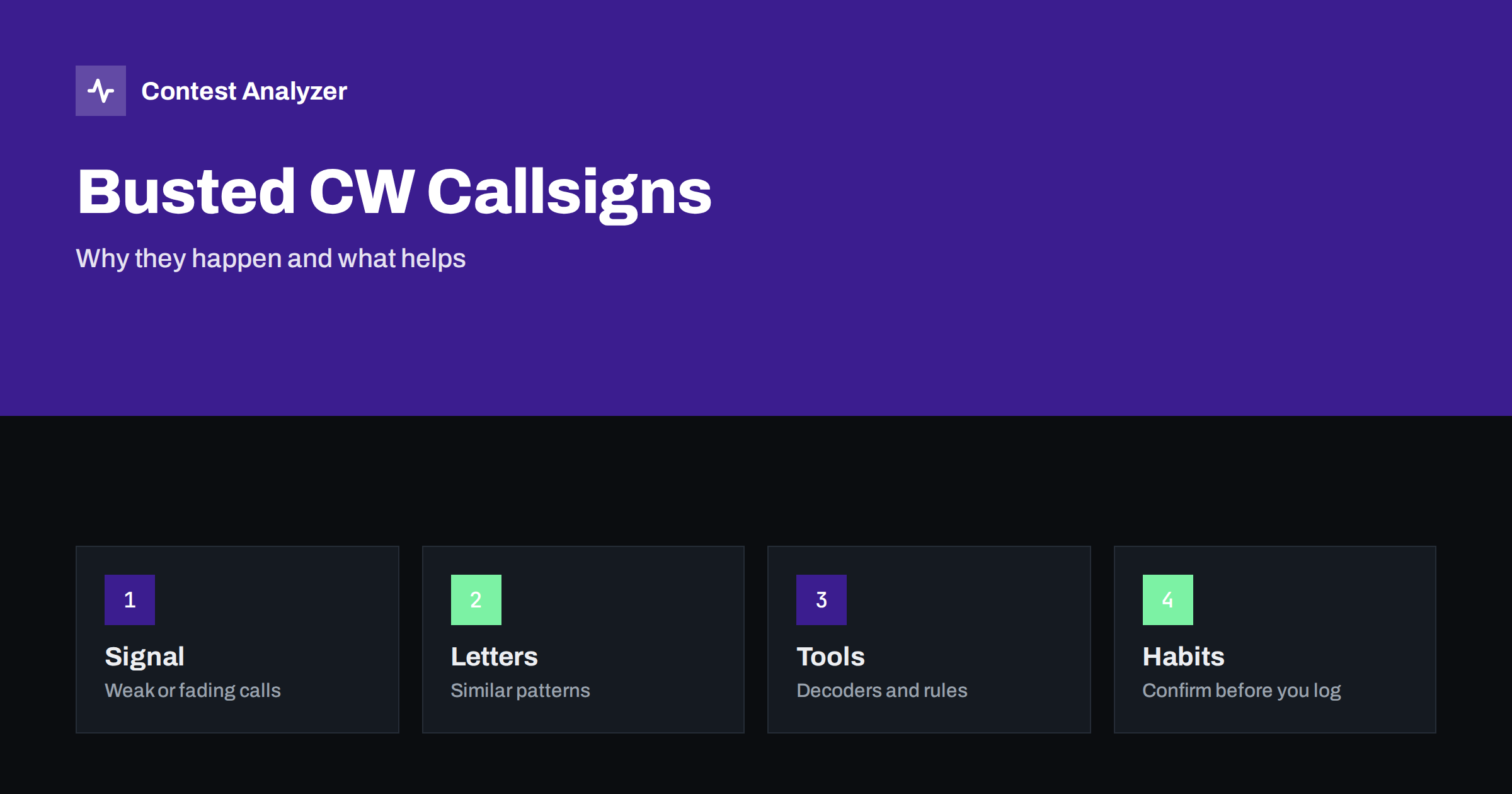
Short answer: CW callsigns get busted because signals are weak, because fading removes a dit or a dah, because several letters sound alike and because the operator is tired or in a hurry. Decoding software can help in categories where it is allowed, but it also makes mistakes and may change your category. The best protection is a short confirmation of the call before you log, and a review of the log afterwards.
What a bust is, in one paragraph
A busted call is a callsign that is logged with at least one character wrong. The QSO usually happened, but the other station will not find your call in its log, or will find a different one. The result is a removed QSO and, in many contests, an extra penalty. If the wrong call happens to be a real station, the error can also appear as a unique call or a not-in-log QSO. The article on busted callsigns in contest logs explains the cost in more detail.
Weak signals and noise
The first cause is signal strength. A call that is only just above the noise is copied in pieces. The ear fills in missing characters with the most probable ones, and the brain is often wrong in the same way each time. Under noise, short characters such as E, I, S and H are the first to be lost, and calls that depend on them change their meaning. A call with a letter that was masked by a crash can still be logged confidently, because the rest of the call looked plausible.
Practical remedies are simple. Use the narrowest filter that your receiver supports without losing the signal. Reduce the gain of the receiver and use the noise blanker or the noise reduction carefully, because they can also distort the characters. If the call is weak, wait for the second transmission rather than guess after the first.
QSB and QRM
Fading, called QSB, makes a call strong and weak within seconds. A dit that falls into a fade is lost, and a dah may be shortened. The result is a call that looks right but differs by one character. QRM from stations nearby on the frequency adds a second source of errors, because a caller overlaps with another one. In these cases the operator hears part of one call and part of another and may combine them.
The remedy for fading is patience. Ask the caller for his call again and compare the second copy with the first. If both copies agree, the call is probably right. If they differ, ask for a third. For QRM, use the filters and the receiver settings, and prefer the QSO where the call is clear. The article on partial callsign copies shows when to ask for a repeat of the full call and when to ask only for the doubtful part.
Letters that look alike
CW has pairs and groups of characters that differ by one element, and these are the source of many busts. Typical examples are B and 6, D and B, G and Z, U and V, S and H, F and L, K and Y. A single lost dit or dah turns one into the other. The error is very hard to see, because both versions are valid callsigns. The article on CW characters that get confused lists the typical pairs in more detail, and the article on similar prefixes that are easy to confuse shows how the problem appears at the beginning of the call, where it also changes the country.
The habit that helps is a reasoned check. When you copy a call with one of these ambiguous letters, ask yourself whether the neighbours of the call in your log or on the band make sense. A familiar call from a regular contest station is more probable than an unusual one that differs by one letter. This reasoning is not proof, but it is a reason to ask for a repeat when the signal allows.
Decoding aids and the rules
Many operators use software that decodes CW from the receiver audio and shows the result on the screen. Such tools can be a help for finding stations and for checking a call that you have copied by ear. They also make mistakes, especially on weak or fading signals and on stations with an irregular keying style. A decoder that shows a call with confidence is not evidence that the call is right.
More important are the rules. In many contests, the use of a decoder or any outside source of callsigns changes the category of the entry, for example from a single operator without assistance to one with assistance. The article on assisted versus unassisted categories explains the general idea. Check the current rules of the contest and your category before you use any such tool during the contest.
Habits that protect the call
- Log the call only after you have heard it twice, or once and clearly.
- Send the call back to the other station, so that he can correct it. If he sends back an OK, the call is confirmed.
- Use the logger’s Super Check Partial style hints as a hint only, never as a replacement for listening. See Super Check Partial while operating for the traps.
- If the call is not clear, ask for a repeat, and say which part is doubtful if you can.
- Do not fill in missing characters from memory or from a guess.
- At night and in the late hours, slow down your speed a little and increase your care.
Record the audio if you can, because a recording is the best way to settle a doubt after the contest. The article on recording audio in a contest explains the set-up.
Finding busts after the contest
Before you submit the log, look for calls that are rare, calls that appear only once and calls with a character combination that is unusual. Most busts are among them. Contest Analyzer checks every callsign and every zone against official license databases and several independent reference sources and shows only the few QSOs worth a second look. You can listen to these QSOs in your own recording, mark them as checked, edit the call, zone, time or frequency and download a corrected Cabrillo. It works with Cabrillo from N1MM Logger+, DXLog and Win-Test, and the contests page lists the 22 contests that are supported.
The statistics help to find the weak points of your operation. Look at the busts by hour and by band: if they cluster on one band, the receiving conditions may be the cause. If they cluster in certain hours, fatigue may be the reason. If they cluster among long callsigns, you may need to ask for repeats earlier.
Speed, rhythm and the style of the sender
Not every station sends perfectly. A hand key, a bug with uneven spacing, a keyer with a very high speed or a keyer with incorrect weight can make a call hard to copy even when the signal is strong. Some stations send letters close together with long gaps between words, others do the reverse. The result is that you can hear every dit, but the characters do not divide in the place where you expect them. A call such as one with a short letter followed by a digit may be heard as a different pair of characters.
The best remedy is to listen to the rhythm and not only to the characters. After a few seconds with the same station, most operators learn the style, and the second copy is more accurate than the first. This is one more reason to wait for the second transmission of a doubtful call. It is also a reason to keep your own sending clean: a regular rhythm with correct spacing helps everybody who copies you, and it reduces the number of requests for repeats that slow your rate.
The effect of a pileup
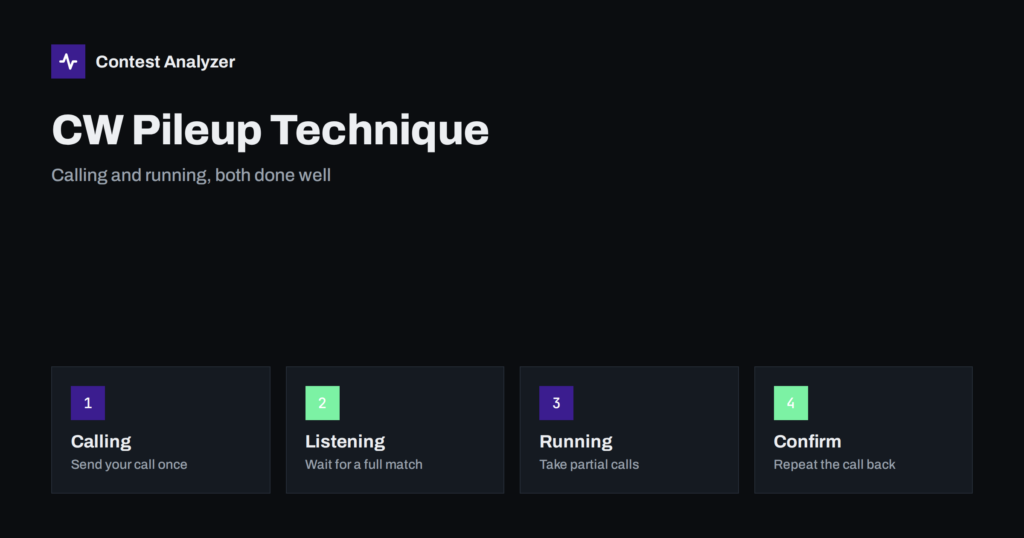
When a rare station or a strong multiplier is called by many stations, calls are heard in overlapping pieces. The operator on the other side picks one and sends a partial call, and several stations answer. If you are one of the callers and the answer does not clearly match your call, do not assume that it was for you. Many errors happen when two stations with similar calls both think that the answer was for them, and one of them logs a QSO that did not happen with him. Send your call once, listen and wait for the full call before you proceed.
When you run and have a pileup, the same advice applies in the other direction. Answer a partial call, ask for the missing part and confirm the call that you log. A confirmation takes a second, and it removes the doubt from both logs. The article on logging partial calls in a pileup gives more detail on the technique.
Related reading
The bottom line
CW busts come from weak signals, fading, similar letters and fatigue. Confirm the call before you log it, use decoding aids only within your category rules and review the log with the help of a recording.
FAQ
Can a decoder replace my ear?
No. It can help in some situations, but it also makes errors, and its use may change your category. Check the current rules.
Is it better to guess or to ask for a repeat?
Ask for a repeat when you can. A guess that is wrong costs the QSO and may cost a penalty.
Which letters are busted most often?
Pairs that differ by one element, such as B and D, G and Z, U and V, S and H. Weak signals make this worse.
How can I find busts in my log?
Look for rare or single calls, check them against your recording and use a report that shows the few doubtful QSOs.
Does slowing down help?
Often yes, especially at night. A slightly lower speed gives the caller and you more time to be clear.