Short answer: Copying callsigns quickly and correctly is a skill, and like any skill it improves with short, regular, honest practice. Use recorded contest audio, a callsign trainer and live listening, write down what you hear, check it against the truth and keep a note of the mistakes you make. Fifteen minutes a few times a week do more than one long session before the contest.
Why callsign copy decides your accuracy
In a contest, the callsign is the part of the QSO that gives you the credit. A good exchange with a wrong call is worth nothing, and a busted call can cost more than the QSO. Callsigns are also short and have little redundancy: unlike words in a sentence, a callsign has no context that helps you correct a mistake. K5ZO and K5ZD are both perfectly valid. For this reason the ear has to be trained to hear details, and the hand has to be trained to write them without guessing.
Good copy is also a matter of speed. An operator who can copy a call at first attempt makes more QSOs per hour than one who needs a repeat each time. A repeat costs the other station time as well and may lead it to move on. The articles on CW copying accuracy and on SSB phonetics show how copy quality affects the log; this article is about how to improve it.
Set a baseline first
Before you start training, find out where you stand. Take a recording of a contest, or use a callsign trainer, and copy fifty calls at a speed that feels comfortable. Check each against the answer and note how many were fully right, how many had one wrong character and how many were far off. That is your baseline. Repeat the test after a few weeks of practice to see progress.
Write down also the kinds of errors. Are they at the end of the call, in the digit, in the first letter? Are they with similar sounding letters, such as M and N, B and D, or F and S? Do you lose characters when the call is short and fast? The pattern of your errors tells you what to practise. A person who loses the last letter needs different training from a person who mixes up digits.
Use real contest audio
Real audio is the best material, because it has the noise, fading and overlapping calls of a real contest. If you recorded your own contest, you have a personal library. The articles about setting up audio recording and recording the whole contest explain how to get one. Listen to a stretch of an hour of a busy period and copy the calls as you would in the contest, then compare your copy with your log. You may be surprised: the log is sometimes wrong, and sometimes your ears were right.
Use a short sample many times rather than a long one once. Hearing the same difficult call at slow and normal speed teaches your ear what the real signal looks like. Over time, the difficult calls become easy, and you start hearing similar patterns in new calls.
One more way to use a recording is to copy it twice. On the first pass, copy as in a real contest, in real time, and accept that you will miss some calls. On the second pass, pause and replay as often as you like and write the truth. Then compare the two passes. The difference between them is the part of your copy that is limited by speed and attention, and not by ear. That part can be trained by lowering your own pressure: slower first passes at first, faster later.
Callsign trainers and games
Many free and paid programs can generate callsigns at any speed, with noise, with several stations at once and with different accents or sending styles. They are a handy way to practise in short sessions, in a break at work or on a phone. Start with a speed a little below your comfort level and increase it only when you copy at least nine out of ten calls correctly. Add noise or interference gradually.
The advantage of a trainer is the instant feedback. A trainer tells you immediately whether the call was right, which is something that a real contest never does. Use the feedback: after each mistake, say what you wrote and what was sent, and think about why. A mistake that you understand is less likely to be repeated.
Shadowing and live listening
A simple exercise is shadowing: listen to a live contest or a busy part of the band and write the calls in a notebook without making any QSOs. You are not under time pressure, so you can concentrate on accuracy and not on rate. If you can, compare your notes with the log of a friend or with a recording. Even a quiet evening on a busy band is useful practice, and so is a short listening session during an ordinary weekend.
Another exercise is to practise the rhythm of a QSO: copy the call, say it to yourself or type it, and only then decide whether to answer. Contest stations that work at a high rate often do this almost without thinking. The habit takes time to build, but it is the base of accurate operation. See also the article on logging what you really copied, where this habit is part of a wider rule set.
Train the confusing pairs
Every mode has its own confusing pairs. On CW, characters with similar shapes in sound, such as 6 and B or S and H, are the problem. On SSB, letters that sound alike over a weak channel, such as F and S or M and N, are the trouble. On RTTY, the issue is shifted characters and decoding errors. The articles on confused CW characters, confused SSB letters and cut numbers in CW exchanges list the typical pairs.
Make a short list of your own five worst pairs and practise them: record yourself writing them from a trainer at slow speed, then at normal speed. Repeat for a week. Many operators find that their personal list is shorter than expected, and that a few weeks of focused training reduces most of it.
Practise the suffix, not only the whole call
Suffix errors are the most common kind of busted call, as the article on suffix errors in callsigns shows. In training, give extra time to the last two or three letters. Play a recorded call and stop before the end, then guess the suffix, then listen to the end and check. The exercise teaches your brain to listen carefully to the part that matters most, and to avoid assuming a familiar ending.
When practising phone, train a short, clear way to confirm a suffix with phonetics, and when practising CW, train a short way to ask for a repeat of the suffix only. Having a ready phrase saves time and avoids confusion in the real situation.
Check the result with a log check
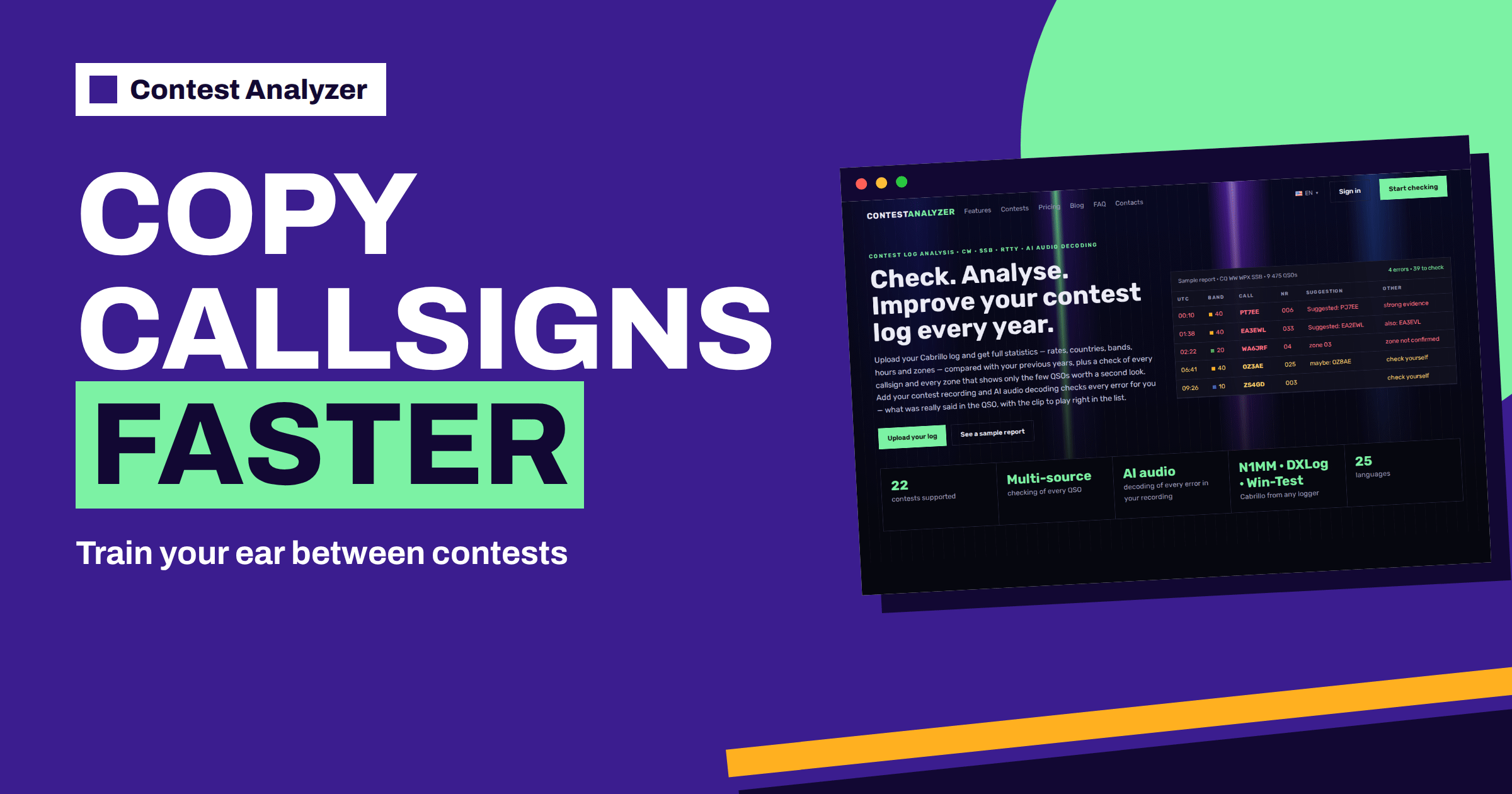
After a contest, the log can tell you how well your copy worked. Contest Analyzer checks every callsign and every zone against official license databases and several independent reference sources and shows only the few QSOs worth a second look. The pattern of those QSOs is useful feedback: if most of them are suffix errors at night, you know what to train. You can mark QSOs as checked in your own audio recording and edit the calls that were wrong, and the report also shows callsign length and structure, which can help to see which kinds of calls give you trouble.
Use the report as a feedback tool, not as a verdict. Add the findings to your notebook next to the training plan. After the next contest, compare the numbers. The contests page lists supported contests, and the FAQ answers common questions about the service.
A simple weekly plan
- Two sessions of 15 minutes with a trainer at a comfortable speed.
- One session with a real contest recording, copying a busy ten minutes.
- One session of shadowing on the band, writing calls without making QSOs.
- Five minutes of notes: which errors did you make this week?
Keep to the plan for a month before a contest, and reduce it in the last days to avoid tiredness. The aim is steady improvement and a calm ear on the day.
Practise also when you are a little tired, though not exhausted. In a contest, most errors happen at night, and the ear that you will have at three in the morning is not the ear of a fresh evening. A short session late in the evening, with the same material as in the morning, shows how much your copy changes with fatigue. If the drop is large, you know that you need to slow down at night, ask for repeats more often and plan your rest well. The article on night hours and logging errors shows what the pattern looks like in a real log.
Finally, practise your reaction when you make a mistake. In the contest, a wrong call that you notice a few seconds later can still be corrected, if you stay calm. Train yourself to stop, say “Sorry, check”, ask for the call again and fix the log entry, without panic. A calm correction costs a few seconds. An unnoticed mistake can cost much more.
Related reading
- CW Speed and Error Rate in Contests
- Busted Callsigns in Contest Logs: Why They Happen
- Your First HF Contest: A Beginner’s Guide
The bottom line
Callsign copy improves with short, regular and honest practice. Measure a baseline, train with real audio and a trainer, work on your own confusing pairs and the suffix, and use your log after each contest as feedback. A month of this will make the next contest quieter and more accurate.
FAQ
How long should a practice session be?
Fifteen to twenty minutes is enough. Short sessions several times a week work better than one long one.
Which speed should I train at?
Slightly below your comfort level, until you copy about nine of ten calls correctly, then raise it a little.
Is recorded contest audio better than a trainer?
Both help. Real audio has realistic noise; a trainer gives instant feedback.
Can a log check show me where my copy is weakest?
Yes. The pattern of the QSOs worth a second look, such as suffixes at night, points to what you should practise.