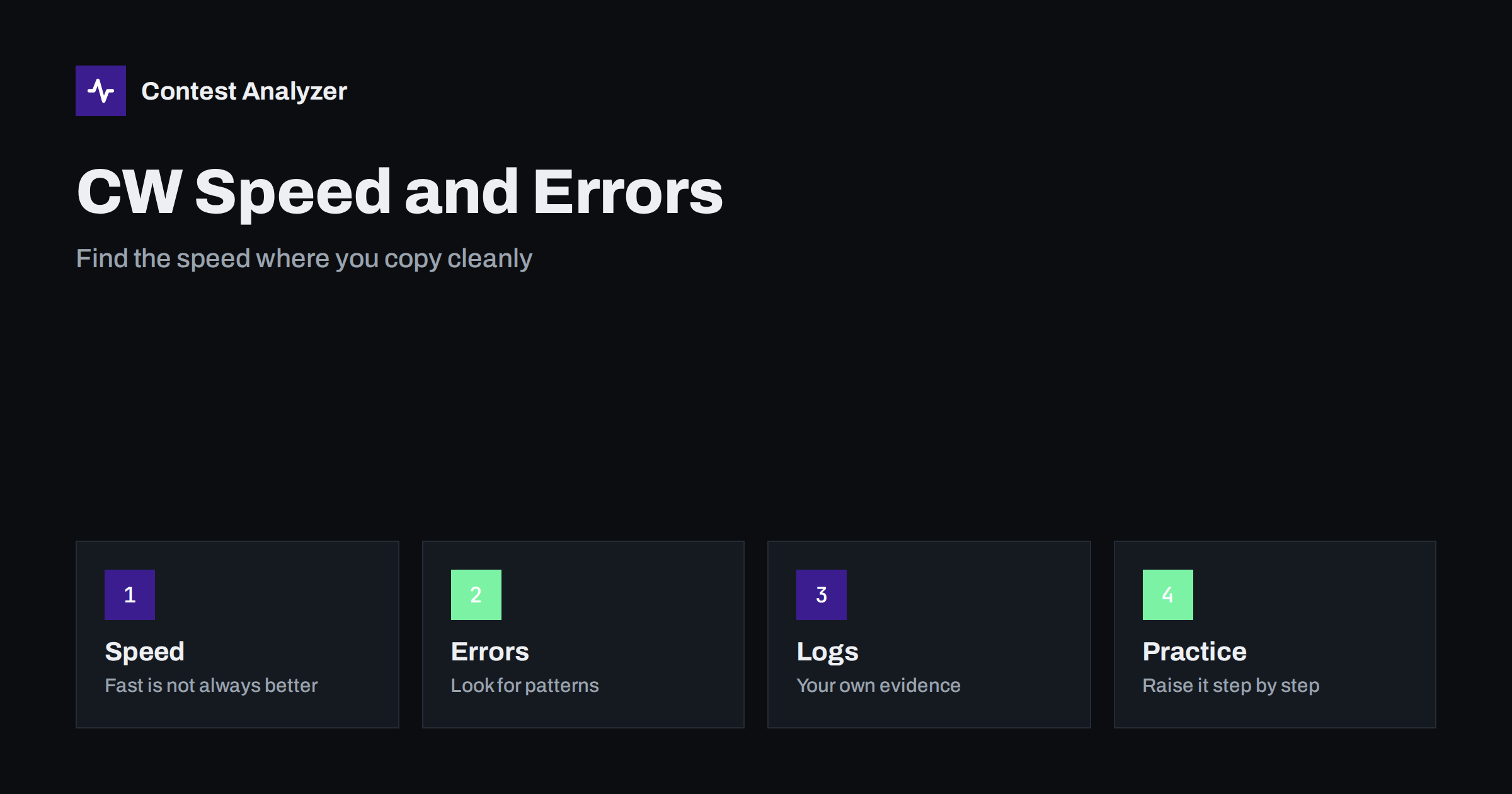
Short answer: Faster CW means more QSOs per hour only while you copy the callsigns and exchanges correctly. Beyond your comfortable speed, every extra word per minute adds repeats and busted calls that cost more than the speed gains. You can find your own limit from past logs by comparing the error pattern in fast hours and slow hours, and then raise the speed gradually with practice and not with hope.
The trade-off behind speed
In a CW contest, the speed at which you send and receive sets a ceiling on the rate. A faster exchange takes fewer seconds, so more contacts fit into an hour. That is the reason why high-rate stations often send at a speed that seems extreme to a newcomer. But the benefit exists only if the other side copies you the first time and you copy them the first time. Each repeat doubles the time of the QSO, and a fast operator who needs a repeat in one QSO out of three can end up slower than a calm operator who needs none.
A second cost is accuracy. Copying at the edge of your ability makes you more likely to confuse similar characters, to miss a letter at the end of a callsign or to put a digit in the wrong place. These errors can survive until the log is checked, and then they cost the QSO and sometimes more. The article on CW copying accuracy in contests describes the mechanics of fills and repeats in more detail. In this article we ask a more specific question: how do you measure your own comfort zone?
What your log can tell you
A contest log does not record the speed of each QSO, but it records the time, and the time shows the rate. You can use the rate as a proxy: hours with a high rate usually mean a higher speed or a more efficient exchange. If you also record the speed in your station notes, for example the setting of the keyer at different hours, then you have a direct link between speed and results.
The second source is the errors. After the contest, you can find the QSOs that were changed during checking: callsigns corrected, zones fixed, QSOs removed. Note the hour of each. If most corrections cluster in hours when your rate was highest, speed is a candidate cause. If they cluster at night or in the last hours, fatigue is the more likely cause; see finding your tired hours in contest statistics. Both effects can be present, which is why the two analyses should be done separately.
Error patterns that point to speed
Some errors are typical of copying too fast. A callsign with the last letter wrong is one: the operator wrote the start of the call and moved on before the end was complete. Another is a swap of neighbouring characters, such as two digits in a number. A third is the confusion of characters that have similar rhythms in Morse. Our article on CW characters that get confused lists such pairs.
In the exchange, speed errors look different: a zone number copied from the previous QSO, a cut number read as the wrong digit, or an element missing. If the same kind of error appears repeatedly in the fast hours, you have a pattern, and a pattern can be fixed by changing the speed, the way you write or the way you ask for a repeat. Write the patterns down in a short list and read it before the next contest.
Compare fast and slow hours
Take your log and divide it into the hours with the highest rate and the hours with the lowest. For each group, count the QSOs that needed correction. Divide the number of corrections by the number of QSOs to get an error percentage. If the fast hours have an error percentage twice as high as the slow hours, but also a rate twice as high, the net effect on score may still be positive. If the fast hours have a three times higher error percentage and a rate only slightly better, the speed is too high for you.
The calculation is approximate, because the QSO counts and corrections are small, and many things differ between hours. But it gives a rough indication, and over several contests the trend becomes clearer. A tool that lists the QSOs worth a second look helps you collect the corrections: Contest Analyzer checks every callsign and every zone and shows only the few QSOs worth a second look, so you can count those that you decided to change.
Setting a working speed
From your analysis, choose a working speed for the contest: the speed at which you copy almost everything the first time. Then decide on rules for changing it. When you call CQ, send at your working speed or a notch above, and when a station answers at a different speed, adapt your reply to theirs if it is slower, and consider whether to match it if it is faster. Many experienced operators slow down for a weak or difficult signal; this is a sign of skill and not of weakness.
The article on choosing CW speed in a contest discusses the choice in more detail. A flexible approach beats a fixed one: the best speed depends on the band, the noise, the density of callers and your own fatigue. Set the working speed for the start of the contest, and allow it to fall by a few words per minute when conditions or tiredness require.
How to raise your comfort zone
Speed is a skill that can be trained. Short daily sessions of copying at a speed slightly above your comfortable level, using recorded contest audio or a practice program, raise the ceiling. The key is progress in small steps: when you can copy callsigns at one speed with almost no errors, move up a little. Training with random callsigns, which look like the real thing, is better than reading plain text.
Old contest recordings are useful for this training because they contain real conditions, with noise, fading and overlapping stations. You can also replay your own contest and check your copying against the log. The article on train with your old logs describes a method. Repeat it regularly and compare your results with the error percentages from the actual contest.
Practical rules for the contest itself
- Start at a speed that you know you can sustain for hours, not at your maximum.
- Ask for fills on the specific part you missed, not the whole exchange.
- Slow down when you notice repeated errors, even if the band is full.
- Make notes for doubtful callsigns, so that you can check them later.
- Use breaks to recover, since copying skill falls with fatigue.
These simple habits keep the error rate low without any special equipment, and they work at any speed. The general principle is that your log is only as good as your copy, so protect it.
Remember the other side
Your speed is not only your own business. The station you work has its own limit, and a good operator adapts. Sending your callsign at a speed that is too fast for the caller causes repeats; sending it a little slower may save time overall. Some operators deliberately use a slightly slower speed for the callsign and a faster speed for the exchange, because the callsign is the element most often copied wrongly. If you try this, test it over a few hours and look at the result in your statistics.
A worked comparison
Suppose that in the best three hours of a CW weekend you logged 330 QSOs and had to change 21 of them after checking, an error rate of about 6 percent. In three ordinary hours you logged 210 QSOs with 6 changes, about 3 percent. The fast hours produced 120 more QSOs, but also 15 more problems. If each problem costs the QSO and perhaps a penalty or a multiplier, the real gain is smaller than the raw count suggests, and it may even be negative once the cost of repeats and the follow-up work is included.
Now suppose that you repeat the exercise next year after practising at a higher speed and find the error rates are 4 and 3 percent. The speed has risen while the accuracy has not fallen much; this is evidence that the comfort zone has really moved. The numbers in this example are made up for illustration, and your own will differ. The method, however, is the same: compare, calculate, decide, and test again.
Keep the results in your station notebook, with the date, the contest and the speed settings. A year later, you will not remember the details, but the notes will make the comparison easy. Over several seasons, the notebook becomes the most useful training record you have.
Related reading
- Choosing CW Speed in a Contest: Slow Down or Speed Up?
- Why CW Callsigns Get Busted in Contests and What Helps
- Asking for Repeats in CW: AGN, ?, QRS and Short Fills
The bottom line
CW speed pays only while accuracy holds. Use your past logs to see where the errors cluster, compare fast and slow hours, choose a working speed that you can sustain, and raise it step by step through practice. A log with fewer errors scores better than a faster log with many.
FAQ
Is faster CW always better in a contest?
No. It is better only as long as you and the other stations copy correctly. Repeats and busted calls can cancel the gain.
How can I tell if my speed is too high?
Compare the error percentage in your fastest hours with the slowest hours. A much higher percentage in fast hours suggests the speed is above your comfort zone.
Should I match the speed of the caller?
Often it helps to adapt, especially if the caller is slower. It reduces repeats and keeps the QSO short overall.
Can I train for higher speed?
Yes. Short regular sessions with real contest audio, raised in small steps, are effective.