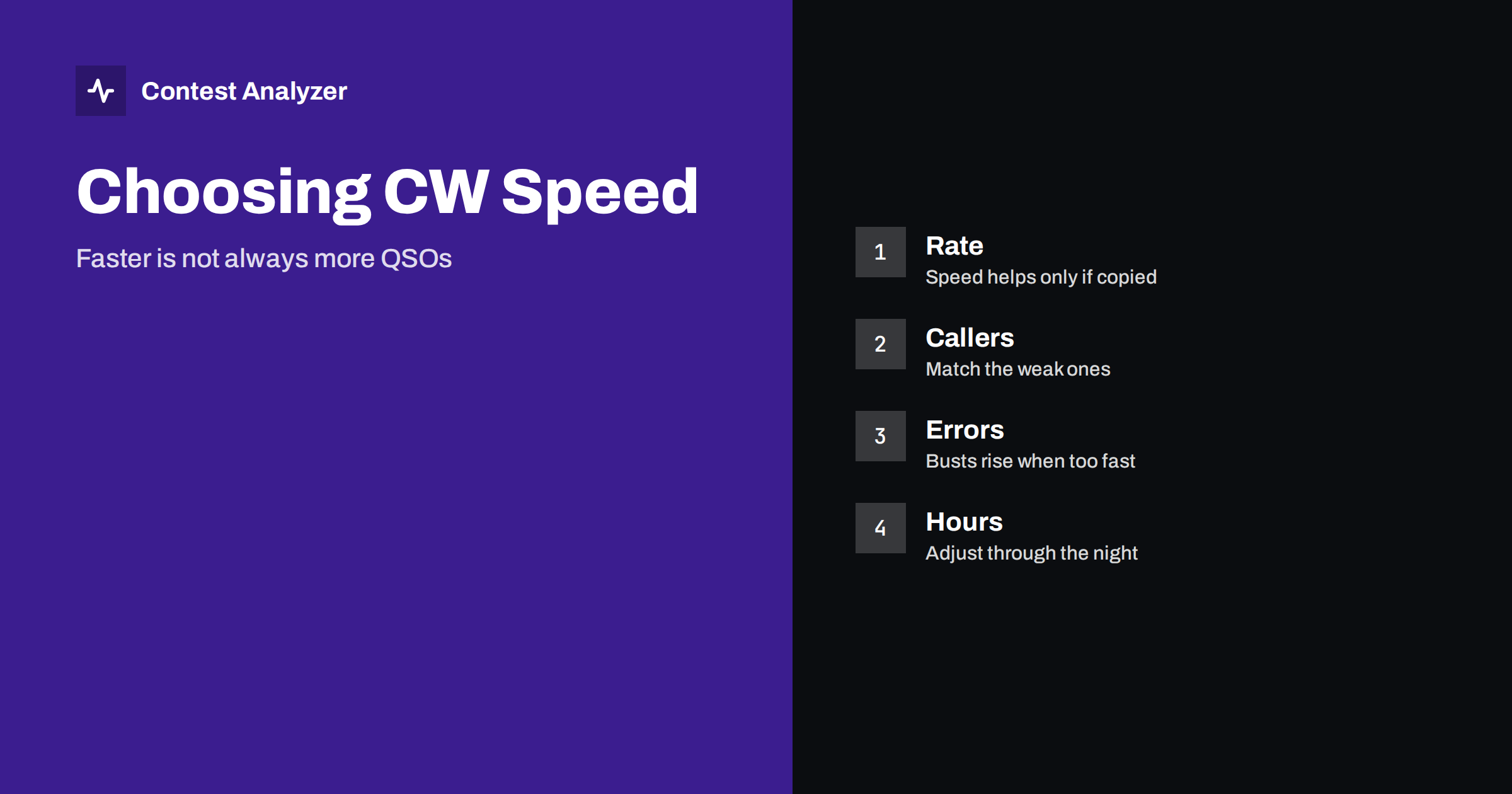
Short answer: The best CW speed in a contest is the one at which callers copy your exchange the first time and you copy their calls without repeats. A higher speed shortens each QSO only if it does not cause repeats. Many operators raise the speed when conditions are good and the band is full, and lower it when callers ask for repeats or when they feel tired.
What speed really changes
A CW exchange in CQ WW is short: callsign, report and zone. At a higher speed, the whole QSO takes a few seconds less. Over many QSOs this adds up, and a faster operator can have a higher peak rate. But the saving is small compared with the cost of a single repeat. A repeat costs the time of the whole exchange again, plus the time to ask for it. If one QSO in ten needs a repeat because of speed, the gain from the higher speed is probably gone.
It helps to think about the QSO as a chain: your CQ, the caller’s call, your answer, the caller’s confirmation. Speed affects each link. The weak link is usually the one where a caller who is not fully comfortable with your speed tries to copy your exchange. The article on the rate meter shows how to see the effect on short and long time windows.
Match the caller, not only yourself
When you run, the callers choose to answer you. A fast CQ attracts fast operators, and a slower CQ attracts a wider group. Some contesters deliberately slow down by a few words per minute to pull in more callers, especially from the regions where operators are not always at high speed. Others hold a high speed and accept that some stations will not call. Neither approach is right in every case. What matters is that you notice what your own log tells you.
A practical technique is to answer the caller at the speed that he used, within reason. If he calls slowly, a slightly slower exchange will help him copy it and avoid a repeat. Many logging programs let you change the speed with a key during the contest, and some can follow the speed of the received signal. Check your logger’s manual for how this works and practise before the contest.
When to slow down
- When many callers ask for AGN or send a question mark after your exchange.
- When the band is noisy or fading, because weak signals are harder to copy at any speed.
- When you notice your own errors rising, for example wrong letters in callsigns or a wrong zone in the log.
- In the late hours, when concentration drops.
- When you work stations from a region that is known to be slower.
Slowing down is not a defeat. The aim is a better rate over an hour, not a perfect speed on a single QSO. The article on CW copying accuracy gives a more detailed look at the link between speed, fills and repeats.
When to speed up
A faster speed is useful when the band is full of strong stations, when your rate is limited by the length of your own messages and when you hear that nearly all callers copy you the first time. In that situation, a small increase in speed can raise the rate without raising the error count. A good test is to raise the speed a little, watch the number of repeats in the next ten minutes and go back if it grows.
Remember that speed also affects the stations that you work in search-and-pounce mode. When you call someone else, a faster call can be copied by a station that is used to it, but a weak or crowded signal may be lost. Send your call at a speed that matches the operator you are calling, and do not rely on repeating it often. The article on run versus search and pounce describes how the two modes differ in the numbers.
How speed appears in the statistics
You rarely log your speed directly, but you can read its effect. A rate chart with a high peak and then long gaps may show a fast operator who runs out of callers or concentration. A smoother chart often belongs to an operator who matched speed to conditions. Compare the first and the second night: if the rate drops and the number of corrected QSOs rises, speed may have been too high for the state of the operator. The article on operator fatigue in 48-hour contests shows how to look for this pattern.
Contest Analyzer gives rates, QSOs by hour and band, breaks and off time, and callsign length and structure. It checks every callsign and every zone against official license databases and several independent reference sources and shows only the few QSOs worth a second look. You can then compare the hours with the highest rate with the hours that had most flagged QSOs. It works with Cabrillo from N1MM Logger+, DXLog and Win-Test.
Practise speed changes before the contest
Changing speed during a contest is a skill. Practise it in a small contest or in a training session: raise the speed in steps, copy calls from a recording, and note the point at which you start to make mistakes. This point is your personal limit for the early hours, and it will be lower for the late hours. A practice session also shows if your keyer or logger changes speed smoothly and if the messages stay readable.
Listen to your own signal as well. A very fast signal with short spaces can be hard to read for others, especially under QRM. Clear spacing between words matters more than a few extra words per minute. Many operators find that slightly wider spacing at a high speed gives better results than compressed characters.
Write down what worked
After the contest, write a short note: the speed that you used in the best hours, the speed at which repeats grew and the point at which you slowed down. Next year you can compare it with your statistics, and the note will help you decide the starting speed. The year-on-year comparison in how to compare your results makes this note more useful.
Speed and the different phases of the contest
The best speed is not constant. In the first hours of a big contest the bands are full of strong stations, many operators are fresh and a high speed is natural. In the middle hours, when the rate falls, a lower speed helps to attract the stations that still have not worked you. At night on the low bands, weak signals, noise and fading make a lower speed the safer choice. In the last hours many contesters increase the speed again to squeeze out a few more QSOs, but this is also the moment when mistakes grow.
It is worth planning these phases before the start. Decide a starting speed and a floor below which you will not go. Decide what signs will make you change: for example, more than a few requests for repeats in a short time. This way the choice depends on what you hear and not on how you feel at that moment, because tired operators often misjudge their own accuracy.
Speed, errors and the final score
Errors cost more than time. A busted callsign costs the QSO and, in many contests, an additional penalty, and a wrong zone can cost the multiplier. Contest committees check logs against the logs of other stations and against reference data, so errors are found after the contest even if they were not found at the time. The article on claimed versus final score shows how the gap between your claimed result and the final one is built.
A small increase in the error rate can cancel the gain from a higher speed. If your speed adds ten QSOs per hour but increases the number of removed QSOs by the same amount, the net result is zero. The fair comparison is the number of correct QSOs per hour, not the number that the logger counted. This is a good reason to review your log in detail after the contest.
Callsign length and speed
Short callsigns are faster to send and copy, and they often belong to experienced stations who can answer at high speed. Long callsigns with a portable suffix or several digits are harder to copy and need more attention. When you work such a station, a short pause and a slightly lower speed often give a better result than a fast call that has to be repeated. The article on callsign length and rate shows what the numbers say about the effect.
The same applies to your own callsign. If it is long, a clear and slightly slower CQ may avoid repeats. If it is short, you can use a higher speed with less risk. You cannot change your callsign for a contest, but you can adapt to it.
Related reading
The bottom line
Choose a speed at which both sides copy the first time. Raise it when the band is strong and the repeats are rare, lower it when callers struggle or when you tire, and use your statistics to learn the right range for next year.
FAQ
Does a higher CW speed always give a higher rate?
No. It gives a higher rate only if the number of repeats does not grow. A repeat costs more time than the speed saves.
Should I answer at the speed of the caller?
Often yes, within reason. A caller who struggles with your speed is more likely to ask for a repeat.
Is it a problem to slow down at night?
No. In the late hours a lower speed often keeps the accuracy and the rate stable.
How can I see the effect of speed in my log?
Compare the rate and the number of corrected QSOs by hour, and look for hours where the rate fell while the errors rose.
Can the logger change the speed for me?
Many loggers can change the sending speed with a key. Check the manual of your program and practise before the contest.