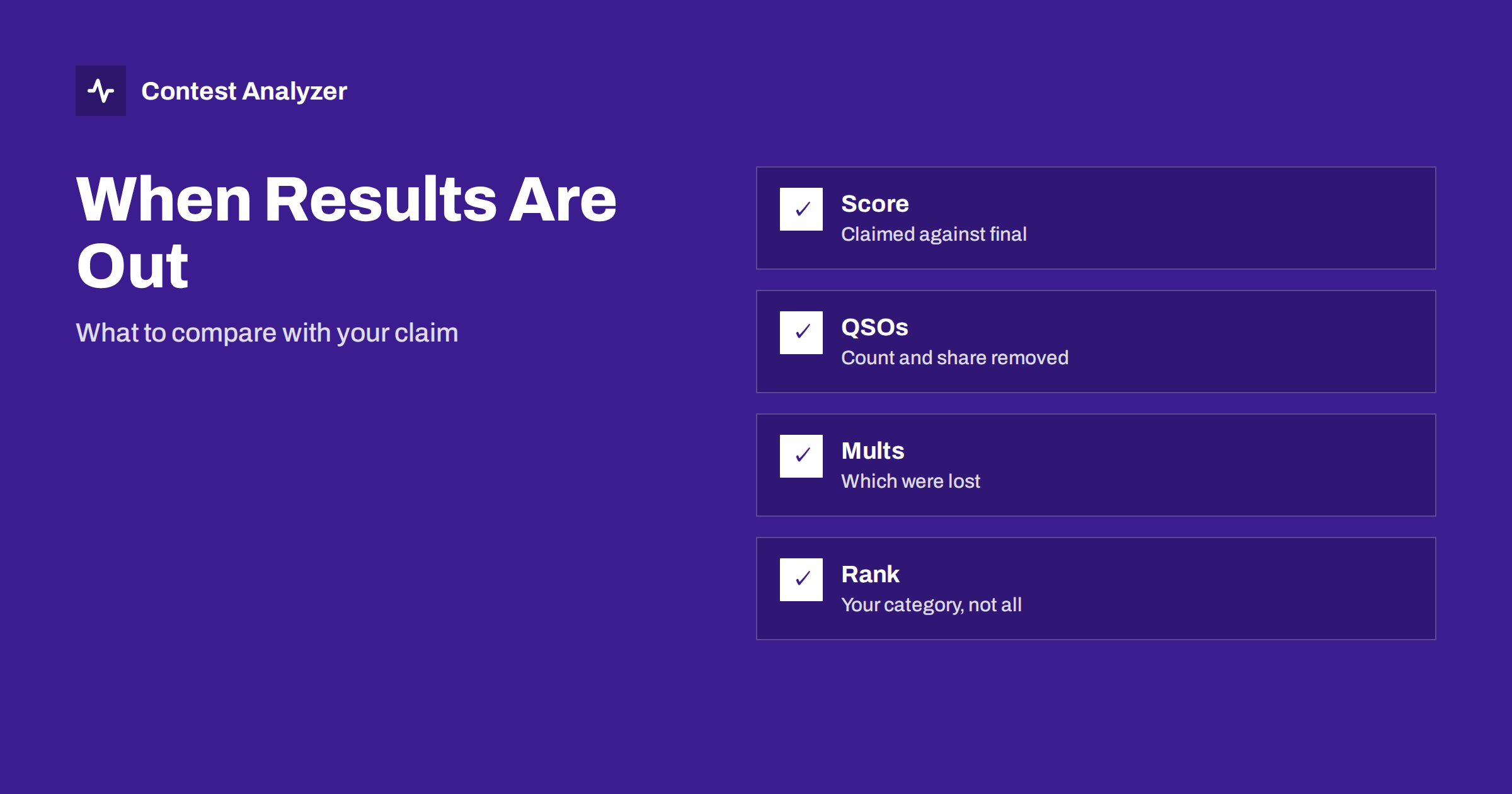
Short answer: When the results are published, do not stop at the final score. Compare it with your claimed score, then look at the number of QSOs, the number of multipliers, the penalties and the position in your own category. Then lay these numbers beside your statistics by hour and band to see where the difference between the claim and the final result came from.
Why the final score is only the beginning
The published result gives you a single number and a position. It is the end of the contest for the organisers, but for you it is a source of information. The difference between your claimed score and the final score tells you what the check changed, and the position in the table tells you where you stand among comparable stations. Used together, these numbers help you to improve the next contest more than the placing itself.
The reasons for the difference are explained in claimed versus final contest score. Here we look at what to compare and in which order, so that the review is short and useful.
Step one: claimed against final
Write down your claimed score, QSOs and multipliers, as they were in the log when you submitted it. Next to them, write the numbers from the published result. Calculate the difference in each of the three. A small difference suggests that the log was clean. A large difference, especially in multipliers, means that some of the QSOs or multipliers were removed, and you should find out why.
Look at the proportion, not only at the number. If you lost five QSOs out of a thousand, that is a small share. If the same five QSOs were the only ones for five multipliers, the effect on the score is large. This is why the multipliers need a separate look. The article on multiplier strategy in CQ WW explains why a multiplier is worth more than an average QSO.
Step two: the reasons for removal
If the organisers send a checking report, read it with care. It usually gives the list of QSOs that were removed or penalised, and the reason for each one: a busted call, a wrong exchange, a QSO that is not in the other log or one that is a dupe. Count the reasons by type. The article on log checking reports and the one on the UBN report describe the typical content and how to read it.
If there is no report, you can still find the likely reasons by checking your own log. Look at the callsigns that appear once, at the calls that are similar to others and at the zones that do not fit the country. Many of the removed QSOs will be among them. A report from a program such as Contest Analyzer helps with this: it checks every callsign and every zone against official license databases and several independent reference sources and shows only the few QSOs worth a second look.
Step three: your category, not the whole table
A comparison with the top of the whole table is rarely useful. Compare your result with the stations in your own category, and in your own region or country. Look at the QSOs, the multipliers, the score and, if the results provide it, the operating time. Stations with a similar number of hours and a similar station are your real reference. If a station has the same QSOs but a much higher number of multipliers, look at which bands it used. If it has fewer QSOs but more multipliers, think about the strategy.
Remember that the category definition matters. An entry in a limited-time category cannot be compared with a full-time one. The article on assisted versus unassisted categories and the one on choosing a category from your own statistics show how to make the right choice.
Step four: lay the numbers on your statistics
Now open your own statistics of the contest. Find the hours where the QSOs were later removed, the bands that carried the multipliers that were lost and the hours when your rate was highest. The differences between these hours and the final result tell you where your effort did not turn into points. A high rate with many removed QSOs is a different story from a lower rate with a clean log, and the comparison shows which is more profitable for you.
Contest Analyzer gives full statistics: rates, QSOs by hour and band, countries, continents, CQ and ITU zones, WPX prefixes, distance, beam heading, breaks and off time, and callsign length and structure. It also gives year-on-year comparison with your own logs, so that you can see in one place how this year differs from the last. It works with Cabrillo from N1MM Logger+, DXLog and Win-Test. See the contests page for the supported contests.
Typical reasons for a large gap
When the final score is far below the claimed one, the cause is usually one of a small number of things. The first is busted callsigns: a call that differs by one character from the real one leads to a removed QSO. The second is wrong exchange data, such as a zone that the other station did not send. The third is a QSO that is not found in the other station’s log, which may be a timing problem, a band problem or a QSO that was not completed. The fourth is a problem with the log itself: a wrong clock, a wrong category in the header, QSOs outside the contest period or a file format that the checking program could not read.
Each of these has a different cure. Busted calls need a better habit at the key and a recording to check doubtful calls. Exchange errors need a check of the zones and a repeat when in doubt. Not-in-log QSOs need a confirmation of the call and a correct clock. Header and file problems need a test export before the deadline. By counting the cases in each group, you can decide where the largest gain is. The article on checking your contest log before you submit gives a checklist that addresses the last group, and the article on busted callsigns addresses the first.
Do not expect the gap to be zero. Every operator has some errors, and even a very good log loses a few QSOs. A realistic aim is to make the gap smaller each year, and to understand it when it grows. Seen in this way, the comparison is a measure of the quality of your operating and of your checking, and not only a judgement of the result.
What to compare year on year
Your result is also a point in a series. If you have the final scores of the last few years, make a short table: QSOs, multipliers, final score, claimed score and the gap. The trend tells you whether you are improving and whether your log is getting cleaner. The conditions of each contest differ, so a lower score does not always mean a worse performance. The article on the same contest in two years shows how to take into account the conditions, and how to compare your results year on year gives the method.
If the gap between the claim and the final result is shrinking, your log checking is working. If it is growing, look for a cause: a new logger, a new operator, a different time of the contest or a change in the rules.
Keep the numbers where you can find them
A comparison that is not saved is lost. Keep the numbers in one place: a spreadsheet, a text file or a notebook, with one line per contest and the same columns every time. Add the date, the contest, the category, the claimed score, the final score, QSOs, multipliers, operating time and a short comment about the conditions and the station. After a few years, you will have a record that shows your progress and that answers questions that nobody can answer from memory.
Save the checking report and your log together with these numbers, so that you can go back to the details. The article on keeping copies of your contest log describes what to save and how long to keep it.
Turn the comparison into actions
The comparison is useful only if it ends with a few actions. Choose two or three, no more. A typical list could be: ask for a repeat of the call when the signal is weak, check the zone in the late hours and keep a recording for doubtful QSOs. Write them down with the date, and look at them before the next contest. The article on turning this year’s log into goals for next year shows how to make the list short and specific, and your post-contest review routine gives a checklist for the whole review.
Do not forget the positive side. If a hard decision gave a good result, write it down as well. A good habit that is not recorded may be forgotten, and a station that knows what works can do more of it.
Related reading
The bottom line
Compare claimed with final, find the reasons for the difference, look at your own category and lay the numbers on your statistics. Finish with two or three clear actions for the next contest.
FAQ
What is the first number to compare?
Your claimed score against the final score. The difference shows what the check changed.
Why look at multipliers separately?
Because a lost multiplier costs more than a lost QSO. A few of them can change the final score a lot.
Should I compare with the winner?
It is more useful to compare with stations in your category and region, with a similar number of hours.
What if the organisers send no report?
Check your own log for rare calls, similar calls and zones that do not fit, and use a report that shows doubtful QSOs.
How many actions should I write down?
Two or three. A short list is more likely to be used.