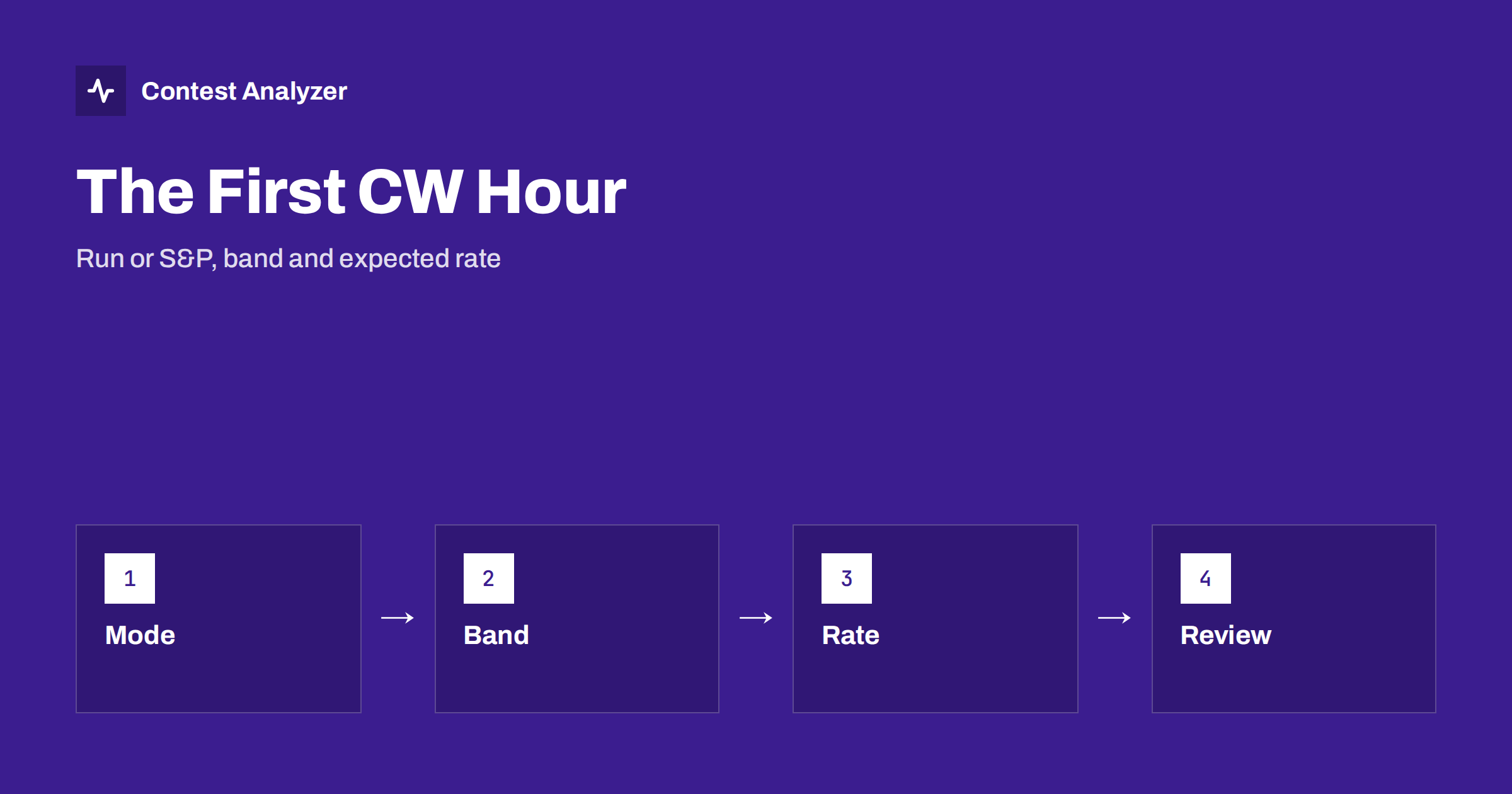
Short answer: Plan the first hour of a CW contest before you sit down: choose the band that is open at the start, decide whether to run or to search and pounce, expect a lower rate than later in the contest and note what you learn. The first hour sets the rhythm of the whole contest, but it is not the place to try new ideas.
Why the first hour deserves a plan
The first hour of a contest is special. Many stations start at the same time, bands are full of activity and the operators are fresh. It is tempting to jump into the first strong signal and to work fast. The risk is that you start at a speed that you cannot keep, that you make errors that you do not notice or that you spend the best opportunities on the wrong band. A short plan before the start prevents these problems.
The article on the first hour of a contest gives general advice for any contest. This article adds the CW angle: speed, copying, and the way the first hour appears in the numbers.
Choose the band at the start
The first band depends on the time of the start and on conditions. A contest that begins in the evening hours of your time zone often opens on a low or middle band, while one that begins in the morning may start on a higher band. Look at the start time in UTC, think about what was open at that time in previous years and listen before the start. Many operators check several bands in the last minutes and begin on the one that has the most activity and the strongest signals.
Look also at what you can do with multipliers. In the first hour many multipliers are easy to find, because stations from many countries are active. The article on band strategy by hour shows how to use your earlier statistics to choose the bands for each hour.
Run or search and pounce
A common plan is to start in search-and-pounce mode for a short period, collect easy multipliers and then switch to running on a good frequency. This approach gives a chance to listen to the band, to hear who is active and to use your callsign when the rate is highest. Another plan is to start running at once, if you have a good frequency and a strong signal. The choice depends on your station and the contest. Large stations tend to run from the first minute, and smaller stations usually gain more from calling.
Do not decide on the basis of what others do. Decide on the basis of your own numbers from previous years. The article on run versus search and pounce shows how to measure them, and the article on a second receiver for search and pounce shows how to combine them if your station allows it.
Speed and accuracy in the first hour
In the first hour, accuracy matters as much as rate. Errors made in the first hour are the same as errors made later, but they are more difficult to fix, because the rate is high and the time to ask for a repeat seems short. Start at a speed that you can keep for a long time. If you notice that you are copying everything easily, increase it a little, and if callers ask for repeats, reduce it. The article on CW copying accuracy explains the link between speed, repeats and errors.
Check the logger in the first minutes: the callsign appears in the entry window, the zone is filled in correctly, the band and frequency are right and the clock is correct. A problem found in the first five minutes is a problem that affects only a few QSOs.
What rate to expect
The rate of the first hour is usually lower than the best hour of the contest for stations that start on a band with fewer callers. For stations that start on a busy band and run, the first hour may be among the best. The rate is also affected by the time needed to find a clear frequency, by your own warm-up and by the conditions. Do not judge your contest by the first ten minutes; look at the whole hour and compare it with the same hour in earlier years.
Use the rate meter as a guide, not as a measure of your worth. The article on the rate meter during a contest explains the difference between the short-term and the long-term rate. A high 10-minute rate is nice, but a stable 60-minute rate is what builds a score. Compare your numbers with the targets that you set in the rates article.
Station checks that belong to the first hour
Several things are easier to check in the first hour than at any other time. Listen to your own signal on a second receiver or ask a nearby friend how it sounds, because a keying click, a hum or a drifting frequency is easiest to fix when it appears. Watch the SWR and the temperature of the amplifier when you change bands for the first time. Look at the backup: has the logger written the first QSOs to the disk and to the second copy? A few minutes spent at this point protect the next forty-seven hours.
It is also the right time to test the routines you planned. If you decided to move to another band after a fixed number of QSOs or after the rate fell below a certain level, try the move once and see if it works smoothly. A band change that was never practised can cost minutes when you need it at night. The article on band changes and rate describes how often a move is worthwhile and how to measure its cost.
Reading the first hour after the contest
After the contest, look at the first hour in detail. How many QSOs did you make? How many multipliers? Which band? What fraction of QSOs were runs and which search and pounce? How many QSOs were corrected after the contest? The answers show whether the plan worked. If the first hour was weaker than the second, ask why: a late start, a wrong band or a slow warm-up are typical causes.
Contest Analyzer gives rates, QSOs by hour and band, countries, continents, CQ and ITU zones, breaks and off time and year-on-year comparison with your own logs, so you can put the first hour of this year next to the first hour of the last year. It checks every callsign and every zone against official license databases and several independent reference sources and shows only the few QSOs worth a second look. It works with Cabrillo from N1MM Logger+, DXLog and Win-Test. See the contests page for the supported contests.
The second and third hour
The first hour leads into the next two, and it helps to plan the transition. When the rate on the first band starts to fall, you have three choices: stay and continue to run at a lower rate, move to another band where the activity is higher, or switch to search and pounce for new multipliers. The best choice is the one that gives the most points in the next hour, and your statistics from earlier years can show which of the three was better at this time of the contest. If you have no earlier numbers, make a note this year and use it next year.
Avoid the common trap of keeping the same plan for too long just because it worked at the start. A plan is a tool, and a good operator changes it when the numbers change. A look at the rate and the multipliers at the end of each hour, a short note and a decision for the next hour make a good rhythm for a 48-hour contest.
Keep a short note
A few lines written immediately after the first hour are worth more than a long report written days later. Note the band, the mode, the rate, any problem with the station and what you would change. Next year, read the note before the start and compare. The article on a station notebook shows a simple format that connects such notes with the statistics.
Over a few years, these notes become a record of the contest from your point of view: which band was best at the start, when the first multipliers came, when the rate began to fall. This record is more useful than any general advice, because it describes your own station.
Common mistakes in the first hour
- Starting too fast and paying for it in the third hour.
- Staying on one band because it is comfortable, while another band has more multipliers.
- Skipping the logger check and finding a wrong setting an hour later.
- Searching for the perfect frequency for too long.
- Copying calls without confirmation because the rate seems high.
Related reading
- Reading your statistics after the first 24 hours
- CQ WW DX CW checklist
- Setting realistic contest goals from last year’s stats
The bottom line
Plan the first hour, choose the band and the mode on the basis of your own numbers and start at a speed that you can keep. Then read the hour in your statistics and use what you learn for the next contest.
FAQ
Should I run at once or start with search and pounce?
It depends on your station and your past numbers. Large stations often run at once, smaller ones often gain by calling first.
What rate should I expect in the first hour?
It varies with the band, the conditions and your station. Compare it with the same hour in your earlier logs.
Which band should I start on?
The one that is open at the start time and has the most activity. Listen to several bands before the start.
Is a slow first hour a problem?
Not by itself. A steady speed and low error count in the first hour often pay back later.
How do I review the first hour?
Look at QSOs, multipliers, band and corrections in your statistics, and compare with earlier years.