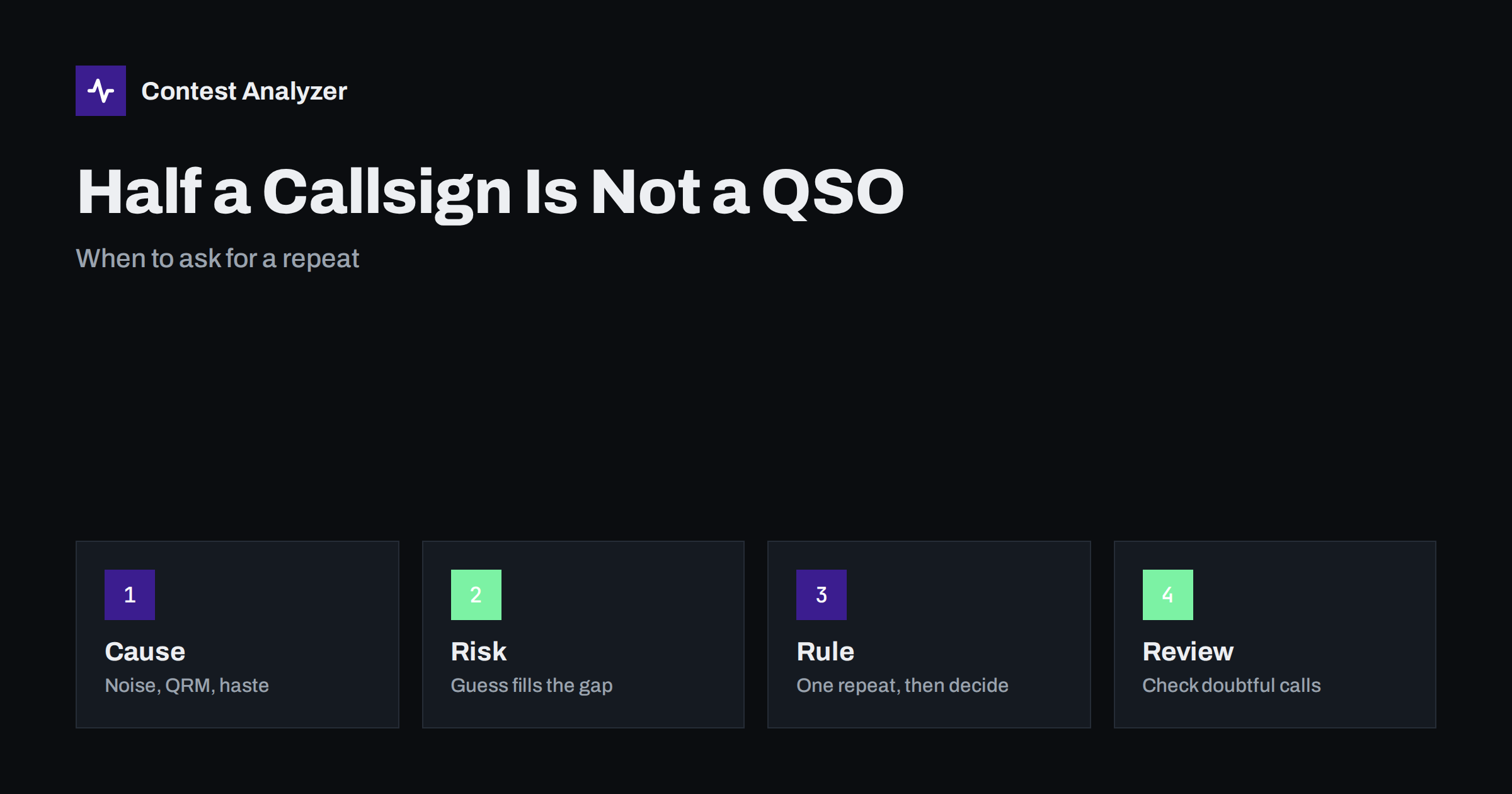
Short answer: A partial copy happens when you hear only some characters of a callsign and the rest is filled in by guesswork, by the logger or by habit. These QSOs are a quiet source of busted calls. The practical rule is to ask for a repeat once, and if the call is still not clear, either confirm it by sending what you think it is or leave the QSO unlogged. After the contest, review the calls that you were unsure about, before you submit the log.
What a partial copy is
A partial copy is a callsign that you did not hear in full. It may be the beginning, such as the prefix and the number with the suffix lost in noise, or the suffix with the prefix unclear, or the middle letters cut off by another station that started calling. In a pile-up, a partial copy is a normal experience: you hear a fragment, you start to answer and the rest is guessed.
The danger is that a guess often looks plausible. You hear “K…XY” and the logger suggests a station with a similar call. You type it, the other side says “roger”, because the operator at the other end wants to continue, and the QSO is in the log. But a station that confirms your partial guess may be a different station from the one you intended, and if the call is wrong, the QSO is wrong too. The article on busted callsigns describes how these errors cost both the QSO and sometimes the multiplier.
Why partial copies happen
- Interference. Another station transmits at the same time, and part of the call is lost.
- Noise and fading. Weak signals drop below the noise for a moment, and a character disappears.
- Speed. The sending is fast, and the operator does not get all the characters in the time available.
- Short calls. A call that is sent only once, quickly, gives little chance to confirm.
- Expectation. You expect a particular station, and your brain fills in the missing part.
- Typing too early. The operator starts typing before the call is finished, and the rest is completed from the suggestions.
The article on CW copying accuracy and the one on SSB phonetics give habits for each mode that reduce the number of partial copies at the source.
The simple rule: ask once
A workable rule for most contests is this: if you are not sure of the whole call, ask for a repeat once. The question can be very short, for example sending the part you have with a question mark, or asking for the call again. This costs a few seconds. If the repeat gives the whole call, log it. If it is still unclear, you have three choices.
- Confirm by sending your best copy. Send what you think the call is, together with your report. If the other operator confirms or corrects it, you have a better call. Some operators do this by default.
- Ask for the call a second time. This is reasonable when the signal is weak but the QSO is worth having, for example a new multiplier.
- Move on. If the QSO is not important and the conditions are poor, leave it. A QSO that is not logged cannot be busted.
The choice depends on the value of the QSO and on how busy the frequency is. In a high-rate run, the cost of a second repeat is higher. In search and pounce, the cost is lower, and the value of a multiplier is larger.
Partial copies in a pile-up
Pile-ups are the place where partial copies are most common. When a rare station is called by dozens of operators at once, the person who is working the pile-up usually picks out a fragment, such as the last two letters of a call, and sends only that. The caller who thinks the fragment is his own answers, and if the fragment fits more than one station, two of them may answer at once. In this situation, the best protection is for the caller to send his full call once and then to listen carefully for the return, instead of sending it again and again.
When you are the operator who takes the calls, the rule is the same in reverse. Send back what you copied, not what you wish you had copied. If you send only a part of the call, the other side can confirm or correct it. If you send nothing and just give the report, you have no way of knowing that the call was right. This small habit of repeating the call back, together with the report, is used by most experienced operators in both runs and pile-ups, and it is the cheapest form of checking that there is.
It is also fair to say that a good operator does not log every QSO. In a busy run it is natural to skip a call that did not come through, because the next caller is already waiting. Your log is a record of QSOs that were completed, and a partial copy is not a completed QSO.
What partial copies cost
The cost of a partial copy depends on the contest and on the rules of the committee. In general, a QSO with a wrong call is not counted, and in some contests it may also lead to a penalty. If the busted call was used for a multiplier, the multiplier is lost as well. The result is that one doubtful QSO can cost more than the one point it was meant to bring. The article on the UBN report shows how such errors appear in the report that a committee may send, and claimed and final score explains why the difference between them often comes from calls like these.
Do not let the logger decide
Logging software helps with partial copies, by suggesting calls that match the characters you have typed. This is useful, but it is also a trap. A suggestion is a statement about what stations might be on the air or have been on the air before, not about what the other operator just sent. If the call you heard is only partial and the logger shows one match, it is tempting to accept it. The article on Super Check Partial explains how to use this help without letting it replace your ears, and the one on call history files describes a related risk with prefilled data.
A good habit: when a suggestion appears, check that you actually heard the characters that it adds. If you did not, ask for the call again.
Recording doubt in the log
Sometimes you cannot ask again, for example when the other station has gone on to the next QSO, or when you have to keep the rate. In this case, log your best copy and mark it for later. Many loggers allow a note or a flag on a QSO. If yours does not, keep a short list on paper with the time and the call. The marks tell you where to look first after the contest. This approach is much better than trying to remember which calls were uncertain.
When you review the log, you can compare the marked calls with other evidence, such as your own notes and the report of the review. This is where a partial copy that went into the log can be found and corrected. A QSO that cannot be confirmed in any way is better removed than left as a possible bust, though it is your decision and the rules of the contest should be considered.
Using the review to find partial copies
Contest Analyzer checks every callsign and every zone against official license databases and several independent reference sources and shows only the few QSOs worth a second look. In a log with partial copies, these are often among the calls on the list. For each flagged QSO, think about what you heard and what the suggestion offers, and decide whether to edit the call. The report also shows full statistics, with rates, QSOs by hour and band, countries, continents, CQ and ITU zones, WPX prefixes, distance, beam heading, breaks and off time and callsign length and structure. You can edit calls or zones in the report and download a corrected Cabrillo, and you can compare the result with your own logs from earlier years. It works with Cabrillo from N1MM Logger+, DXLog and Win-Test and supports 22 contests, listed on the contests page. Serial numbers are not checked and dupes are not errors.
Callsign length and structure statistics can also give a hint. If you see that your partial copies cluster in long or unusual calls, you can pay more attention to them next time; see callsign length and rate.
Habits that reduce partial copies
- Wait until the whole call is sent before you start typing, unless you are very sure.
- Keep your receive filter and audio comfortable, to reduce fatigue and the strain of listening.
- Use a headset that gives a clear signal and cuts down other noise in the room.
- Slow down the sending speed in CW if a station seems to have trouble copying you, and expect others to do the same.
- Take a rest before the hours in which copying is hardest. See operator fatigue and breaks.
- Do the review after the contest, and make a note of the calls that you changed.
Related reading
- Busted callsigns in contest logs
- CW copying accuracy in contests
- SSB phonetics and confirming callsigns quickly
The bottom line
A partial copy is not a disaster, but a partial copy that goes into the log as a full call is. Ask once, confirm what you think you heard, mark what you doubt and review it after the contest. The few seconds you spend on a repeat are cheap compared with the loss of a QSO and a multiplier.
FAQ
How many times should I ask for a repeat?
Once is a good rule. If the call is still unclear, confirm your best copy or leave the QSO.
Can I rely on the logger’s suggestion?
Use it as help, not as proof. Log only what you heard or what the other station confirmed.
Should I delete a doubtful QSO?
If you cannot confirm it, it is often better to remove it, but check the rules of the contest and decide carefully.
Does the review find partial copies?
It shows the few QSOs worth a second look, and some of them will be calls that were only partly copied.
Do partial copies matter more in some modes?
They are common in all modes, but the typical cause differs: noise and similar characters in CW, similar sounds in SSB and decoder errors in RTTY.