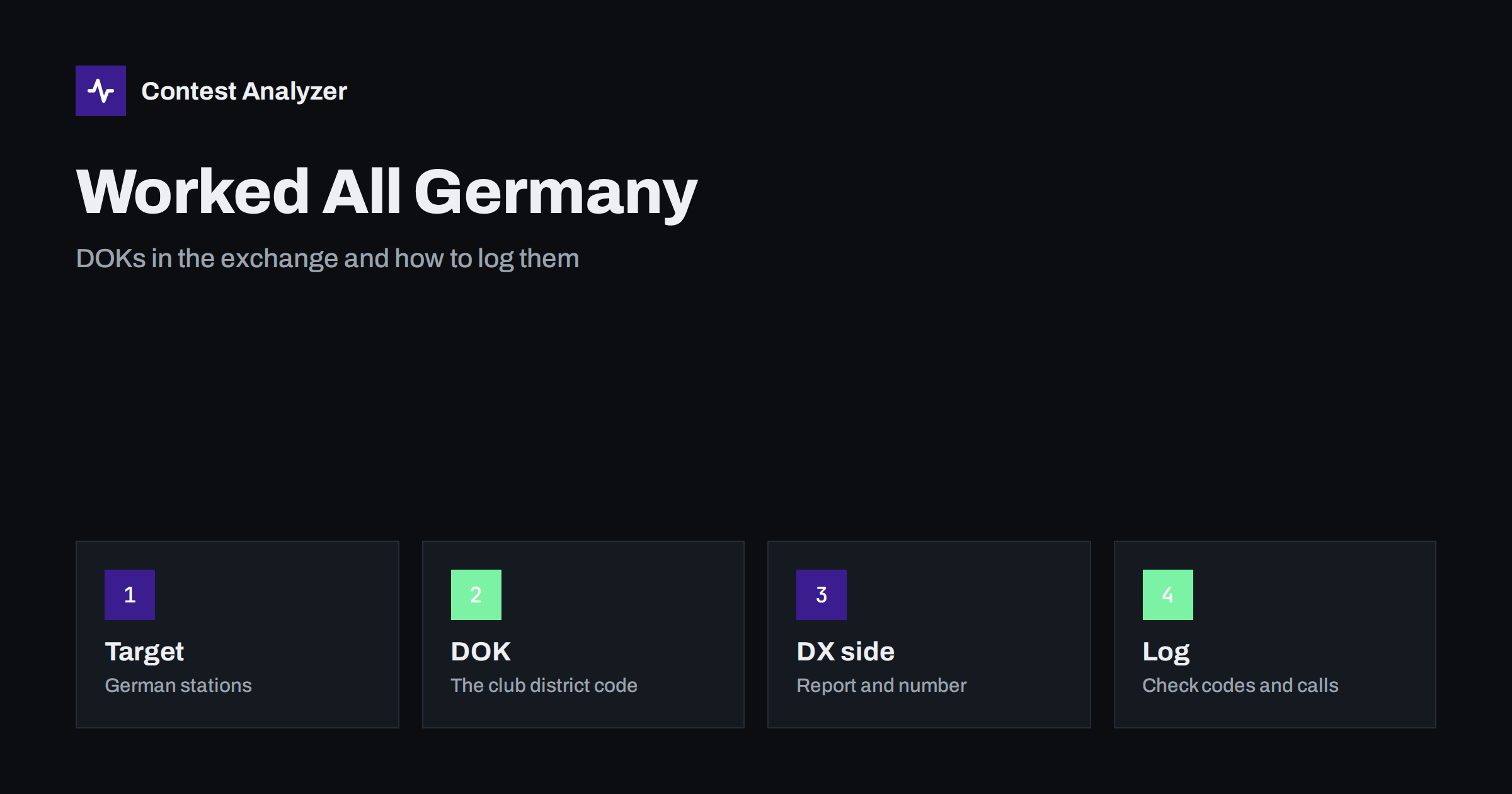
Short answer: Worked All Germany, usually called WAG, is a contest organised by the German amateur radio club DARC in which stations outside Germany try to work as many German stations as they can, and German stations try to work the world. In the form most operators know, German stations send a signal report and a DOK, a local club district code, while others send a report and a serial number. This article is a general introduction; take the details of categories, bands, scoring and dates from the current official rules.
A contest built around one country
Like the ARI and 9A contests, WAG is built around a single country. Its name says what it is about: the aim of the DX stations is to work Germany, and the aim of the German stations is to collect contacts from outside. Germany has a very large number of licensed amateurs, and a good share of them take part, so for a European or a transatlantic station there are many potential partners, and the activity can be heavy on the bands that are open.
The organiser, the Deutscher Amateur-Radio-Club, publishes the rules, the categories and the submission instructions on its own pages, and the rules may be updated from year to year. Before the contest, find the current text, read the sections on the exchange, the categories and the submission and keep a copy. Anything written here that sounds like a rule is a general description and must be checked there.
What a DOK is
The DOK is the Distrikt-Kenner, an identifier used in the German club structure. Each local chapter has a code made of a letter and digits, and members of a chapter normally use their chapter’s code when it is asked for. In a contest, a German station sends its DOK as a part of the exchange, together with the signal report. For a DX operator, a DOK is thus a short alphanumeric code that you must copy and enter in the log.
A few facts about DOKs help to explain why they are easy to mistake:
- The code is short, so it is easy to send quickly, and the sender may assume that you know it.
- It mixes a letter with digits, so under noise, a letter can be mistaken for another, and a digit for a letter.
- There are many codes, so a wrong character often produces a code that is valid but belongs to a different chapter, which makes the mistake invisible to a simple format check.
- Some stations use special codes for events or special groups. The rules and the logger’s list tell you what is accepted in the current contest.
As a result, the best protection is not a checklist after the contest but the habit during it: copy carefully, repeat when in doubt and read the code back to yourself before you press Enter.
The exchange for other stations
Stations outside Germany traditionally send a signal report and a serial number. Details of how the number is counted, for example whether it is continuous across all bands, are part of the rules. The practical advice is the same as in other serial-number contests: let the logger generate the number, never type it by hand, and check at the end that the sent column in your Cabrillo file runs without gaps or repeats. It is worth remembering that serial numbers are not checked by Contest Analyzer, so the numbers in your file are exactly what you entered. The article on serial numbers in CQ WPX describes the routine.
If you are a German station, your own DOK is part of what you send. Set it once in the logger and make sure that it is right, because a mistake there is repeated in every QSO. Operators who belong to more than one chapter, or who operate from a club station, should take their instructions from the current rules and from the club.
Setting up the logger
Most of the main contest loggers can handle contests of this type, but the definition for the current year must be loaded. Before the weekend, run a short test:
- Select the contest and set your own callsign, your category and, if you are a German station, your DOK.
- Log a few contacts with a German call and with a non-German call. See what the program accepts in the received exchange for each, and what happens when you enter an invalid code.
- Export a test Cabrillo file and read it. The received column should show the DOK for German stations and a number for the others. The article on the Cabrillo QSO line explains the columns.
- Check the clock and the time zone setting of the computer, since all times in the file must be in UTC. The article on UTC clock errors shows the typical problems.
A test of this kind takes fifteen minutes and shows you most of what can go wrong at the exchange field. Do it a few days before the contest, so you have time to correct the settings.
Logging DOKs under pressure
On SSB, a DOK is spoken letter by letter and digit by digit, and the usual phonetic alphabet helps. On CW, the letter and the digits run together, and the pattern is easy to mix with a similar-sounding one. Whatever the mode, a few techniques make the log more accurate:
- When a station sends its DOK twice, listen to both and compare them. Repetition by the sender is a free check.
- If your logger shows a list of known codes, read the suggestion against what you heard. If it does not match, ask again.
- If you are running, keep your own exchange short and regular. A caller who knows what to expect hears the report faster.
- If the code is spoken quickly, ask for a repeat of the code only, and not of the whole exchange.
For voice work, the article on SSB phonetics gives habits that apply directly. For CW, see CW copying accuracy.
Strategy for a single-country event
With a large pool of target stations, the main strategic questions are about timing and direction. Which band is open towards Germany at which hour, and for how long? If you are in a position to use a beam, the heading is nearly the same for most contacts, which makes it a good contest for stations with a fixed antenna pointing at Europe. Look at your earlier logs to see which hours gave the best rate: the band strategy by hour article shows how. For a station with a lower power or a modest antenna, the greyline and the opening and closing of the band often matter more than the mid-day peak.
Reading your own result
A country-centred contest gives you a convenient set of numbers to compare from year to year. The share of your contacts that were with Germany tells you how much of your activity went to the real target. The QSOs by hour show when the band was open towards Europe or towards your own side, and the rate shows how steady your running was. The number of different DOKs you worked, if the rules count them, is a useful measure of how widely you covered the target. Use your earlier logs to see whether the pattern changed, and write down two or three notes for next time, as suggested in the article on the post-contest review routine.
After the contest: check and send
Export the Cabrillo file, read the header and a few QSO lines and make sure the category and the callsign are right. Then run a check of the callsigns. Contest Analyzer checks every callsign and every zone against official license databases and several independent reference sources and shows only the few QSOs worth a second look. You can edit calls or zones in the report and download a corrected Cabrillo. It also gives full statistics, such as rates, QSOs by hour and band, countries, continents, distance, beam heading and breaks and off time, with year-on-year comparison against your own logs. It works with Cabrillo from N1MM Logger+, DXLog and Win-Test; the contest list shows which of the 22 contests are covered at the moment.
Dupes are not errors. If the rules ask you to keep them in the log, do not delete them. Send the file in the way the sponsor specifies, and keep the confirmation. The Cabrillo format is documented by the World Wide Radio Operators Foundation.
Related reading
The bottom line
WAG is a contest of German stations and their callers, with a DOK on one side and a serial number on the other. The rules tell you the details; your job is to set up the logger properly, copy the short codes with care and keep the sent numbers in order. Review the callsigns before you submit and keep the confirmation. A modest log with few errors usually beats a large one with many.
FAQ
What is a DOK?
A district identifier used in the German club structure, written as a letter followed by digits. In the contest, German stations send it as part of the exchange.
What do stations outside Germany send?
Traditionally a signal report and a serial number. Check the current rules for the exact format.
Does Contest Analyzer check serial numbers?
No, serial numbers are not checked. Callsigns and zones are, and you can edit them in the report.
Can I use any contest logger?
Most major loggers offer a definition for this contest, but you should test it with a few practice QSOs before the weekend.
Where do I find the rules and dates?
On the organiser’s official pages. The contest calendar on the site also shows dates calculated from the rules for the supported contests.