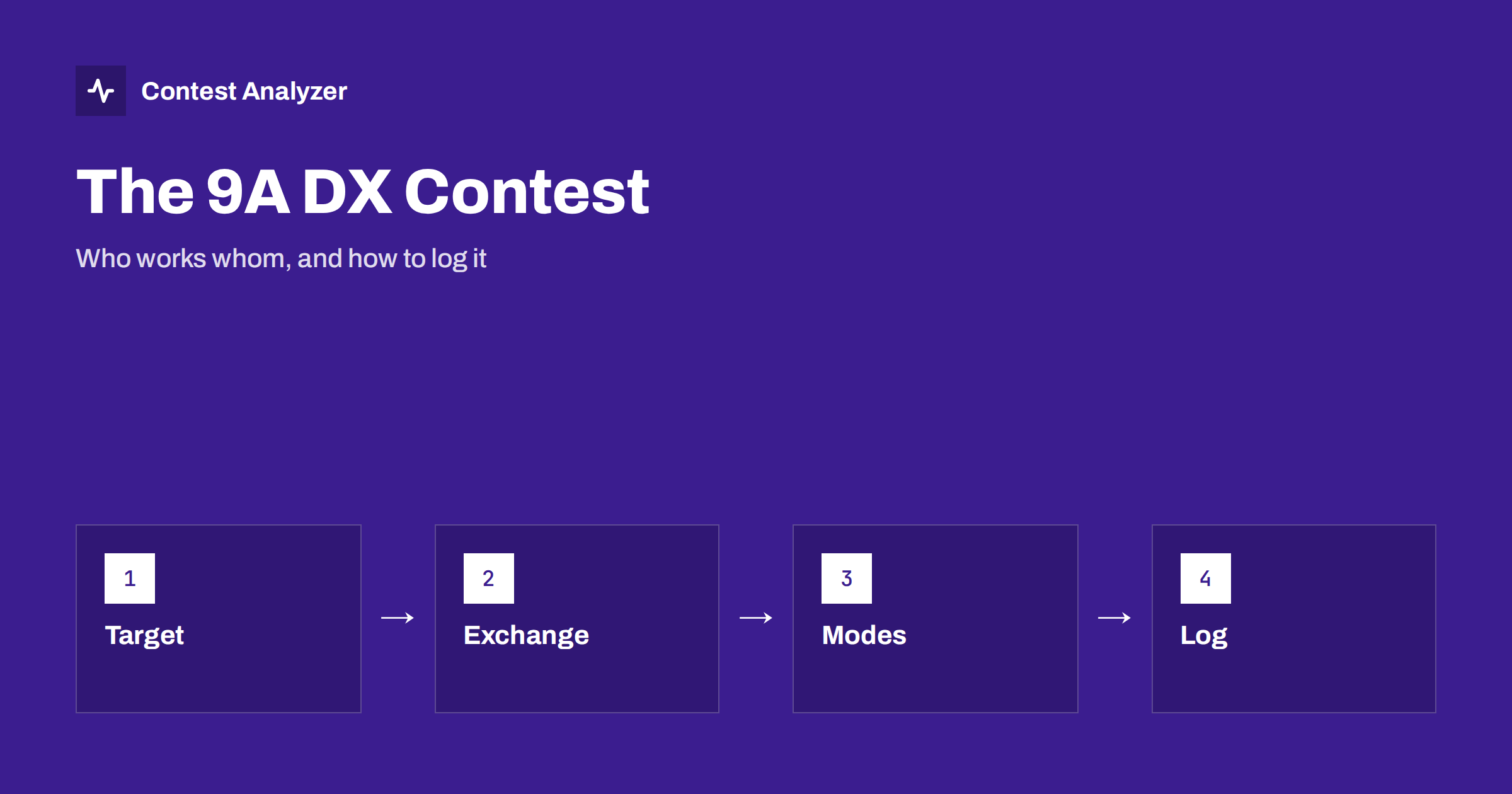
Short answer: The 9A DX Contest is a winter weekend event built around stations in Croatia, whose callsigns begin with 9A. Others try to work as many of them as possible, and the Croatian stations in turn work the world. In its usual form the exchange has two versions: Croatian stations send a county abbreviation and everybody else sends a serial number. Because the details of categories, bands, points and deadlines are decided by the sponsor and can change, use this guide as orientation and take every rule from the current official text.
A contest centred on one country
Many weekend contests are worldwide with every country a target for every other. The 9A DX Contest is different: its design points everyone towards one group of stations. For a DX operator the 9A stations are the ones that count, and for the Croatian stations the rest of the world is the goal. The contest list on the site shows the current date; open the contest calendar and compare it with the date announced by the sponsor.
A country-centred contest changes how the hours feel. There are fewer possible partners than in a global event, so the early part of the contest is usually dominated by who can hear the Croatian stations on which band, and the later part by the search for the remaining ones. For European stations the 9A signals are often strong and close, and the contest can seem like a long sequence of short exchanges. For stations farther away it is a test of antennas, patience and band timing.
Who works whom, in principle
The basic structure of the contest, as it has usually been organised, is that stations in Croatia and stations outside Croatia exchange information, and the contacts that count are those between the two groups. Contacts between two DX stations, or between two stations in Croatia, may not count or may be scored differently, depending on the current rules. This is the main thing to confirm before you start, because it decides whom you should call.
It also affects the log. Many loggers allow you to log every contact, including those which will earn no points, and the committee will deal with them under the rules. That is fine in principle, but it is better to know which contacts are worth your time, and to understand how the rate is calculated. If you look at your hourly figures later, for example in the sheet view described in the article on hour-by-hour analysis, the QSOs that earn nothing will be visible as dips in useful rate.
The exchange: county and serial number
In the usual form of this contest, each contact has an exchange of a signal report plus a piece of information that depends on the station’s location. Croatian stations send a short code for their county. Stations outside Croatia send a serial number that starts at one and increases with each QSO. As with any rule, confirm the format in the current text, including how the signal report is expected to be sent and whether other details are required.
These two kinds of information are logged differently:
- When you work a Croatian station, you copy a county code. Most loggers have a list of valid codes, which helps to catch a typing error immediately.
- When you work another DX station, you copy a serial number, in the same way as in a WPX-style event.
- Your own sent exchange depends on where you are. A station in Croatia should be set to send a county code, and every other station should send a number, which the logger should generate.
The county codes are not complicated, but they may be new to you, and under noise they are as easy to mishear as any short code. Ask for a repeat when you are not sure. If your station is in Croatia, memorise the way you pronounce your own code, so that it is clear every time. The article on SSB phonetics gives tips that also work for short codes.
Serial numbers and what is not checked
Contest Analyzer checks callsigns and zones, but serial numbers are not checked, so a wrong number in your log is not something the report will correct for you. Make sure the sequence in your own sent numbers is unbroken. A simple test is to open the Cabrillo file after the contest and scan the sent-number column: it should rise by one with every QSO, except where a QSO was removed. If a number is repeated or skipped, find out why before you submit.
For the received numbers, the best protection is the live habit of a quick check at the moment of the QSO, with a repeat request if the number does not sound plausible. After the contest it is too late to guess.
Modes, bands and categories
The 9A contest is run as a mixed event with more than one mode, as seen in the contest list. It matters which categories the sponsor offers for the current year, because they determine whether you are a single-mode entrant or a mixed-mode entrant, whether you can use assistance and whether you operate alone or with others. The article on assisted and unassisted categories explains the difference in general terms; the sponsor’s rules say what applies here.
Band choice depends on the time of year and the time of day. In winter in Europe the low bands open early in the evening and stay open through the night. The statistics that guide you are the same as in every other contest: QSOs per band per hour, and the number of different counties and countries. If you did the contest last year, your own log tells you which band was best at which hour, and the idea of using it to plan the next time is the subject of the article on comparing contest results between years.
Strategy in a short, focused contest
When the target group is small, two ideas help. First, call CQ only when it brings callers. If you are a DX station and the 9A stations are not answering on your frequency, your CQ is wasted time, and tuning across the band to find them is the better use of the hour. Second, keep a note of which bands you have already used in which hour, so that you can see where the signals came from. The continent and distance statistics in your report show later whether your antennas favoured the right direction, and the beam heading figures show where your QSOs actually came from.
For a Croatian station the picture is the reverse: the callers come from everywhere, and the work is to run steadily and to keep the exchange fast and clear. In both cases the log is only as good as the callsigns in it, which is why the review after the contest is worth the time.
Logging tips for a country contest
- Choose the right contest definition. If your logger does not have a definition for the current year, check the options before the weekend and update the program and its data files in good time.
- Test both kinds of exchange. Log a few practice QSOs with a Croatian call and with a DX call and see what the logger accepts in the received field.
- Check the clock. Times in the Cabrillo file must be in UTC. The article on UTC clock errors shows why this matters.
- Do not skip the repeat. With short codes and strong, fast stations, a repeat is cheap and an error is not.
- Save a backup. At every break, copy the log. It is a small habit that pays off the one time something goes wrong.
Most of these are easy to do and are part of every contest preparation. The special part is that the exchange has two forms and that your target group is small, which makes every wrong callsign more costly than usual.
After the contest
Export the Cabrillo file from your logger and read its header and a few QSO lines as plain text. The contest name, your callsign and your category should be right. Look at the received exchange: Croatian stations should show a county code and the others a number. Then check the callsigns. Contest Analyzer checks every callsign and every zone against official license databases and several independent reference sources and shows only the few QSOs worth a second look. You can edit calls or zones in the report and download a corrected Cabrillo. It also gives full statistics, such as rates, QSOs by hour and band, countries, continents, distance, beam heading and your breaks and off time, and you can compare the year with your own earlier logs. It works with Cabrillo from N1MM Logger+, DXLog and Win-Test.
If the contest allows you to keep dupes in the log, do so; dupes are not errors. Then send the file by the method the sponsor asks for. The article on submitting a contest log goes through the typical steps, and the Cabrillo format is documented by the World Wide Radio Operators Foundation.
Related reading
The bottom line
The 9A DX Contest is a compact, country-centred event with one exchange for the Croatian side and another for everybody else. Confirm the current rules, set up your logger so that it handles both forms, ask for repeats when a code or number is uncertain and review the callsigns before you submit. A small, well-prepared log is better than a big one with avoidable errors.
FAQ
Who works whom in the 9A DX Contest?
Stations in Croatia and stations elsewhere are each other’s targets. Check the current rules for exactly which contacts score.
What is the exchange?
In the usual form, Croatian stations send a county code and other stations send a serial number. Confirm the details, including the report format, in the official rules.
Do I need a special logger for it?
No, the main contest loggers normally provide a definition. Make sure it matches the current year and test both kinds of exchange first.
Does Contest Analyzer check serial numbers?
No, serial numbers are not checked. Callsigns and zones are checked, and you can edit them in the report.
Is the contest on the contest list?
Yes, the contest calendar on the site shows it with its current dates. The sponsor’s page gives the official ones.