Short answer: The ARI International DX Contest is organised by the Italian amateur radio association and invites stations all over the world to work Italian stations, and Italian stations to work the world. In recent years the exchange has differed by side: Italian stations send a province, others send a number. The contest has more than one mode, so the log, the header and the category all need care. Treat this article as general orientation and take every figure, time and rule from the current official text of the sponsor.
What kind of contest it is
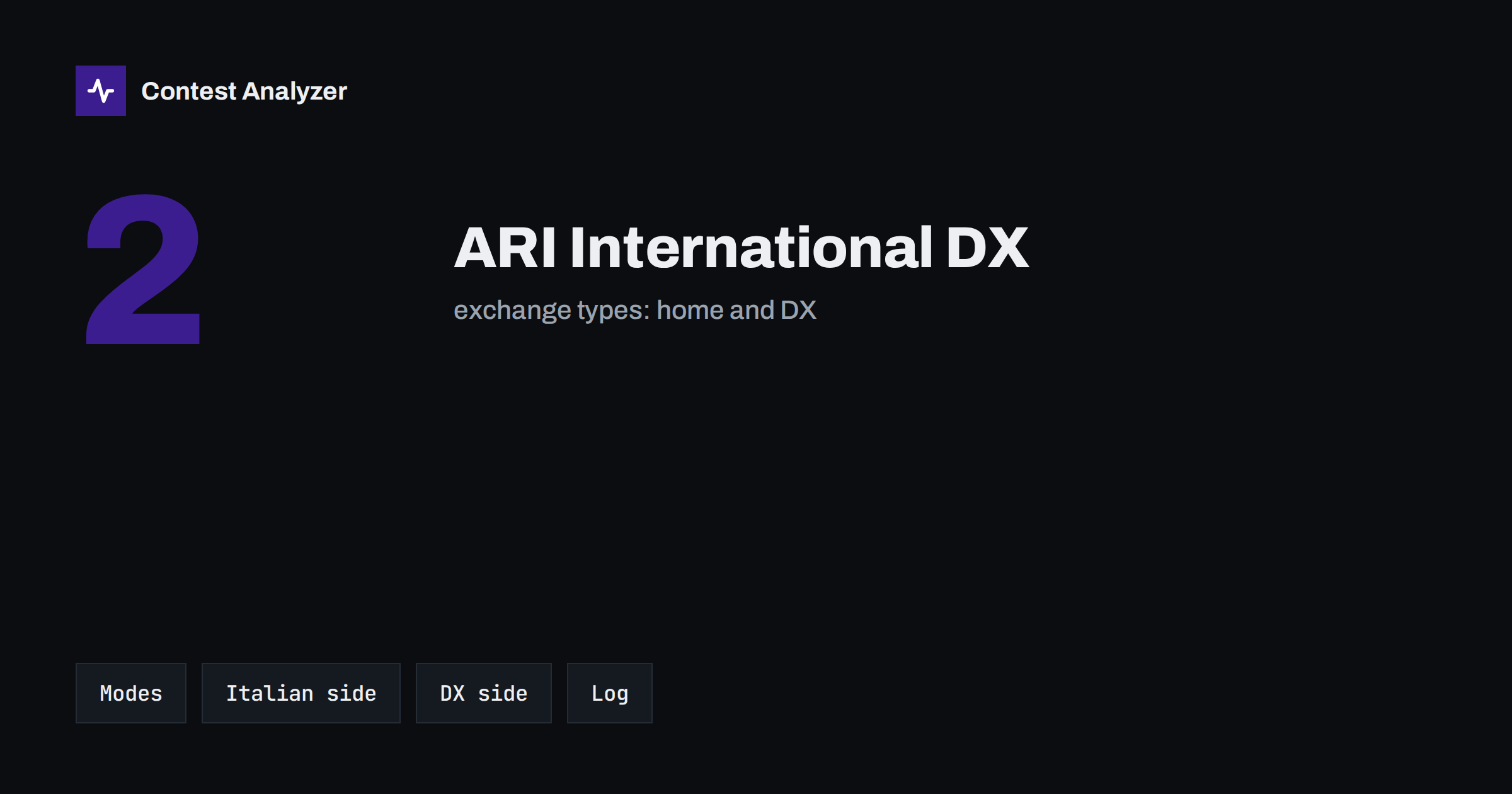
The ARI International DX Contest is a yearly event run by the Associazione Radioamatori Italiani. Its idea is simple and popular: Italian stations are the target for everyone else, and Italian operators in turn try to work as many DX stations as they can. It is listed among the contests that Contest Analyzer supports; the contest list shows the current calendar.
Because it is a contest centred on one country, the activity pattern differs from a worldwide event such as CQ WW. On the European side, the Italian stations are many and close, and for stations outside Europe they are often the main target during the open hours. If you are not sure when to expect them, look at the pattern in your own earlier logs, using the continent and hour statistics described in the article on continent breakdown.
Modes and categories in general terms
The contest has been run with more than one mode, which means that your log may contain QSOs made in CW, SSB or digital modes, depending on the rules of that year. Whether the modes are scored together or separately, and whether a station can enter as a single-mode or mixed-mode entrant, is determined by the sponsor’s rules. Read the section on categories carefully and choose the one that matches how you actually operated.
Some points deserve a check before you start:
- Which modes are allowed, and whether each QSO counts once per band, once per mode, or in some other way.
- Which bands are included. Not every contest uses all HF bands.
- Which categories exist, for example single-operator and multi-operator ones, and how assistance is treated. The difference between assisted and unassisted entries is explained in the article on assisted and unassisted categories.
- The time limits, the log deadline and the way of submission.
If you change mode during the contest, make sure the logger records the correct mode for each QSO. A QSO entered with the wrong mode can end up being counted incorrectly or flagged when the committee processes the file.
The exchange: province for the Italian side
In the ARI contest the exchange depends on where you are. As the rules have been written in recent years, Italian stations send a signal report together with an abbreviation for their province, while stations elsewhere send a signal report together with a serial number. This is the pattern to look for in the current rules, and the details, such as how the serial number is counted, must be confirmed there.
What matters for you as a logger user is that the two sides are different, so the loggers’ contest definitions normally have a field for the received exchange that accepts either a province code or a number, depending on who you are working. Check how your program handles this. In some programs, you enter the received exchange as a single field and the program decides what it means from the callsign; in others you select the right type. Before the contest, work a few practice QSOs in a test log and see what the program shows in the received column.
Provinces are written as short letter codes. They are easy to copy when you know them and easy to confuse when you do not, especially on SSB, where two codes can sound alike. Learn the codes for the provinces around the places where most of your callers will come from, and ask for a repeat if the code is unclear. A logger can show the list of valid province codes, and that is a helpful way to catch a typing error immediately.
Serial numbers for the DX side
Stations outside Italy send a serial number, which starts at one and increases with every contact. Since the same logger has to generate the number for every QSO, a good habit is to let it do so and never to type the sent number by hand. When you log the numbers you receive, remember that Contest Analyzer does not check serial numbers, so the numbers in your Cabrillo file are exactly what you typed. Keep an eye on them yourself while you operate.
Another typical problem is a missing number caused by a QSO that was entered and then deleted, or by a logger that skips a number when you correct a QSO. A short look at the sent serial numbers in the Cabrillo file, in order, is a quick check: they should go up without a break. The article on serial numbers in CQ WPX describes the same habit in another contest.
Working a contest on a mixed band plan
When a contest is open to several modes, the band plan matters. Each mode has its own part of the band, and stations may be crowded together in the segment where the conditions are best. In practice, the operator has to decide when to follow the Italian stations by mode, when to move to another band and when to stay where the rate is highest. The statistics that help with this are the usual ones: QSOs per hour, per band and per mode, and the number of different provinces. Reading them after the event tells you which hours were productive. You can see how to do this in the article on band strategy by hour.
Do not assume that a strategy from a worldwide contest applies without change. The target group is much smaller and more local, so the number of distinct provinces you can reach may be limited by propagation more than by effort. In that case it is useful to compare the provinces you have worked in one year with those of the next, using your own old logs.
Cabrillo and the log header
Your logger will create the Cabrillo file with the contest name from its definition. Check that the CONTEST line, the category lines and your callsign are right before you send the file. Pay special attention to the category when you worked more than one mode, because the header must describe the entry as it was operated. Read the Cabrillo header guide to see what each field is for, and the sponsor’s instructions for the format of the file name and for the way of submission.
Also open the file as plain text and look at a few QSO lines. The received exchange column should show a province code for contacts with Italian stations and a number for the others, and the mode column should match what you operated. The Cabrillo specification is available at the World Wide Radio Operators Foundation.
Checking the log before you send it
A mixed-mode, multi-band log with two kinds of exchange has more places for a slip than a simple one. The most expensive ones are still wrong callsigns, so it pays to look at them before the committee does. Upload your Cabrillo file to Contest Analyzer; it checks every callsign and every zone against official license databases and several independent reference sources and shows only the few QSOs worth a second look. You can edit calls or zones in the report and download a corrected Cabrillo. The report gives full statistics, including rates, QSOs by hour and band, countries, continents, distance, beam heading and your breaks and off time, and a year-on-year comparison with your own logs shows how this year differed from the last. It works with Cabrillo from N1MM Logger+, DXLog and Win-Test, with a contest list of 22 events and an interface in 25 languages.
Dupes are not errors in the report; they are contacts that simply do not score twice. If the rules ask you to keep them in the log, leave them there. The article on dupes in contest logs explains how to handle them.
Related reading
The bottom line
The ARI International DX Contest is a friendly, country-focused event with two kinds of exchange and more than one mode. Read the current rules for the categories, the exchange and the deadline, set the logger so that the exchange is stored correctly for each side, and check the Cabrillo header and a few QSO lines before you send it. A clean file takes minutes to prepare and saves the points that you worked hard for.
FAQ
Who works whom in the ARI contest?
The contest is built around contacts between Italian stations and stations elsewhere. The exact scoring and any exceptions are in the current official rules.
What do Italian stations send in the exchange?
In recent years, a signal report and a province abbreviation, while others send a report and a serial number. Confirm this in the current rules.
Can I enter with more than one mode?
That depends on the categories offered. Check the rules and choose the category that matches how you operated.
Does Contest Analyzer check serial numbers?
No, serial numbers are not checked. Callsigns and zones are checked, and you can edit them in the report before downloading a corrected Cabrillo.
Where can I see the next date of the contest?
The contest list shows the calendar dates calculated from each contest’s rules, and the sponsor’s page gives the official ones.