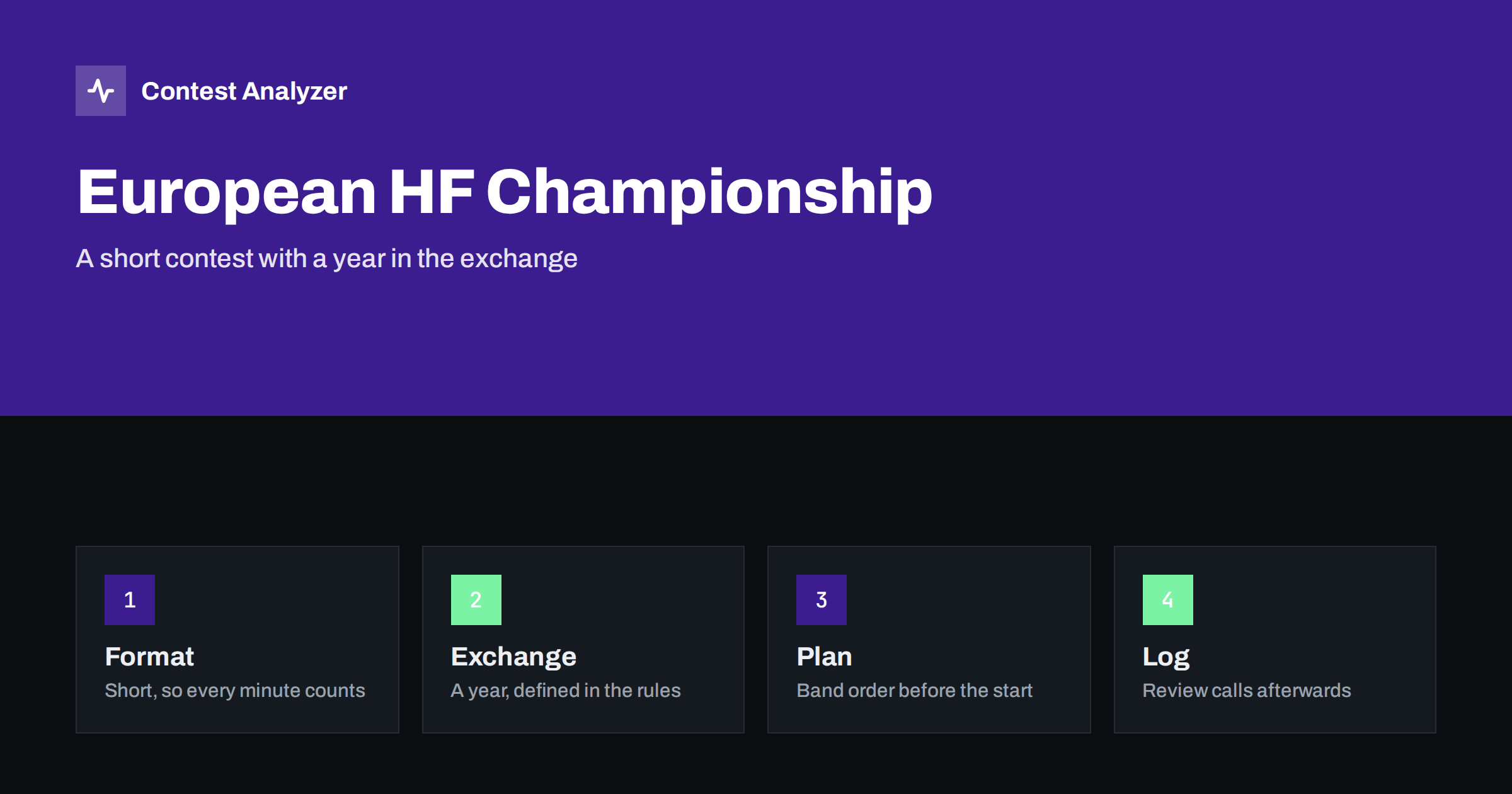
Short answer: The European HF Championship is a short, intense contest, much shorter than a full weekend event, in which the exchange contains a year in addition to the signal report. Because it is short, there is no room for long rests or experiments, and the plan you make before the start decides much of the result. The details of the year, the categories, the bands and the scoring come from the sponsor’s rules and can change from season to season, so read the current text before you operate and treat this guide as general orientation.
A different rhythm from a weekend contest
A 48-hour contest rewards stamina, sleep planning and the ability to work through several propagation changes. A short contest is something else. It is closer to a sprint, and there is little time to recover from a wrong decision. If you choose the wrong band for the first hour, you cannot make it up on the second day, because there is no second day. The numbers that matter are the rate in the best hours and how long you can keep it up.
Check the current rules for the exact length and period of the contest, and for how the operating period is divided if the sponsor offers both modes in the same event. These facts determine your plan. You will find that the strategic questions are the same as in other contests, but their answers are compressed: which band to start with, when to switch, whether to call CQ or to search, and how to keep the clock and the log in order while doing it.
The year in the exchange
The most unusual feature of this contest is that a year is part of the exchange. In general terms, each station sends a signal report followed by a number connected to a year, as defined by the sponsor. Which year is meant, and whether it applies to the station, to the operator or to something else, is something that must be taken from the current rules and not from memory.
That kind of exchange has practical consequences for logging:
- It is a short number, so it is quick to send and copy, but it looks similar to many other short numbers. A repeat costs little.
- Your own number is fixed. Enter it once in the logger’s settings and check it, because a wrong entry is repeated in every QSO you make.
- A received value can be entered with the same field type as other numeric exchanges. Check that your program accepts the whole range and does not reject a plausible entry.
- Multi-operator stations should agree who sends what and make sure every operator uses the same value if the rules require it.
The year-style exchange is also useful as a sanity check during operating. If a station sends a value that is out of the plausible range, you probably copied it wrongly, and a repeat is justified. Most of the time, however, the point is simply to keep things fast and accurate.
Who can enter and how to choose a category
The contest has a European focus, but the rules say who may take part, which stations count for which scores and which categories exist. Read these parts carefully, since a category chosen without reading the conditions is the most common reason for a reclassification. Typical choices in any contest of this kind include single-operator entries and multi-operator ones, and sometimes divisions based on power or mode. The discussion in the article on category overlays is a useful reminder that an extra group has its own conditions, and that you should enter it only if you meet them.
Declare the category in the Cabrillo header exactly as the rules and the submission instructions require, and keep a copy of the rules you used. The header is explained in the Cabrillo header guide.
Planning a short contest
The plan for a short event can be written on one page. It should answer the following questions.
- Which bands are open at the start? Find the sunset and sunrise times for your location in UTC and think about which bands are open at the start and which will open later. The article on planning your contest in UTC shows how.
- Which band do I begin on? Start where you can run, not where you hope to run. A band with many callers gives the best early rate.
- When do I change? Decide before the start which signs, such as a falling rate or a lack of new callers, will make you move. Without a plan you may stay too long on a band that is fading.
- How do I use multipliers? If the rules count multipliers, think about which ones you can gain by searching and which come by themselves with running.
- Do I take breaks? In a short contest, many operators take none at all or only the shortest. Check the rules, because off-time limits are common in contests, and see the article on off time and breaks.
Practise the first hour on paper: your first band, your first frequency, your macros and the first change. A prepared start is worth more minutes than anything you can optimise later.
Run, search or both
With little time, the difference between running and searching is more visible. A run frequency that works delivers a high, steady rate. Searching finds the multipliers that the run does not bring, but at a lower rate per hour. The traditional approach is to run when the band is full of callers and to search in the lulls. Your own statistics show how effective each method was. The article on run versus search and pounce and the one on the rate meter explain how to measure and read this.
One more point: in a short contest the first and last ten minutes are often fast and chaotic. If you can keep your head and your callsign copying accurate in those minutes, you gain more than a tired operator can in a quiet hour.
Setting a goal for a few hours
A short contest is a good place to set a measurable goal, because the numbers are small enough to understand at a glance. If you have an earlier log, look at your best 60-minute rate and the number of QSOs in the first and the last hour. A realistic target is a small improvement in the average rate across the whole period, not a record in every hour. The approach is described in the article on setting realistic goals from last year’s statistics. Write the target on the plan page and compare it with the result later; the difference tells you whether the plan or the conditions made the result.
Keeping the log clean under time pressure
Speed is when mistakes happen. In a fast contest, they follow the same pattern as everywhere else: partial calls, similar-sounding calls, numbers copied wrongly and a clock that jumped. The general advice is to prefer a correct QSO over a fast one when the signal is weak, to use the logger’s suggestion list as a help and not as a source of truth, and to enter the call completely before you send your report. The article on busted callsigns lists the usual causes and habits against them.
If you have time between periods of high rate, glance at the last few entries. A call that looks strange now is easier to repair than the same call after a hundred more QSOs. And make the backups you need: a log of a short contest is smaller, but you cannot redo it either.
After the contest
Export the Cabrillo file as soon as the contest ends, check the header and read a few QSO lines. Then review the callsigns. Contest Analyzer checks every callsign and every zone against official license databases and several independent reference sources and shows only the few QSOs worth a second look. You can edit calls or zones in the report and download a corrected Cabrillo before you send it. It also gives full statistics: rates, QSOs by hour and band, countries, continents, CQ and ITU zones, WPX prefixes, distance, beam heading and your breaks and off time. Because the contest is short, the rate and hour statistics are especially readable, and the year-on-year comparison with your own logs shows whether your plan improved. It works with Cabrillo from N1MM Logger+, DXLog and Win-Test; the contest list shows the supported events.
Related reading
The bottom line
A short championship rewards preparation. Learn the current rules, especially the year in the exchange and the category conditions, plan your bands and changes on one page, and keep the log accurate even when the rate is high. After the event, give the callsigns a last review and send a clean Cabrillo. A few correct QSOs more can change the result in a contest this short.
FAQ
What is unusual about the exchange?
It contains a year in addition to the signal report. Which year, and for whom, is defined in the sponsor’s current rules.
How long does the contest last?
It is much shorter than a full-weekend contest. Check the current rules for the exact period and any limits on operating time.
Should I take breaks in a short contest?
Many operators do not, but the rules may include limits or definitions for off time, so read them first.
Can I compare my result with last year’s?
Yes. Upload both Cabrillo files and compare rates, bands, continents and breaks. Keep in mind that propagation differs from year to year.
Is the log checked in the same way as in a large contest?
The sponsor’s committee applies its own rules. Before you send the file, Contest Analyzer can show you the QSOs worth a second look.